G. A. IRWIN

8%

Review and Herald Publishing Association · Tacoma Park Station, Washington, D. C. · Jul 18, 1907

FromReview and Herald, Vol. 84, No. 29.

Read the full edition

G. A. IRWIN

From Zanzibar to Port Said, Africa

G. A. IRWIN
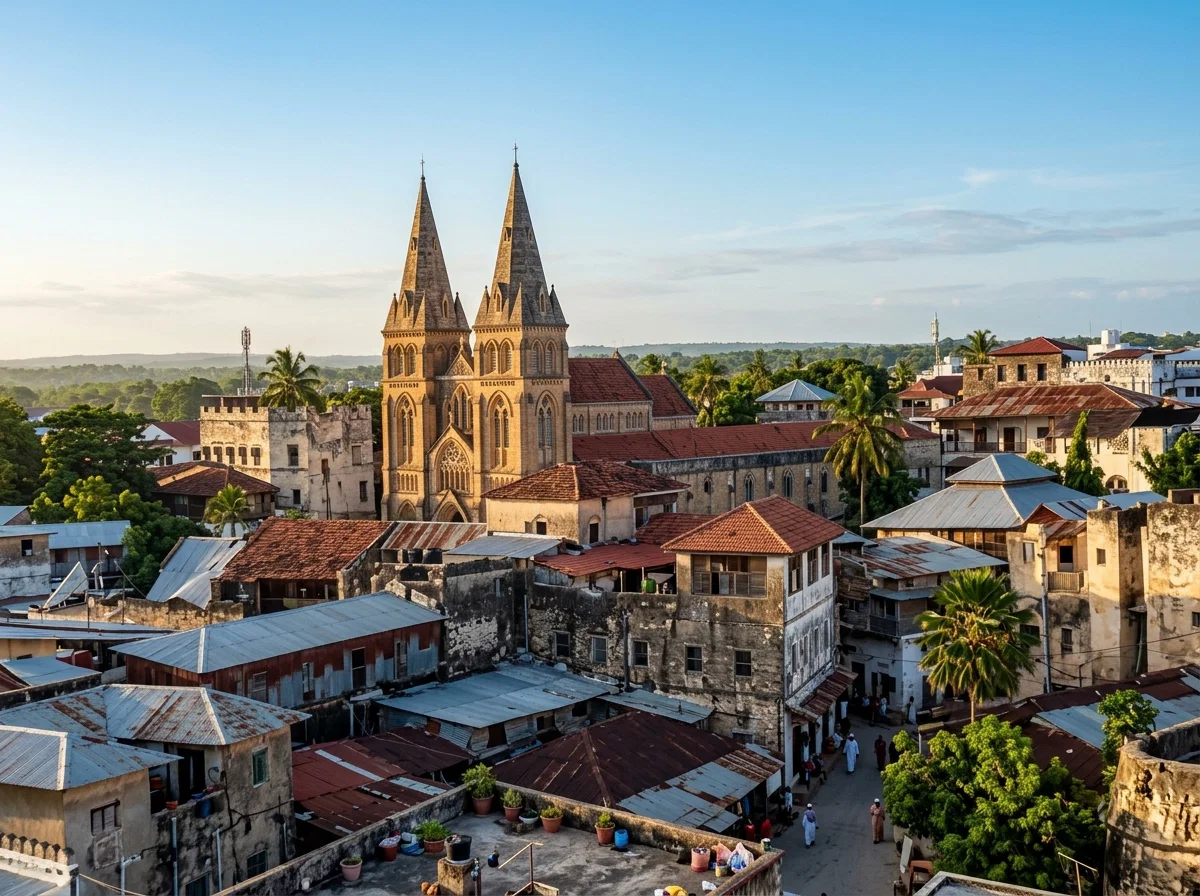
At about 11:30 A. M., April 17, we cast anchor in front of the town of Zanzibar. This place is on an island seventy miles long by thirty wide. Zanzibar proper comprises the islands of Zanzibar, Pemba, and Mafia, on the east coast of Africa. This territory was captured from the Portuguese in 1784 by an Arabian sultan, and became an independent dominion in 1856. It is now a British protectorate, and is practically ruled and controlled by the British government, although the present sultan is permitted to exercise a limited authority over his own people.
The population of the three islands is estimated at 260,000. Zanzibar has in the past acted a very prominent part in the affairs of Africa. In the early days, it was the center of the extensive slave-trade that was carried on by the Portuguese and Arabs. In the center of the city there was a large pen, or kraal, where the captured natives of Africa were brought and sold as cattle in the market. Later, however, through the influence of European philanthropists, the mind of the sultan “Seyyid Barghash” underwent an entire change, so that he who had been educated to regard the black natives of Africa as the lawful prey of conquest or of lust, and fair objects of barter, suddenly turned round and became one of the most active opponents of the slave-trade, and contributed his share toward bringing this accursed traffic to an end. It is a fact worthy of special note in this connection, that the Universities’ Mission of Central Africa, a Church of England Society, purchased the old slave market of Zanzibar, and built a handsome cathedral on a portion of the ground.
Zanzibar has been the starting-place of nearly all those expeditions into East Africa that have given the world an intelligent knowledge of its geography and inhabitants, and stimulated missionary and commercial enterprises that are rapidly letting light into this hitherto dark and practically unknown continent. Among the expeditions referred to as having started from Zanzibar, and the major part of whose numbers were made up of African natives residing in the place, I call to mind that of Burton and Speke, which was organized and left in the beginning of 1857. The next was that of Speke and Grant, which left in September, 1860. Livingstone’s last expedition sailed from this place March 19, 1866. Stanley’s expedition started from this place in search of Livingstone in 1871, and Stanley’s last expedition to establish the source of the Nile was made up and sailed from here Nov. 24, 1874. The town itself bears the Eastern, or Asiatic stamp, the streets being, in the main, narrow and irregular. It has a mixed population of English, Arabs, Indians, and African natives, most of the latter belonging to the Swahili tribe. The principal product of the island is cocoanuts.
Our next port of call was Dar-es-Salaam, on the mainland forty miles to the west. It is the capital of German East Africa, and is located on a beautiful little bay, with a narrow but very deep inlet. A large amount of money has been expended on buildings, roads, drives, and parks, to beautify the place. The trees and foliage have a decidedly tropical appearance.
Our next stop was at Tanga, where we remained for a day, taking on freight. We left Tanga at 5:30 A. M., and arrived at Mombassa at 11 A. M. Mombassa is on an island about three miles long and one mile wide, and is reached from the landing place by small tram cars that carry six persons, and are pushed by natives. Mombassa is the capital of British East Africa, and the terminus of the Uganda Railroad, which runs from here to Port Florence, on Lake Victoria, a distance of five hundred and eighty-four miles. It requires two days and nights by rail to make this journey, the trains leaving Mombassa three times each week. Traffic over the road is rapidly increasing, since white people are pushing into the country, and opening up farms, and starting other industries.
Mombassa is an old Arab town, and the houses and narrow, crooked streets are typically Eastern, the only exception being an occasional trim stone bungalow built and occupied by some European. The most interesting spot in the town is the old Portuguese fort, built in 1593. It is surrounded by a deep moat on the land side, and guarded by the sea on the other. It was partially destroyed during one of the conflicts between the Arabs and Portuguese for the possession of the town and district, but was rebuilt by the Portuguese in the year 1635.
After our vessel was loaded to the top of the hatchways, a large amount of freight was still left behind. Of the freight taken on board along this route, the following articles made up the bulk: rubber, copra, ground nuts, bark, fiber, ebony wood, hides, and ivory.
Our next port of entry was Aden—giving us a seven days’ sail without a stop. Aden is a fortified town located on a small peninsula of the southern coast of Arabia, on the Gulf of Aden, one hundred and eighteen miles from the entrance of the Red Sea. Perim, an island in the Red Sea, and a small district in the Arabian Peninsula, are under the government of Aden, which is a crown colony of Great Britain, having been purchased and taken possession of by that government in 1839. The latest estimated population of Aden is 41,910,composed almost entirely of Arabs. Owing partly to the lack of rainfall, the land in and around the town is perfectly bare of trees or vegetation of any kind, which gives it a very uninviting appearance, and makes it dusty and very disagreeable when the wind blows.
THE ZANZIBAR CATHEDRAL, BUILT BY THE CHURCH OF ENGLAND UPON THE SITE OF THE OLD SLAVE MARKET
About eight o’clock of the evening of April 19 we entered the Strait of Bab-el-Mandeb, which connects the Gulf of Aden with the Red Sea. This strait is from two to three miles wide. The Red Sea proper is about thirteen hundred miles long, and has an average width of one hundred and twenty miles. The sea is generally quite calm, and the heat intense. There is no town of any importance or port of call from Aden to the town of Suez, which is situated at the point where the Suez Canal enters the Gulf of Suez.