The Centenary Conference in China

5%

Review and Herald Publishing Association · Takoma Park Station, Washington, D. C. · Oct 10, 1907

FromReview and Herald, Vol. 84, No. 41.

Read the full edition

The Centenary Conference in China

J. N. ANDERSON
A very interesting and important representative conference of all the missions operating in China was held in the city of Shanghai, April 25 to May 2, in commemoration of the coming of Robert Morrison to this land. It marked a missionary period of one hundred years of Protestant evangelistic endeavor in this empire. In actual results this centenary period has far surpassed the most sanguine expectations of the most hopeful of one of the first pioneers (Milne), who accounted it a great venture of faith to look for one thousand converts at the end of the first hundred years of missionary effort in China. In view of this, it is interesting to think of the one hundred and seventy-five thousand converts who now stand as a memorial to the grace of God in this heathen land. As compared with the great mass of Chinese who still remain the slaves of idolatry, this number is not very great; but when considered by itself, it is a cause for rejoicing. It is indeed a most hopeful promise for the future, in that it is the basis for the final work of carrying the gospel to this race.

The Personnel of the Conference

The total number of persons present at the conference was eleven hundred and seventy. Of this number one hundred and twenty-two were ex officio members, three hundred and fifty-four were missionary delegates elected by the various missionary societies, and six hundred and ninety-four were visitors either from China or from countries outside. The voting members of the conference were from the various provinces of China, while the visitors from foreign lands came from the following countries: Africa, Australia, Burma, Canada, Ceylon, Finland, Formosa, France, Germany, Great Britain, Holland, Hawaii, India, Italy, Japan, Macao, Norway, Philippine Islands, Siam, Straits Settlements, Sweden, Switzerland, and the United States. The missionary societies at work in China (something over sixty) were represented from their home boards by over one hundred men and women.

The Work of the Conference

For months before the time of the conference the special topics or subjects to be dealt with had been assigned to representative committees composed of missionaries from different parts of the field, thus representing a large number of the different missionary societies at work in China. In this way much of the work of the conference had not only been prepared, but actually done, prior to the date set for the conference itself. These committees had prepared papers on the various subjects to be dealt with at the conference, and as these papers had been printed and placed in the hands of all who cared to purchase and read the same before the gathering, it was so arranged that only the resolutions growing out of these subjects and papers were brought in and discussed in the meeting. In this way it was possible to devote practically all the time to the discussion of the resolutions. The subjects dealt with were the following: “The Chinese Church,” “The Chinese Ministry,” “Women’s Work,” “Education,” “Evangelistic Work,” “Medical Missions,” “Comity and Federation,” “Christian Literature,” “Ancestral Worship,” “The Holy Scriptures,” “The Missionary and Public Questions.” Resolutions dealing with all these subjects were submitted to the conference, and discussed with much enthusiasm. In general there was remarkable unanimity of feeling and opinion, though there were some questions brought forward which called forth no little diversity of opinion. The question of federation in particular, which has been agitated very vigorously and extensively in China, provoked a great deal of discussion, and it was manifest that the time has not come for an organic union of the missions in this land. (A fuller statement of the question of federation in China is reserved for a separate article.)

The Chinese Church

With reference to the Chinese church, or more properly the church in China, it was quite unanimously agreed that the native Christians be not merely allowed independence, but that they be encouraged and aided in their growing desire to be independent and self-supporting. It was voted that the missionaries should be quick to recognize the national spirit that is at the present time sweeping over the whole empire, which in many ways manifests a restless impatience of foreign control, or even influence. Along with this it was contended that there is a feeling on the part of the Chinese Christians that the foreign missionaries are in truth the real cause of all these denominational divisions, which, it was argued, we ourselves regret, and which to the Chinese can never be fully explained, and surely not justified. Furthermore, the opinion prevailed that missionaries should not only hail the day when all Chinese Christians become one united church, but that this church should be a national church developed and perpetuated on Chinese soil. Thus was it voted, but as to how many really believe in this great scheme it is not so easy to say. Federation and the spirit of union ran high from the very first day. In harmony with the above opinion, it was urged that all foreign missionaries should seriously and thoroughly set themselves to the task of training young men and women to assume the duties that must fall to them in view of the new conditions in this land. Young men must be carefully selected for the ministry; and these young men, it was voted, must be given a careful and thorough training to fit them not only for the present situation in China, but for the intellectual and social difficulties that are certain to confront the church in her future enlargement.

Medical Missions

The importance and value of medical missions were forcefully and emphatically stated by the conference, much stress being laid on the fact that the medical missionary is first and last a gospel missionary, seeking first and always the eternal well-being of the unsaved. It was also argued that a medical mission must not be looked upon as a mere entering wedge in the sense that it serves only a temporary purpose; it is indeed an integral part of the gospel in every situation, as is abundantly illustrated in the life of our Lord. Let the healing hand be laid on the unfortunate of all classes—blind, lepers, deaf and dumb, opium slaves, sick, etc.—that they may be healed of their physical maladies, and above all, that they may receive the life eternal. Resolutions setting forth the evils of opium and intoxicants were adopted, and it is to be regretted that tobacco was not in like manner dealt with. It is difficult to explain why physicians laboring as missionaries in a land like China can not squarely set their face against this filthy and soul-destroying habit.
The topic “Women’s Work,” as might have been expected, called forth a great deal of very interesting discussion. Chinese women are, if possible, in this day of general awakening in this empire, called to a larger emancipation and to graver responsibilities than the men; and in view of this fact the missionary’s responsibilities with reference to the training and preparation of China’s women for a true and strong womanhood are correspondingly great and difficult. It was strongly urged that all missionaries having this work in charge should give themselves to the task of giving them the Bible and of making them intelligent students of the same. This it was felt would call for a Romanized Bible in the Mandarin language as well as in other dialects, since so very few of the women of the day have any knowledge whatever of the Chinese characters. The agent of the British and Foreign Bible Society assured the conference that such Bibles were now in process of publication. In view of the new conditions attending China’s hurried reforms and the many temptations arising therefrom, it was felt that special efforts should be made to safeguard and protect the virtue and purity of Chinese girls and women. More native women should be trained to act as Bible women, and a call should be made for a larger force of foreign lady missionaries to carry forward this very important work. Strong resolutions favoring broader and more thorough education for Chinese women were passed with enthusiasm; and at the same time some positive recommendations were passed, urging that in this dayof “New China” great care should be exercised to conserve all that is good, and to take a positive stand against everything that has the appearance of being extreme. There is a very grave danger that in this hour of female emancipation in China, the women may be so led, through ignorance or otherwise, to adopt customs and fashions that will shame even the most advanced women of the West.
The subject of the “Evangelistic Work” was one of great interest, and the entire conference entered into its discussion with a hearty interest. It was felt that of all the agencies contributing to the evangelization of this land, this was first and foremost, and for that reason it should be duly emphasized and be kept continually before all missionaries. Greater care should be exercised in, and more effort be directed to, the work of selecting and training native evangelists, since in the last analysis the great work of evangelizing this people must fall to the Chinese themselves. The different missions in China were urged to provide for training-schools to prepare men for this all-important work. It was resolved to work steadily to the end of making this feature of the work self-supporting by the contributions of the churches themselves, since in this way alone can the work be permanently established. One of the resolutions on this subject urged that all believers in the gospel give a definite part of their time to the spread of the gospel message beyond their homes. In line with this feature of the work of evangelizing this empire, great stress was laid on the urgency and the importance of Bible distribution and the preparation and wide circulation of a greatly increased volume of Christian literature.
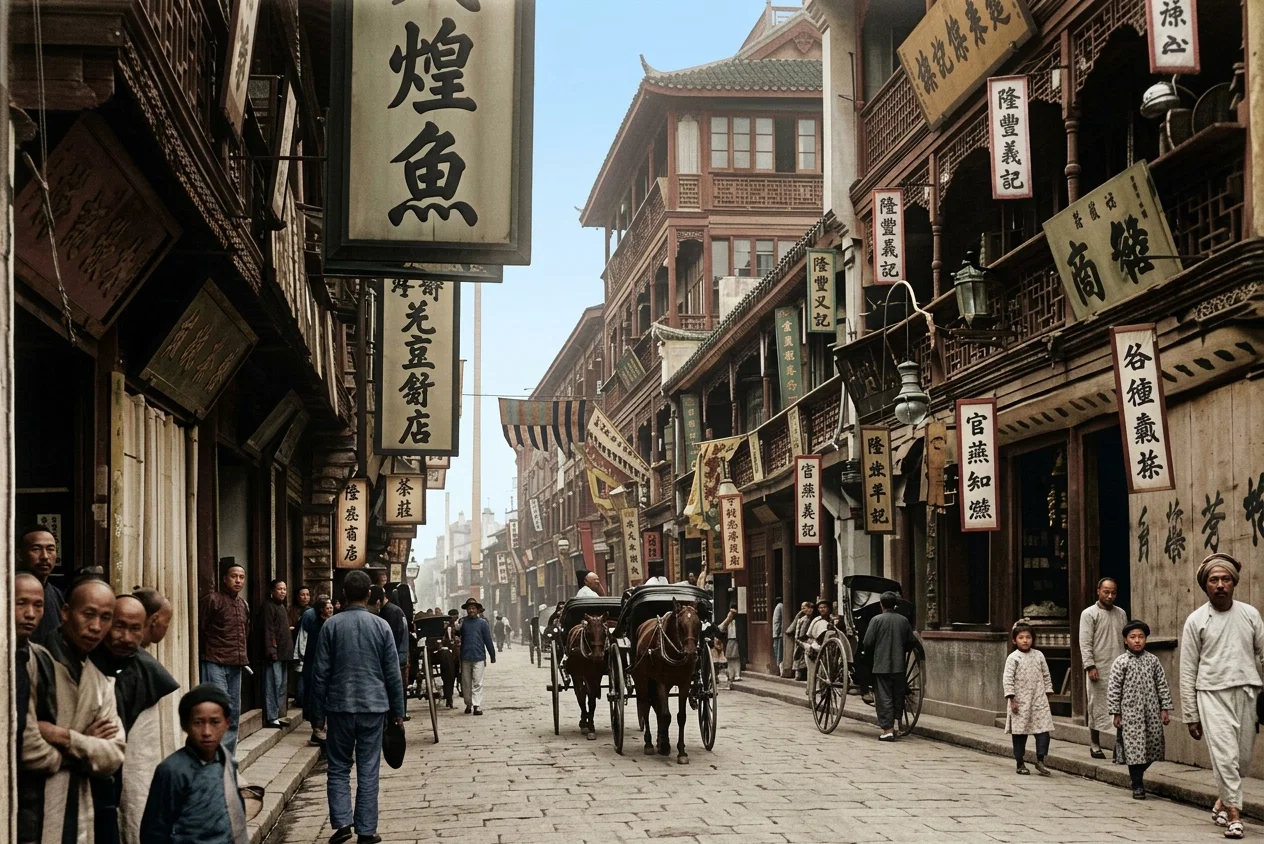
A STREET IN SHANGHAI

Education

With the very great interest in the subject of education, and the almost phenomenal changes that are to-day taking place in China, it was only natural that this topic should occupy a very prominent place in the conference. It was urged and voted that the already existing schools and colleges be greatly strengthened, and that new ones be speedily set in operation. It was felt by a large number of the delegates at the conference that the different missions might successfully unite in the educational work, and so secure larger and better results, and at the same time avoid overlapping and reduplication of efforts. Particular attention was called to the advisability of establishing normal schools in the different centers of the various provinces, supported by the combined efforts of the mission bodies working therein. But the one educational item that enlisted the greatest amount of enthusiasm was the proposition to found a union Christian university in one of the great centers of the empire. The aim of those advocating this institution was to make it in every respect a university of higher education in which every subject belonging to modern scholarship should be taught by educators of the first rank and according to approved methods. It is evident that the conference as a whole was not prepared to launch this great university scheme at this time. The whole question was finally referred to a committee with instructions to study the subject of education in China in a general way, and report to the next conference.

Comity and Federation

The all-absorbing, transcending question of the entire conference, sweeping over the entire meeting as a great wave, was the subject of federation. Beyond a peradventure it was the paramount question of the conference, and as such it enlisted the highest enthusiasm, and provoked a vast deal of more or less heated discussion. All, with very few exceptions, were in favor of federation of some kind; but when it came to definitions, and to looking at the proposition in the light of a scheme to be actually put into practise, there was a great diversity of opinion—an apparently irreconcilable difference of opinion, which, if it ever would allow of federation or union, would certainly necessitate not only many compromises, but even open surrender of what heretofore has been counted vital and permanent. The two extremes in this federation scheme, which to the majority in the conference meant either the success or the failure of the entire gathering, were the Anglicans on the one side, and the Baptists, especially the Southern Baptists, on the other. With the former, federation has little value, except in so far as it involves organic church union, and “the church,” as everybody knows, spells episcopacy, creeds, apostolic succession, etc.; while in the case of the latter, federation must not seriously be taken to mean more than co-operation or spiritual union in the sense of being spiritually joined to Christ the Head. In spite of these differences, however, it was voted almost unanimously to set about to federate all the missionary bodies working in China by way of provincial and general councils made up of representative members from the different societies at work in China.
In closing, the conference memorialized the throne, expressing gratitude for past imperial favors, and requesting full religious liberty to all Chinese subjects in professing Christianity. A second memorial on the opium question, intended for all the rulers and peoples represented by the different nationalities at the missionary conference, was voted with a great deal of enthusiasm. Two letters, one of fraternal greeting to the native Christian church, and the second to the home churches, were voted, after which the conference adjourned.
Canton.