The Eastern Polynesian Mission

7%

Review and Herald Publishing Association · Takoma Park Station, Washington, D. C. · Oct 10, 1907

FromReview and Herald, Vol. 84, No. 41.

Read the full edition

The Eastern Polynesian Mission

B. J. CADY
THE Eastern Polynesian field comprises the Society, Cook, Marquesas, Tuamotu, Gambier, and Austral Island groups, and Easter and Pitcairn and some other lone islands. There are probably as many as one hundred and ten inhabited islands in this mission. Some work has been done, and we now have Sabbath-keepers in seven of these islands, but the larger part of them have never yet been reached by the truth. We have in this field six organized churches, four companies, five church buildings, one hundred and seventy-three church-members, and three hundred and seventeen members in the Sabbath-schools.
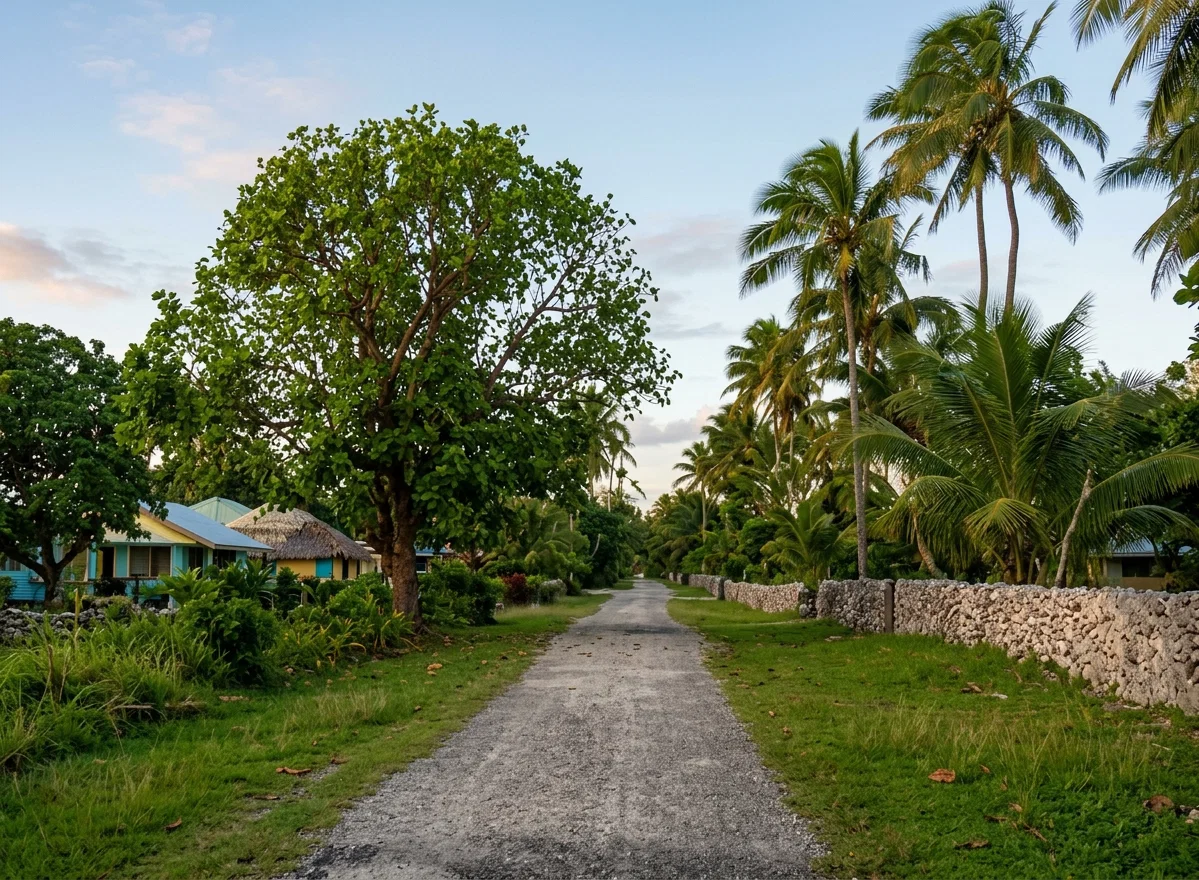
A ROAD THROUGH A RAROTONGAN VILLAGE, COOK ISLANDS
We came out on the second trip of the “Pitcairn” thirteen years ago. When we arrived at Raiatea, in the Society Islands, the natives of that island urged that a missionary be left with them to teach them the gospel, and it was decided that my wife and I should stop there.
The people promised to put up a house for us, and the leading governor kindly offered the use of one of his houses until our own should be ready. This was only a rude hut, about twelve by fourteen feet in size, with a pole floor carpeted with hay, in which lived a great many fleas. We lived here for three months, and then had the pleasure of moving into our own home, which had the advantage of being new and clean, and of having a board floor.
We began a school in a part of this building, and soon had about one hundred children in attendance. We had no school supplies to begin with, except a map of the world and the Bible, but a little later we secured a lot of slates and pencils, and a small Tahitian primer. After we had worked in this way for some time, the circumstances were such that we felt compelled to close our school. The Raiatea natives were in rebellion against the French government, which had taken the Society Islands under its control, and we were notified that if we continued our school for these people, we also would be counted as rebels against that government, so we thought advisable to discontinue it. In the meantime, we had found that the reason that the Raiateans were so anxious for us to stop with them was not because they wanted spiritual help, but because they hoped that we might intercede for them with the government of the United States, and get it to come to their assistance.
Soon after this, Brother A. J. Read and wife left Tahiti and returned to the States, and we were advised to move to Tahiti, which we did.
We saw that the training of children in the islands was very erroneous. The natives have no word for “home,” and do not know what it means. Parents give away their own children, and adopt others instead, and the children are allowed to run around and do about as they please, and as a natural consequence they form many evil habits. We felt like doing what we could to help them, so we began to take them into our home to teach and train them to habits of usefulness. Our family gradually increased till we had ten children. In time we found that the expense of keeping so large a family in the city was more than we would be able to carry continually.
About that time, a cocoanut plantation on Raiatea was offered for sale. We thought it might be a suitable place for training our youth, and after making the matter a subject of prayer, we decided to purchase it. There was then a blight on the cocoanut trees all over the island. They were not bearing any nuts, and looked as if they might not recover; but within a year our trees were beginning to bear, and have done very well ever since.
There was not a building on the plantation when we got it, but we soon put up a copra house and a small dwelling-house,and later a larger building for a home and other smaller buildings were added. We now have a small sugar mill, twenty-four head of cattle, and six horses. We have started and carried on this enterprise without any financial help except that some of our brethren gave donations to help erect the home building. All our laborers on the plantation have been supported by the income from the plantation, except the teacher. She receives her board there, but her wages are paid by the conference. On account of the existing school laws in these islands, we do not take children under thirteen years of age into the home unless their parents are foreigners. We require our young people to work four hours a day each for their board and tuition, then pay them by the hour for all extra time they work. This furnishes a way for them to earn money to buy clothes, books, etc., so they are better fed and clothed than those outside usually are. We feel that this is one of our most important lines of work, as efforts put forth in this way nearly always prove fairly satisfactory.
We expect soon to start a small paper in both the Tahitian and Rarotongan languages. As these islands are widely scattered and difficult of access, it would be a long time before they could all be reached by the living preacher, but the paper can be sent out everywhere. Nearly every native can read, and they are always very anxious to get something new to read, for there is very little literature in the native languages.
We are not asking for more laborers, because we feel that the need is much more urgent in the large and thickly populated islands of the East Indies, which have not even one representative of our truth. We hope to raise up additional laborers right in our field. We want to take our young people out with us as Christ took his disciples, and train them in the work.
Papeete, Tahiti.