Our Literature in Fiji

10%

Review and Herald Publishing Association · Takoma Park Station, Washington, D. C. · Oct 24, 1907

FromReview and Herald, Vol. 84, No. 43.

Read the full edition

Our Literature in Fiji

THERE is no doubt that the great power of the denomination is found in its literature. Preachers are few in number in comparison with the tens of thousands of tracts and papers and books in every language. Many are the sermons which are preached by the printed page, and there are many staunch believers in the third angel’s message who were led to it through reading our publications.
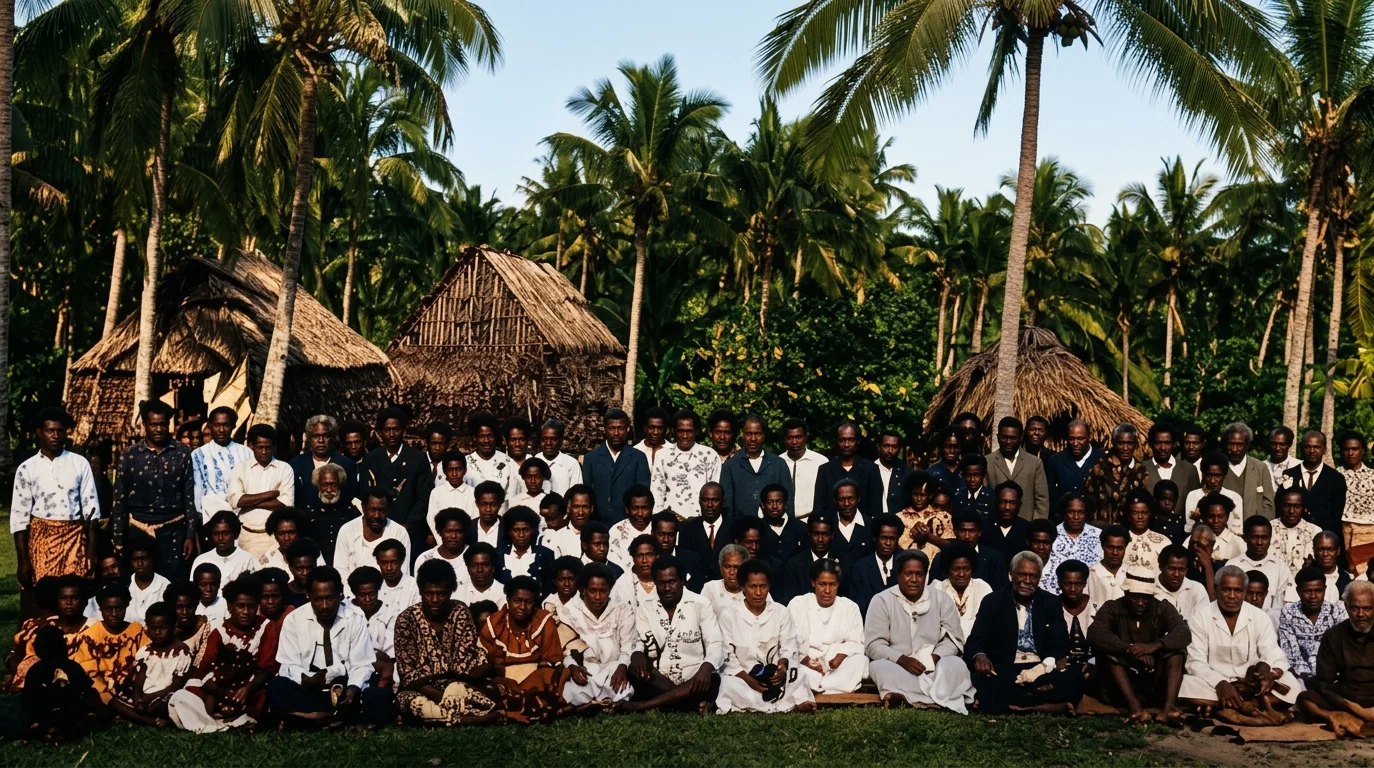
A GROUP OF BELIEVERS IN FIJI
Our work of printing literature in Fijian began under many difficulties. In the year 1900 Brother J. M. Co’e sent us a small printing-press from Oregon. After the press had arrived, there was no one with any practical experience to do the printing. But we felt that the work must be done, and the Lord helped us get a paper started. In May of that year we started the Rarama, a little paper in the Fijian language. We still publish it every month, and there are a number who have been brought into the truth by this paper. The first Fijian publication, however, in present truth was a tract printed by the Pacific Press Publishing Co., then at Oakland, Cal. At that time I was not so well acquainted with the language, and in writing the tract, I sought the aid of several reliable natives for their criticism of the manuscript. A native minister visited me on several occasions, and manifested considerable interest. As his interest grew, his visits were more frequent. On these occasions I read the manuscript of this tract to him, altering it and correcting it as seemed best. Before he came again, more manuscript was written, which would be read and changed at the succeeding visit. Thus the tract was finished, and the native minister was quite fully convinced of the truth by what he had learned while correcting the tract. He was greatly agitated, and sought the white ministers for light on the Sabbath question, but they could not satisfy him
with a “Thus saith the Lord.” I refer to Pauliasi Bunoa, who was ordained at the last union conference in Australia. He was a great help to us after he accepted the message, and he has ever been a vigorous advocate of present truth. He has not only preached the truth, but some of the most pointed articles for our paper have been from his pen.
We have now a number of tracts on various subjects, a bound book of one hundred pages, a little book of Bible readings, an abridged edition of “Great Controversy” (three hundred pages), and a hymn-book containing one hundred hymns. This is the first hymn-book in the language with the music. At our late Fijian council it was decided to print some new tracts, and revise some of the old ones. A physiology in the Fijian was asked for as well.
The results of the circulation of our literature in Fiji have been beyond our expectations. A family was brought into the truth through reading a torn tract, and others were influenced in favor of the truth by one who had read the tract. In 1903 we published a little booklet-calendar
On each of the twelve pages there was a Bible study along with the calendar of the month. This fell into the hands of one who is now a student at the school in Buresala, and he says that that little tract brought him into the truth. In one section of the largest island, where we now have two churches, quite a number accepted the truth largely through the printed page. We are trying in Fiji to scatter the reading-matter as “the leaves of autumn,” and shall look
for good results from this effort.
J. E. FULTON.