The Message in the Land of Livingstone

7%

Review and Herald Publishing Association · Takoma Park Station, Washington, D. C. · Oct 24, 1907

FromReview and Herald, Vol. 84, No. 43.

Read the full edition

The Message in the Land of Livingstone

JOEL C. ROGERS
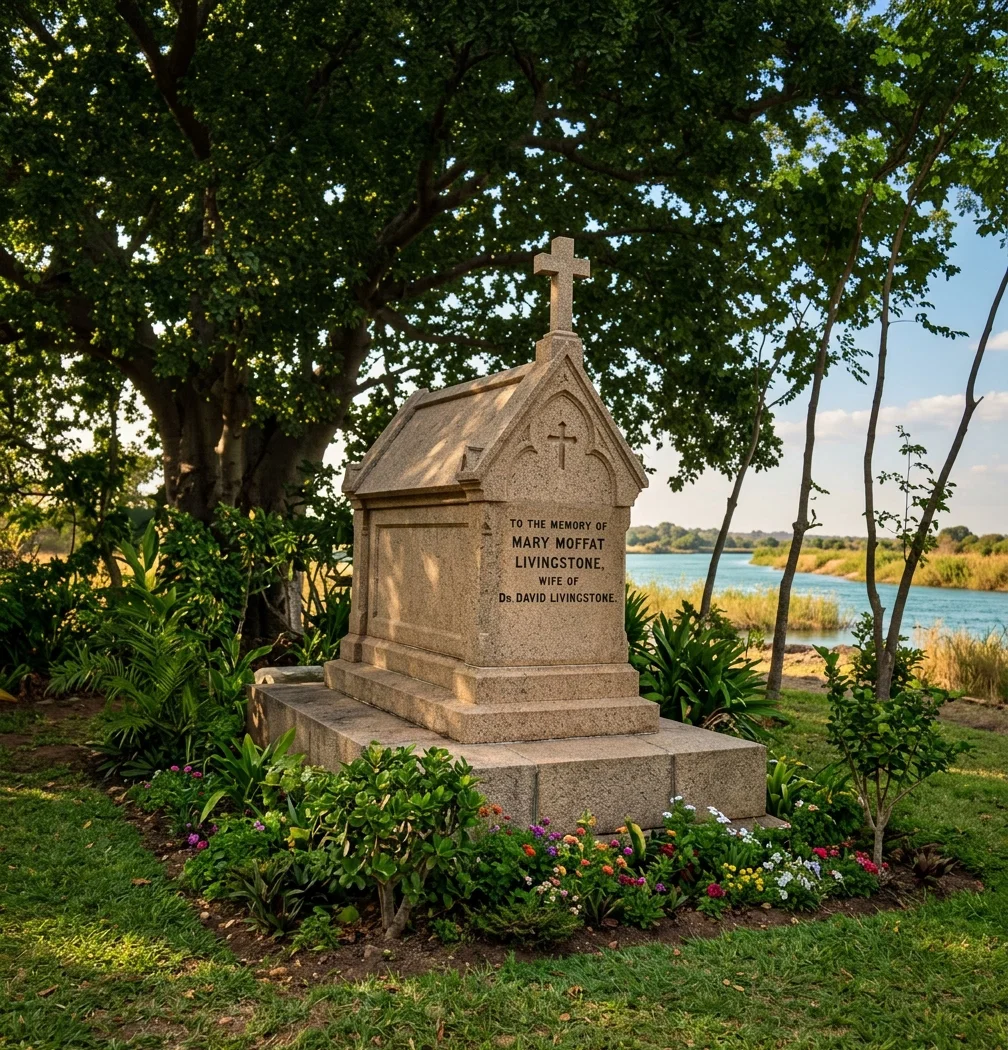
The path of the white man in Africa may be traced by graves. At Shupanga, on the left bank of the Zambesi River, and some two hundred miles from its mouth, Mary Moffat Livingstone is buried. The accompanying photograph, which I took last May, shows her resting-place. Her tomb is under a baobab-tree, near the Roman Catholic mission. The little steamer ascending the river usually stops for passengers to see this historic tomb. The mission was an asylum to Dr. Livingstone and his wife—as it has been to others—when she descended the river, stricken with Africa's plague—malaria. I was thankful to be in good health during the journey up this deadly river, and also thankful that God has sent faithful missionaries before us, to prepare his way.
This East Central Africa may well be called the land of Livingstone. He traversed it many times, and began the suppression of the slave-trade, thus giving the native peace and prosperity, and preparing him for the gospel. He lived a long time in the land, established missions, and died here.
The message now has a foothold in this land. A Brother James came here in 1895, I believe, and scattered the seeds of truth. His fever-stricken remains also lie buried on the Zambesi banks. But the seed took root, and though the plant is still small, it is growing.
On May 23 my wife and I reached our mission at Cholo. We found Brother Branch and family carrying on the work left in their hands by the death of Elder J. H. Watson. On the hillside, a few yards from the mission house where I am writing, is Brother Watson's grave. Brother and Sister Branch have done the general work of the mission, while Miss Mabel has taught the school, assisted by her brother Paul and some native teachers. The attendance is from fifty to sixty-five. The yearly vacation began May 28, and the family, except Brother Branch, went to Cape Town for a rest. They have been here almost five years, and have worked faithfully.
According to instructions from the South African Union Conference Board, I set out, soon after arriving, to find a new station farther in the interior. The old station, called Plainfield Mission by its former owners, the Seventh-day Baptists, is not centrally located. It has comparatively few natives near it, and these are of an inferior tribe. We should have our main station farther north, within reach of the two leading tribes of British Central Africa. In a later article I hope to write more fully of these tribes.
On my first trip over the country, I visited Blantyre. This town is about forty miles northeast of Plainfield, and is the business center, as well as the mission center, of British Central Africa. A railway will soon connect Blantyre with the Zambesi River. The track is now laid within twenty miles of the town. Probably Blantyre will always be the base of supplies for the whole country. Here there is but one way in and the same way out of the country; quite different from American cities, where railways radiate as wheel spokes. I believe our main station for training native teachers should be within reasonable distance of such a center as Blantyre. Small stations where well-trained natives can teach the truth to their own people, must be planted in all parts of the land.
With Brother Branch, I first visited a place called Shiloh, which we found to be entirely unsuitable for our work.
We next visited a place which we found well suited to our needs, and it is offered at a price far below its real value. We have recommended the purchase of this place. If the Board decides to buy it, I shall describe it later. Our training-school for teachers could be started at once on this place.
The three leading tribes of Nyassaland are distributed in the form of a triangle, the center of which is the new station which we hope to secure. Zomba, the seat of government, is forty miles north of Blantyre, and thirty miles from the place just mentioned.
While we must forego many conveniences and comforts of the home land, we are favored with good garden ground; vegetables grow well, and can be had fresh almost the year round. Since coming I have planted sweet corn, beets, potatoes, lettuce, radishes, etc.; we are now eating radishes planted three weeks ago.
Both my wife and myself have had good health in all our travel, and since coming here. We know many who are praying for us, and we are thankful for God's answers. We are studying the language, and while it is not difficult, yet we desire divine help to learn it quickly. Remember us in this, and also pray that we may have wisdom to reach the people quickly with the message.
Cholo, Nyassaland, B. C. A.
Tomb of Mary Moffat Livingstone, wife of David Livingstone, on the bank of the Zambesi River, at Shupanga.