Santalia and the Santals

9%

Review and Herald Publishing Association · Takoma Park Station, Washington, D. C. · Oct 31, 1907

FromReview and Herald, Vol. 84, No. 44.

Read the full edition

Santalia and the Santals

—No. 1

W. A. BARLOW
WHERE is Santalia? and who are the Santals? are questions to neither of which an altogether satisfactory answer can be given; for the boundaries of the Santal country are ill defined, and the origin and past history of the people are shrouded in obscurity. Santalia, or Santalisthan, is not exactly a geographical term, and on recent maps of India it may be looked for in vain. But it is a convenient expression, used to denote in the aggregate those parts of Bengal where the Santals live; and as the Santals have been in the past a migratory people, and still inherit a roving spirit, no clearly defined territory has ever been recognized as exclusively theirs. The district known as the Santal Parganas forms a sort of reserve for the Santals, where they are under special legislative protection; but in considerable portions of it few Santals are to be found, while they are settling in large numbers in other regions.
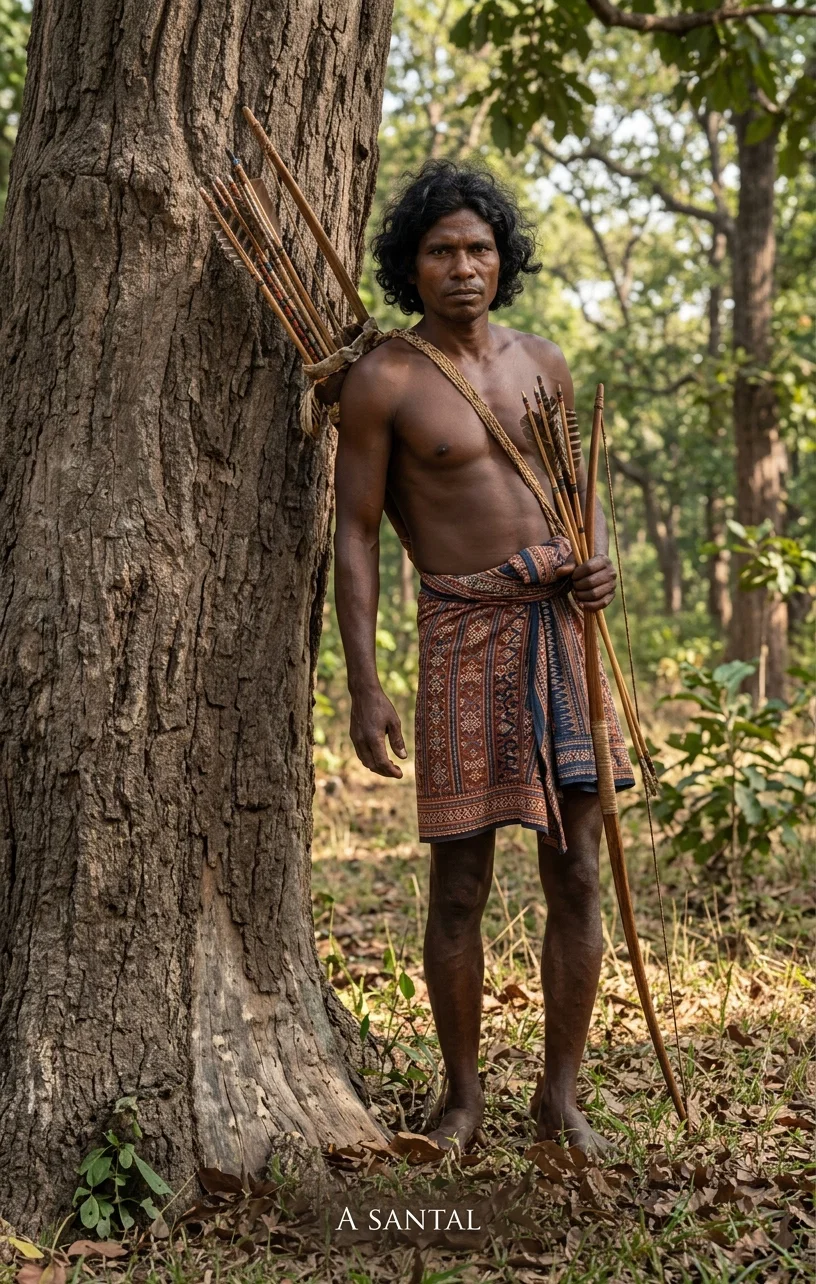
A SANTAL
A SANTAL
Leaving out of account the tea-garden districts, in Darjeeling, Assam, Cachar, and Sylhet, to which large numbers of Santals have emigrated, we may say, roughly speaking, that the Santal country lies in the angle formed by the Ganges and the Hooghly Rivers, and mainly within the jurisdiction of the commissioners of Bhagalpur and Chota Nagpur, but with outlying tracts in Burdwan and Orissa. For the most part, the country we refer to is an upland region, diversified by hills (of which the highest, Paresnath, reaches an elevation of 4,479 feet), and is intersected by many rivers, which are usually expanses of yellow sand in the cold and hot seasons, but become swollen and rolling floods during the rains. Paresnath, the scene of one of the great annual Santal hunts, is sacred to the Jains; and is surmounted by one of their temples, and by twenty-three shrines, in each of which the last contact of as many saints with earthly existence before they passed into Nirvana is plainly discernible in the form of footprints impressed on marble slabs. Devout Jain pilgrims visit Paresnath from all parts of India. In former days before the railway made Darjeeling so accessible, the hill was used as a military sanitarium, and the officers’ quarters are still kept up for the convenience of visitors.
The rivers, which are not bridged except where they are crossed by the railway are often a serious obstacle to traveling in the rainy season. The more remote parts of the district are still covered with forest, but in those which are more thickly populated, and more especially along the railway lines and in the neighborhood of industrial centers, the timber has disappeared or is fast disappearing. This is much to be regretted, for not only does the forest afford a valuable reserve, for man and beast, in time of scarcity or famine, but its removal has a baneful effect upon the climate and rainfall. Nevertheless much of the forest still remains, to refresh the eye and protect the land from the burning rays of the sun. The tree which is most characteristic of the Santal country is the sal, sacred to the Santals. Of it their “sacred groves” (called the “Jaher”) consist. It is a tall, erect tree, with large smooth leaves, of which the leaf-plates, etc., are made. It is a good hard wood, which makes it extremely popular for building purposes. (I may say that the roofs and door frames of our Seventh-day Adventist missions at Simultala and Babolmohal are made from the sal-tree). The banyan is also common, whose spreading branches will shelter a small army. It was under the banyan-tree that we pitched our tent when starting the Seventh-day Adventist Santal Mission only a few years ago at Simultala, where Brother and Sister R. Cook, of Colorado Sanitarium, are now stationed while studying the Santali language. I am glad to say that they are making good progress, for which we thank God and take courage.
The cousin tree to the banyan is the pipal, sacred to the Hindu. The stately semal, or Indian cotton-tree, has a trunk buttressed like a fort, and bears huge red flowers often a foot in diameter. I might also mention the palas, a blaze of color when in blossom in the hot season; the palm, fit emblem of the righteous man; the mango with its delicious fruit, and the almost universally useful bamboo. These are the most common and remarkable of the trees of India. Even more economically useful than any of them is the mahwa. The flower of this tree is edible, and being rich in sugar, is fairly nutritious. It is called the famine tree by some. When in full blossom in March or April, the flowers fall from the tree in the early morning. One thinks of the manna when one sees the ground beneath the mahwa-trees almost covered with the whitish flowers, and the resemblance is enhanced when the people turn out to gather these carefully into baskets. They are dried in the sun, and may be stored for months. To many of the poorer class, it is for the time their staple article of diet, and there are few who do not use it to eke out their food supply. Even those who do not eat it themselves use it for feeding cattle. The fruit is also highly prized. The pulp of it is eaten, and from the kernel a fine bland oil is expressed.
Rice is the favorite crop where the land has sufficient moisture, but much of the higher land is not suitable for this form of cultivation. There the Indian corn is largely cultivated, and a most handsome and luxurious crop it is when it has been favored with the proper blend of sunshine and rain. Planted in June or July, it grows with amazing rapidity. When it ripens in August or September, one is reminded of Longfellow’s lines in Hiawatha:—
“And the maize-field grew and ripened, Till it stood in all the splendor Of its garments green and yellow, Of its tassels and its plumage, And the maize-ears full and shining Gleamed from bursting sheaths of verdure.”
Simultala, India.