W. A. BARLOW

5%

Review and Herald Publishing Association · Takoma Park Station, Washington, D. C. · Nov 28, 1907

FromReview and Herald, Vol. 84, No. 48.

Read the full edition

W. A. BARLOW

Santalia and the Santals—No. 4

W. A. BARLOW

While the religious ideas of the Santals are very crude, and without any moral significance, their character as a people is by no means without its redeeming features. For one thing, they are remarkably honest, not so much from principle as from instinct. Just as some castes or tribes in India are naturally dishonest, born thieves or robbers (in a certain tribe in the Punjab a young man is not entitled to wear a turban, a kind of head-dress, or marry a wife until he has stolen a cow), so the Santals are naturally truthful and straightforward. Of course there are many exceptions to this rule, and truthfulness is conspicuous by its presence in the unsophisticated Santal just because it is so conspicuous by its absence among his neighbors.
God has not left himself without a witness in the character of men any more than in their consciences; there is no people, however degraded, whose moral nature has not some redeeming feature. In the case of the Santals it is honesty. “Have you ever heard of the Santals?” a friend of a Santal missionary asked a native gentleman in Bombay, a thousand miles from Santalia. “Yes,” was the reply, “they are the people who speak the truth.” Among themselves a word is as good as a bond; a knot tied on a string is a receipt, and also a few blades of a certain kind of grass, called “the dhobi-grass,” has at times been given to me by the Santals and others in place of a written receipt.
They are also very brave, seldom showing signs of fear in the face of physical danger, delighting to fight wild beasts of the forest with bamboo sticks, or at best with bows and arrows. There are well-authenticated instances of Santal mothers rescuing their children from the very jaws of the tiger or the leopard. Only a few months ago we heard the noise of the Babolmohal villagers driving away a leopard from the courtyard of the chief’s oldest son. They used brooms and bows and arrows, and seemed to enjoy it.
Morality
The morality of these people certainly does not conform to the Christian standard, but in some respects it compares not unfavorably with that which prevails among races who occupy a much higher place in the scale of civilization. In every Santal village there is an official, called the jog-manghi, who acts as custodian of the morals of the young people. Any woman wronged by a man can appeal to him for justice. It is rare for a child to be born out of wedlock. A manwho has led a girl astray must either marry her himself or provide a husband for her, and this he does by settling on her a dowry sufficiently large to make it worth somebody’s while to marry her.
Bigamy is by no means unknown, nor is it regarded as irregular. Even the Christian Santal often finds it hard to understand why in this matter he should not have the same liberty that the Old Testament saints enjoyed. But few Santals can afford to maintain more than one wife. While the women enjoy considerable liberty, they are regarded as a marketable commodity, pretty much like sheep and cattle, and the market price of a woman is a great deal less than that of a cow. The Santal husband no doubt looks upon his spouse as “something better than his dog,” but it would be an exaggeration to add, “a little dearer than his horse.” It is a very poor horse that does not sell in Santalia for four or five times the price of a wife. A man, not exceptionally callous or cruel, is often much more distressed by the illness of a buffalo or a cow than by that of his wife, as in the case of death it is so much easier to replace the latter than the former.
Divorce is easy; in fact, if a man’s wife runs away from him, he is free to marry again. Here again the Christian law of marriage is a serious stumbling-block to the Santal. Deserted by his wife, he can not afford to go to the expense of a legal divorce, and in a community like his it is almost impossible for him to get any woman to work for him or his children. Generally speaking, the morality of the Santals may be said to be high from the heathen point of view, but low from the Christian. At a certain festival almost unbridled license prevails. The people are fairly kind-hearted among themselves, but their language contains no word for “friend;” the idea of friendship, apart from kinship, is unknown.
Their Language
Their language is the most remarkable possession that this people, exceptionally poor in this world’s goods, can boast of. It is a triumph of complexity, with moods and tenses all its own, a language which is only to be learned by living among the people who speak it, but which, once learned, is peculiarly expressive and convenient. It is very rich in terms for all natural objects and for all things which touch the common life of the people. There are, for instance, more than six verbs in Santali for our verb “to fall.” There is one which means to fall from a standing position, another to fall from a height, another to fall forward, another to fall backward, etc. Then there are an equal number of names for rice, etc. But to express spiritual and ethical ideas and to denote the imports of recent civilization — schools, books, paper, ink, pens, pencils, pins, church, roads (except footpaths), bridges, slate, post, magistrate, taxes, police, etc.—words have to be borrowed, mainly from Hindi or Hindustani.
Village Life
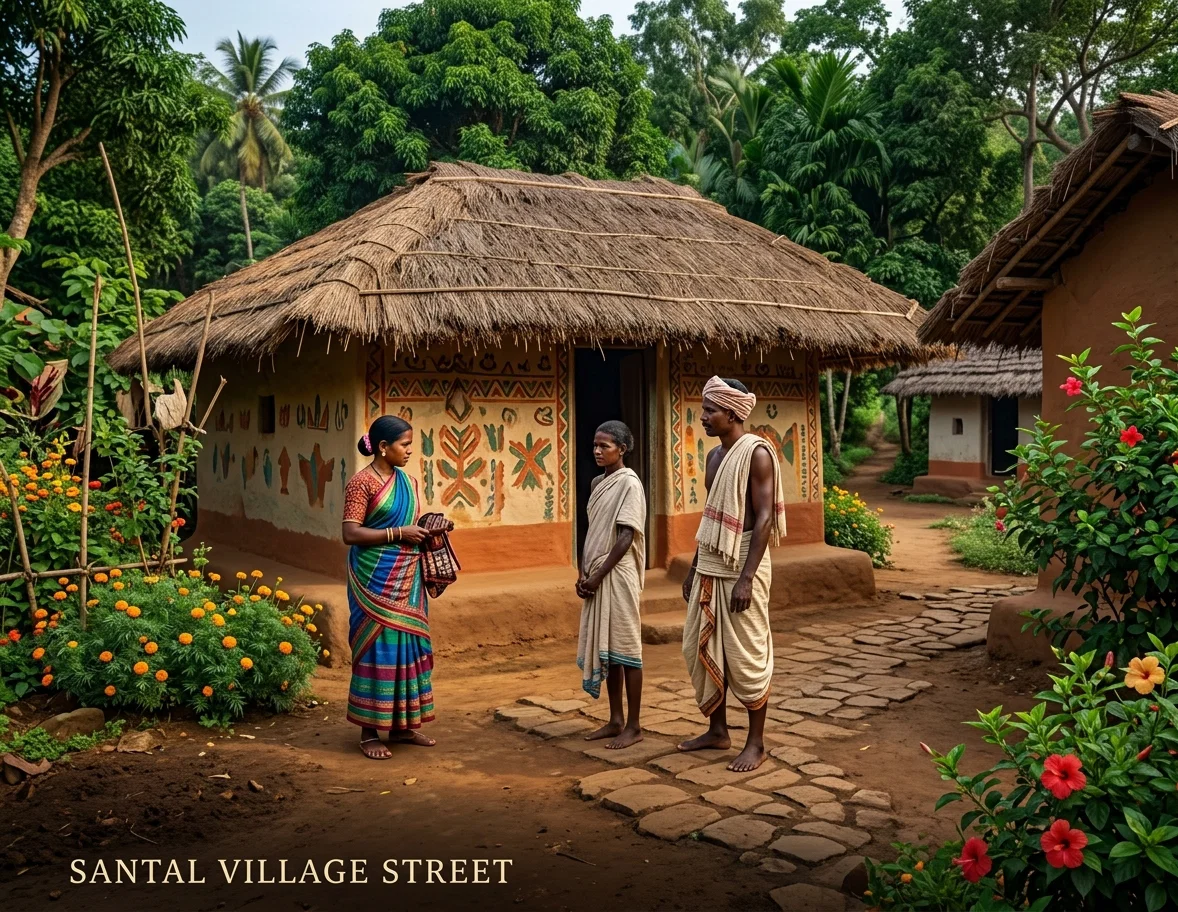
Santal village life is patriarchal in type. The village head man, or manghi, not only holds the lease of the village from the raja, or landlord (in most cases a Hindu), and collects the rent from the ryots, or cultivators, but he holds sway as chief in the social affairs of the community. He is assisted by a paranik, or advisor, two priests, and the jog-manghi. There is also the messenger whose duty it is to summon to the head man. He is to some extent under the authority of a des-manghi, who holds authority over a circle of villages, and the des-manghi, again, may be overruled by the parganite, or head chief of the district. Knotty questions in social law, however, are usually discussed by the elders in council or in presence of all the villagers who may care to attend. Of course the manghi has no criminal jurisdiction recognized beyond fines and social outlawry; but by means of these village councils, disputes about land, marriage, and inheritance are often settled, which would otherwise entail vexatious and expensive litigation.
A GROUP OF VISITORS
A GROUP OF VISITORS
Marriage
Infant marriage, one of the many evils of Hinduism, is practically unknown among the Santals. At the same time it is exceptional for the young people themselves to take the initiative in arranging a wedding. The young man’s parents may approach the parents of the maiden upon whom they have set their eyes, but it is more usual to transact the business by intermediaries. “Have you any diamonds to sell?” is the question, addressed by the old men who wish to negotiate a marriage, to the parents of a possible bride. “That depends upon the quality of your pearls,” is the stock answer. In Santali a double translation has usually to be made to render a conversation intelligible; we have to translate first from Santali to English, and then from the parabolic to the literal. “Have you any diamonds to sell?” means, “Is there a marriageable maiden here?” By the quality of the pearls is meant the eligibility of the young man for whom she is wanted. If they come to terms, the price to be paid for the bride is fixed—three to five rupees, or five shillings, as an average. Afterward the youth’s friends visit the girl, and as a sign of the betrothal give her a cloth. The money is then paid to the girl’s parents, and a date for the wedding is fixed. The next step is for each party to tie a knot in a string for each day that is to intervene till the marriage day. Then the parties separate; day by day a knot is untied, and when they come to the end of the string, the real knot is tied that makes the young couple one.
“To tear the leaf” is the symbol for a divorce, the leaf used being that of the sal, the sacred tree of the Santals. A widow is free to marry again, but just half the price is paid for a widow or divorced woman, on the ground that she still really belongs to her first husband, and will rejoin him in the next world.
The above is the ordinary course of true love, according to Santal ideas, but exceptions are by no means rare. It is called in Santali kiring bahu, or the “bought bride.” But there is another recognized form of marriage known as kiring jawae or the “bought husband,” which has already been referred to, and in which a husband is bought for the young woman by the man who ought to marry her, but is prohibited from doing so on account of his sept being the same as hers. There are also quite legitimate forms of marriage in which either the youth or the maiden may take the matter into his or her own hands and get married in spite of the parents who oppose the match. The youth may go through the form of forcibly seizing the maiden, with or without the consent of his own villagers, at the place where the women draw water, and mark her forehead with red paint. Or the maiden, if the young man’s parents disapprove of the match, may force an entrance into the house they occupy, and if she can manage to stay there all night and brazen out all the taunts of the youth’s mother: the opposition is withdrawn, and the regular marriage is arranged for. Of these marriages by force the former is called itut, or “paint smearing,” the latter nir bolok, or “running in.” There is still another form of marriage for a girl who may be deformed, ugly, or in other ways unattractive. No price is paid for her, but the young man serves the father-in-law for five years, then gets two bullocks, some rice, and tools, and goes his way. The bride, who is regarded as belonging to the family rather than to the husband, is brought into her husband’s home circle. The family share all they have in commontill the father’s death, when the goods are equally divided, except that the eldest son gets a bullock and a rupee more than the rest. The Santals never marry outside the tribe, but within the tribe they are exagamous, that is to say, a man always chooses a wife from a different sept from that to which he himself belongs.
Simultala, India.