In company with Mrs. Porter, I left Cape Town, May 23, for the Barotseland Mission. After a ride of two days and nights we reached Bulawayo, where we lay over one day and two nights, waiting for connections for Pemba. As there are none of our people living in Bulawayo, it was necessary for us to lodge at a hotel. We took our meals at a café, to lessen the expense. One item will show something of the cost of living in this city.
Elder W. H. Anderson and daughter Naomi and Elder R. C. Porter and wife leaving the Barotseland Mission, the two latter to take the train
We had arranged for meals at fifty cents each. As we ate no meat, we called for eggs instead. We then called for milk in place of tea or coffee. About half a glass of nice rich milk was furnished to each. Thinking we were entitled to a full glass, we called for another order, receiving another half glass. It was all done with such grace on the part of the waiters that we ate our breakfast with a hearty relish. What was our surprise on receiving our bill to find that, in addition to the price agreed upon for meals, there was an extra charge of fifty cents for milk. The next meal we tried another café, but with similar results. This is a sample of the surprises awaiting an American while becoming initiated in traveling in Africa.
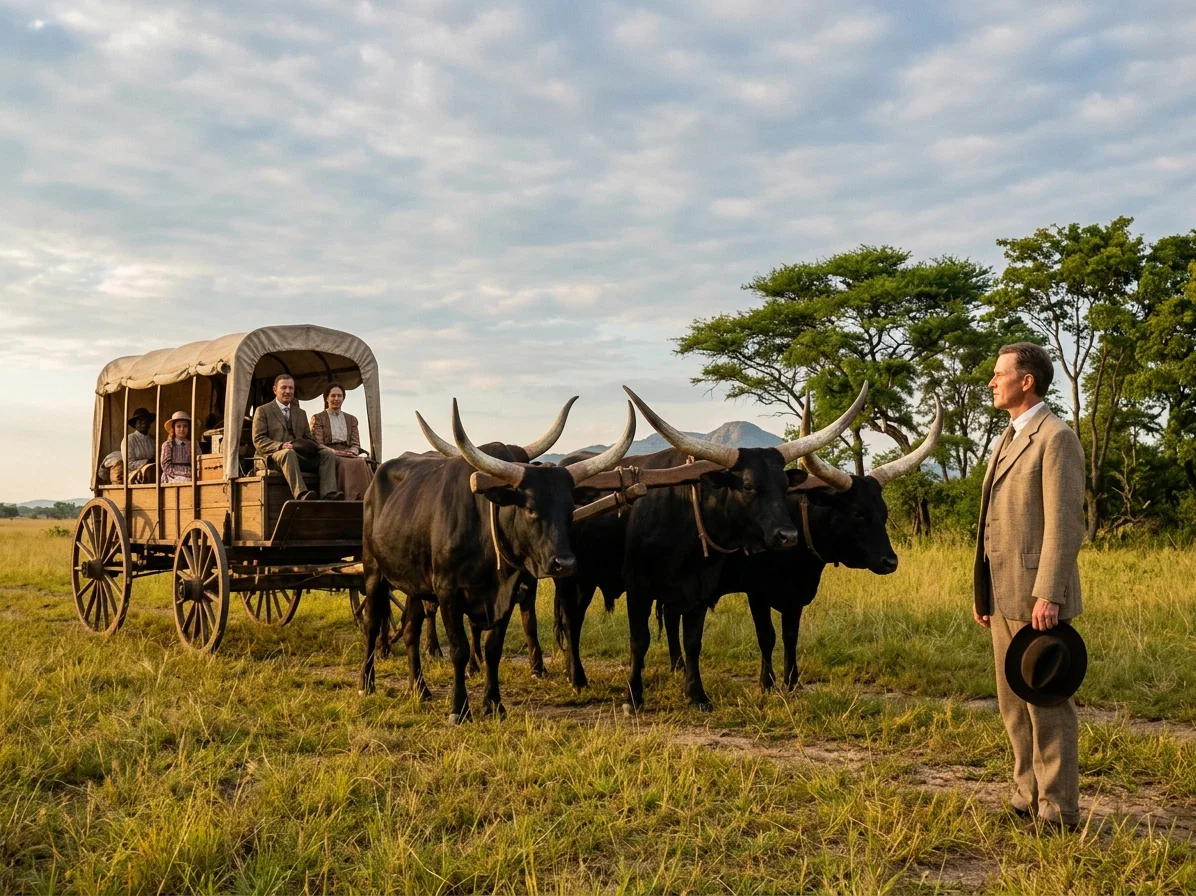
We had a pleasant trip from Bulawayo to Monze, where we were met by Elder W. H. Anderson and daughter, Naomi, with an ox team. We left the station at about 2 A. M., reaching the mission, a distance of six miles, at 7 A. M. We were happily surprised to find that, instead of a wild-looking frontier station, the surroundings were such as to remind us of home life and civilization,—a neat brick cottage for the superintendent and helpers; a Brick chapel for school and Sabbath services, and another brick cottage under construction for Brother and Sister J. R. Campbell, and another brick building for the natives' dining- and study-room. The native thatched huts for the students' living quarters, and a native cattle kraal, reminded us that we were in the wilds of Africa. The flower garden and the fruit orchard showed the care of an experienced manager.
DARKEST AFRICA
After a good, hearty breakfast we started out to look over some of the places of interest on the station. We tramped until nearly noon, but touched only a little corner of the five-thousand-acre farm.
Aside from this, there are two hundred acres with each of the six out-stations. This land is given by the government on condition that it be used continuously for mission purposes. When it fails to be used thus, it falls back to the government.
At the central station they have a great blessing that is not found on every five-thousand-acre farm; it is a spring of pure living water.
There is sufficient water here to irrigate a large field for cultivation. Mealies (corn) does well here, and there is a good profit in dairy farming. Elder Anderson has a nice herd of native cows, so their table is supplied with delicious separated cream and sweet butter.
The stock is in good condition. We remarked that their oxen must be well fed to look so sleek and fair. Elder Anderson replied, “We never feed them anything. They get their living the year round on the veldt when not in use.” And it is true of the cows and other stock as well. The native cow does not give a great amount of milk, but it is usually rich. The calves can not be weaned, as in America, else the mother cow will give no milk after three or four days; the calf must be kept with her, and this lessens the milk for the separator.
Each out-station is equipped with an ox team of six yoke, and a plow, that the work may be made self-supporting. As fast as possible these out-stations are also furnished cows. Some of Elder Anderson's out-stations are even now a little more than meeting expenses, and all above what is needed for the support of the teachers, is returned to the central station. The need is for means to open up more out-stations and equip them faster.
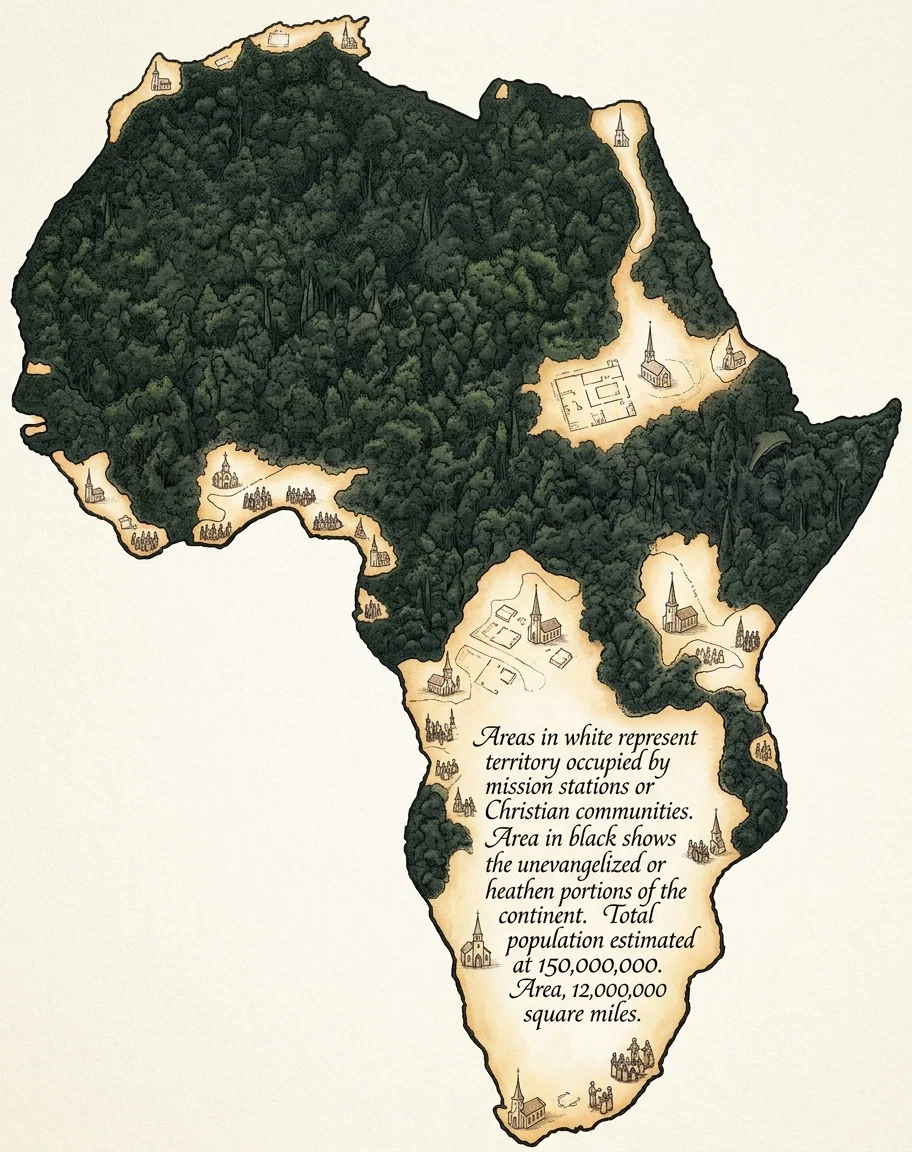
The instruction to us is to step faster, and our burden is to set these darkened lands all ablaze with the light of the message. Every station established is a torch that lights the territory for miles around, so let the money flow into the treasury that more torches may be lighted, for the African darkness is very dense. There are forty boys and ten girls at this station. Since Brother C. Robinson, a graduate nurse from the Plumstead Sanitarium, and Brother Campbell and wife from the Solusi Mission, have connected with the Barotseland Mission, it is well equipped with laborers, and is pushing the work vigorously and successfully into the vast field of Northwest Rhodesia. We are confident that the plans now being laid by this mission will result in the rapid extension of the work in this part of the field.
Returning from our visit to this mission, we spent one day at Victoria Falls. We greatly enjoyed seeing what is known as the greatest waterfall in the world. This fall is four hundred feet high, or twice the height of Niagara, and more than twice the width, and the river at this point is a mile and a quarter wide. The channel below the falls is narrower, but the regular flow at any one point is not so great except during the rainy season. The natural scenery is grand, but the surroundings have not been beautified by the expenditure of large sums of money, as is the case at Niagara Falls.