A Plea for China’s Women

5%

Review and Herald Publishing Association · Takoma Park Station, Washington, D. C. · Sep 16, 1909

FromReview and Herald, Vol. 86, No. 37.

Read the full edition

A Plea for China’s Women

MRS. E. A. LAIRD
We do not see much written about China’s women. True, their condition socially, and in the home, is less deplorable than that of Indian women, who live behind the purdah; yet they are heathen, and are the ones who keep alive the altar fires of idolatry.
The aged Chinese are held in great veneration. Four and five generationsmay be found living under one roof. The eldest woman usually rules the others, and generally gets her own way. A Chinese woman’s greatest ambition is to present her husband with a son, to keep the male line intact, and to sacrifice to deceased ancestors. It appears that women perform these rites by request only, and then usually join with the men. While daughters are not so welcome as sons, they are often greatly petted.
Women at Chang-sha enjoy considerable liberty. But foot binding and other customs confine them closely to their homes.
In the better families, women seldom go out except in a covered sedan-chair. They take their meals in rooms separate from the men. Their time is taken up largely with gossip brought in by servants. They also take special care with their toilet. The hair must be done in the prevailing fashion, which changes but little in this respect. It must be well-oiled, kept smooth, and pasted down close to the scalp, with a fancy coil at the back. Fancy pins and ornaments of gold, silver, and various colored stones are used to keep these twisted coils in place. The finger-nails may be permitted to grow very long, and are carefully manicured; they are often tinted pink, as are the palms of the hands. The face is powdered, and highly tinted with red, which does not add to their appearance.
In wealthy homes, children are reared by a wet nurse. Relieved of care and responsibility, these mothers readily resort to the water-pipe for smoking tobacco, or card playing and other kinds of gambling; and, alas! too often they fall victims to the terrible opium habit, which has slain myriads.
How these heathen sisters need those with the love of Christ in their hearts to visit them in their homes, teach them to do different kinds of needlework, knitting, and crocheting, and such other work as they can be inspired to do. They need reading-matter telling the simple story of Jesus, and some one to read with them, thus opening the way for Bible instruction in the home for those who do not go out. I have not done much visiting, not having a trained Bible woman as yet. It is also quite difficult to gain an entrance into these homes unless one has met some lady of the household through medical work or otherwise. However, we have a class of women who do go out.
To reach the women I have been following this plan: Monday and Thursday afternoons of each week, we give a special invitation to these women and children to come to meeting. The whole afternoon is devoted to receiving, and to studying with them in the Word of God. After some songs and prayer, we have our Bible lesson. This has been learned well by previous study with our own women. All who can read characters are asked to read in rotation with the rest. If they do not wish to read, they seem to delight to look on the book as others read. After reading, we have a talk about the lesson, thus bringing out as many points as we can concerning God’s love, the sinner’s need of Christ, his promises to all who repent and believe the gospel.
These women, never having been at a Christian meeting before, know nothing about order and quiet. When one point has been told them, it is necessary to rehearse it again and again. They often ask questions, and our Sabbath-keeping women are very ready to answer them. They also help out by telling of other lessons which have not been brought out.
Our evangelist’s wife, Mrs. Chang, thinks no lesson is complete until she tells and explains about the ten commandments, and shows their relation to sin.
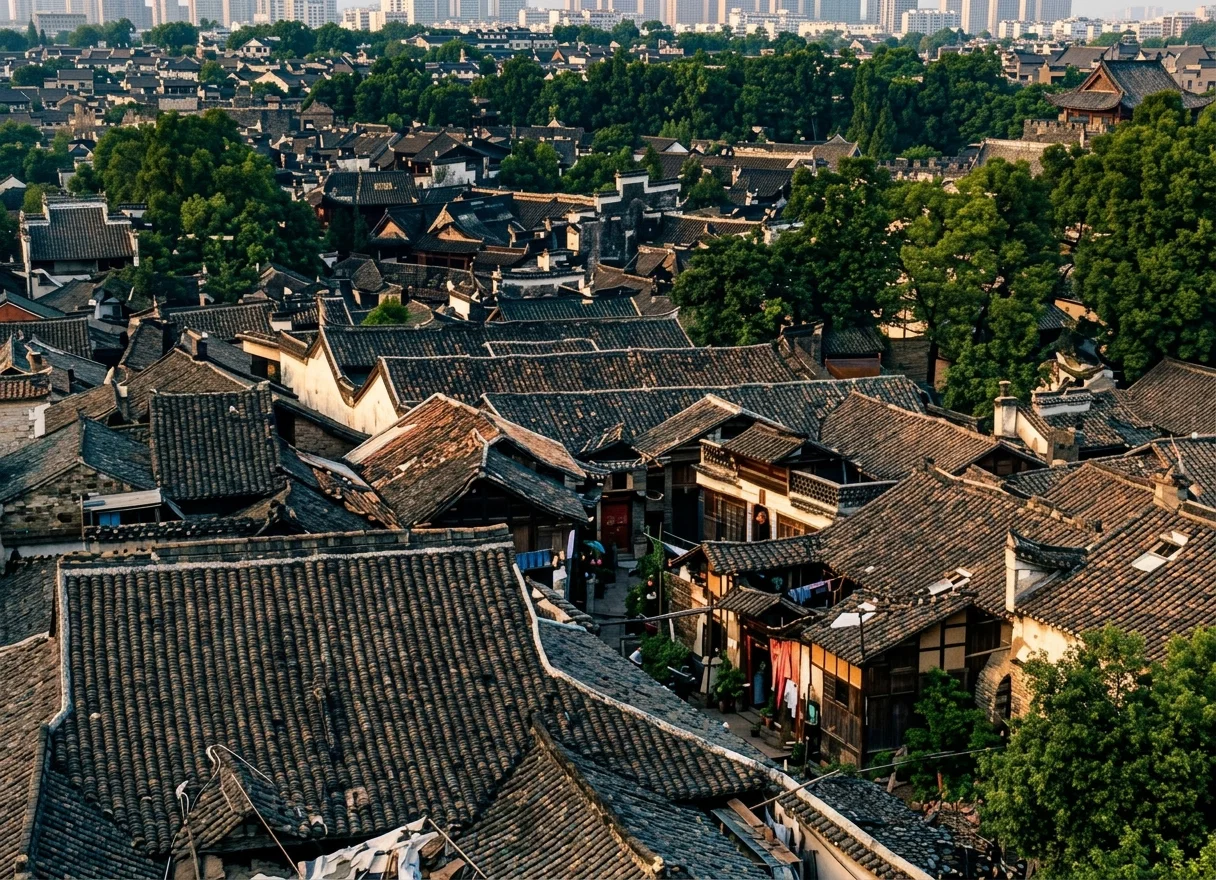
HOMES OF CHANG-SHA, HUNAN, CHINA
After about an hour’s study in this simple way, Bibles are set aside, unless some desire to question further. Mrs. Chang talks to them, and the rest are invited to see my little three-room house, which is an object of great curiosity to them. Their first question is, invariably, “How do you get the floors so clean?” The foreign cook-stove is a wonder to them, not having seen one before. “How wise the foreigner is,” they say, “to make a stove so that no smoke or ashes will come out into the kitchen, and that will cook so many things at one time.” They are quite surprised to find that our bed is much like their own, having been made in China.
They think it strange that I make my own clothes. At Chang-sha it is common for nearly all classes to wear tailor-made garments; but they usually make their own tiny embroidered shoes and white muslin hose.
After they have finished looking at things, they are ready to learn the simple crocheting, knitting, etc., which have been prepared. By the help of those who have acquired some proficiency, they practise at this until it is time to return home to prepare the evening meal.
True, many come out of curiosity, but we are promised that if we “sow beside all waters,” “my word . . . that goeth forth out of my mouth: it shall not return unto me void, but it . . . shall prosper in the thing whereto I sent it.” One very apparent effect of these meetings is seen in the breaking down of prejudice after a few visits.
I am training our own women as fast as possible so that they may be able to give Bible readings and visit the women in their homes, thus opening the Word of life to thirsty and hungry souls. They take great interest in their daily study with me.
What do you plan to do for these very interesting women during the coming year? You can have as definite a part in this work as those who are on the field in co-operating with God in prayer.
Chang-sha, Hunan.
BRIDGE IN HUNAN, CHINA