Little Russian Mission

6%

Review and Herald Publishing Association · Takoma Park Station, Washington, D. C. · May 12, 1910

FromReview and Herald, Vol. 87, No. 19.

Read the full edition

Little Russian Mission

W. J. FITZGERALD
The report of the Middle Russian annual meeting was written while making the trip from Moscow to Kief. The distance between the two cities by railway is about six hundred miles. It required over twenty hours by what is considered a fast train in Russia to make the trip. We traveled through great stretches of forest and only partially developed country. Had the masses of the people a fair degree of enlightenment, and did the government provide a just and liberal administration, the country would provide ample resources for a vastly larger population than it now possesses. The villages contain anywhere from a few hundreds to many thousands of people, whose condition is little better than serfdom.
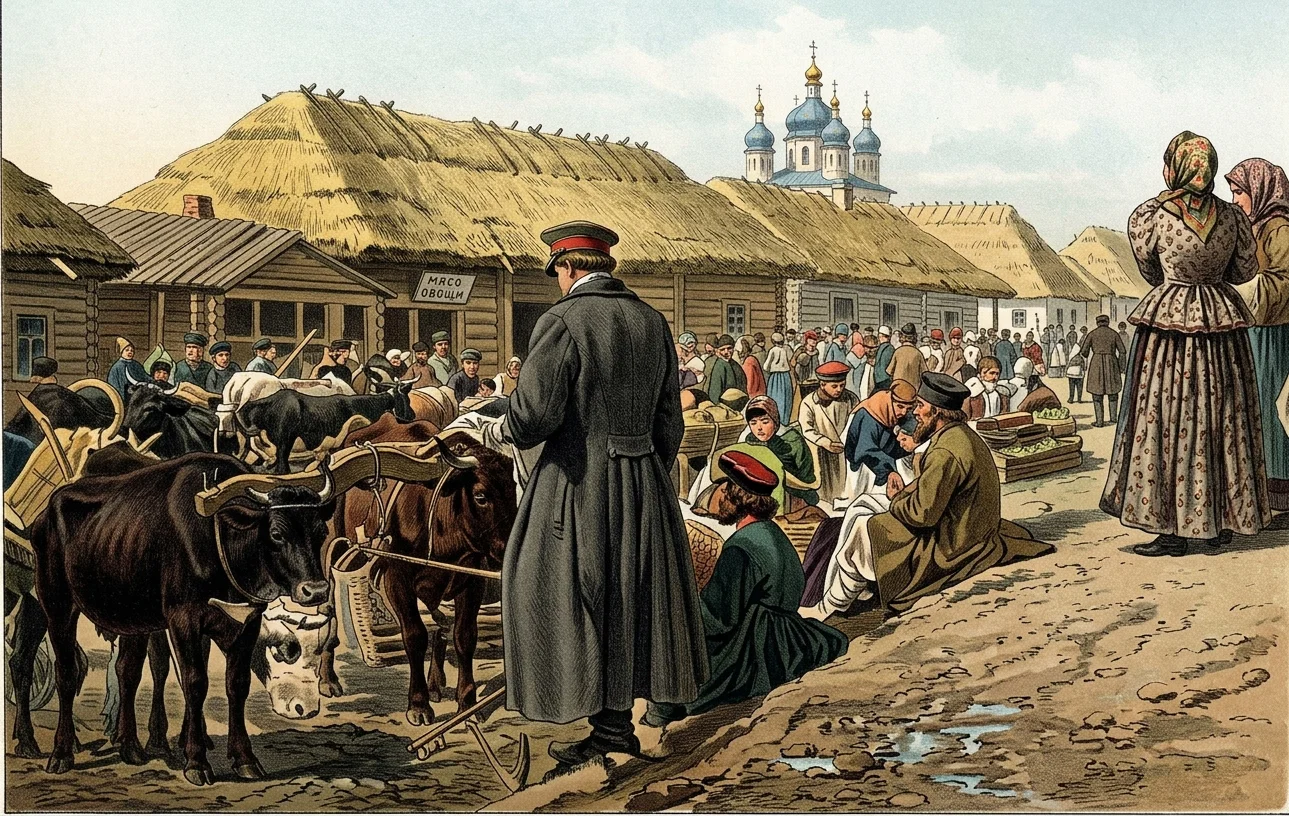
The houses, which, are very low, one-story structures, are scattered about with little apparent attempt to place them in orderly arrangement. A large percentage are covered with very heavily thatched roofs. The windows are very few, as are also the smoke flues. Many of the houses have no chimneys whatever, the smoke from large stoves or ovens contributing to the warmth for the occupants of such houses.
Scattered throughout the country near the villages are many old-fashioned windmills. These provide the only means to the millions of country people in Russia for grinding their grain. Naturally, the product of such mills is not of the finest quality, but the peasants are accustomed to very coarse bread.
There is one striking feature to be seen in every village—the orthodox church. A very wretched-looking village is almost sure to have a beautiful church. For many miles the gilded and painted domes and pinnacles can be seen by travelers. Another feature, just as striking as the ever-present church, is the never-present school. None of the villages has a school. This fact seems incredible to the inhabitants of more enlightened lands. Though the millions of priests boast that their church possesses the true faith, yet scarcely any attempt is made to render it possible for the masses to read the Word of life.
As we approached Kief, the country looked somewhat richer, and, to a little greater extent, subdued by the efforts of the inhabitants. We entered the fertile valley of the River Dnieper. There we saw many signs of considerable commercial activity.
MARKET AMONG THE “LITTLE RUSSIANS”
Kief is regarded as Russia's holy city, or Jerusalem. It possesses many large churches, but that which gives to it special distinction is the famous Lavra, which is a sacred shrine for all Russia. There is a beautiful spot of ground enclosed just outside the city on the bank of the river. Within this enclosure is one very costly church, besides several others less imposing. There is also a cloister where many monks reside. Foods and many other articles are manufactured here. There are a number of shops where many things appertaining to the Greek Catholic Church may be obtained at rather high prices. There are underground passages somewhat similar to the catacombs at Rome. In these passages may be seen many open coffins containing the supposed remains of dead saints. Whatever may be in a coffin, it is always thoroughly concealed from view by thick mantles. To the Lavra there come annually hundreds of thousands of pilgrims from all parts of the great empire. We were informed that about twenty-five thousand visit the place daily during the summer season. The pilgrims are lavish in their exhibitions of idolatrous worship of saints and "holy" things.
The attendance of our people at the Little Russia meeting in Kief, held March 2-6, was good, and many people of the city attended the afternoon and evening services. It was in Kief that Elder J. T. Boettcher had the privilege of presenting some of the leading points of our message to a large company of Greek Catholic priests about two years ago. The city has been much agitated over the matter ever since. For a month before our meeting opened, the newspapers had been printing articles regarding the coming conference. Scarcely had we entered our room in a hotel, when a leading newspaper representative cameto interview us. During the entire time of the meeting, this man, with others from other papers, attended our services. Several papers printed long reports of our meetings daily. Almost without exception the reports were fair and favorable.
From the first, a high official from the ministry of religion (government department) at St. Petersburg was with us, to observe our meetings. The government at Kief also had its special police officer present at all services. Besides these, a special missionary of the Greek Church, from St. Petersburg, honored all the meetings with his presence, and he seemed to be attended by a local man of similar character. These men seemed to watch closely for some point on which they might bring a charge against us. From day to day there were also in attendance from three to six priests. They manifested a very keen interest in all that was said and done, and it was evident that these priests had a considerable number of their partizans in the hall. Such circumstances, and such observers, place those acting a leading part under a severe strain.
The priests almost daily challenged Brother Boettcher to hold a public debate with them. Finally, on the Sabbath, they presented a formal written challenge, and desired an immediate reply. This was given in writing, by calling their attention to Neh. 6: 3, and they seemed to accept this as final. Their evident purpose was to divert the efforts of Elder Boettcher from our regular meetings, where we studiously avoided doing or saying anything which could possibly offend the government officials. Had the challenge to debate been accepted, great confusion would have characterized the debates, with the possible result of closing our important annual meeting.
There was some attempt to disturb the Sunday afternoon service, when one of our younger brethren spoke, in the absence of Elder Boettcher and the writer. When we arrived for the double evening service, the police officer expressed fear of trouble in that, the final meeting. He took the precaution to secure the services of eight additional police officers. The writer spoke the first hour, on "The Home of the Redeemed." A few minutes after the sermon began, about twenty young students, who had entered the place of meeting for the purpose of making a demonstration, arose and tramped heavily out of the hall. Doubtless they were deterred from any further demonstration by the presence of the extra police who were distributed about the hall. The places of the students were at once taken by persons anxious to gain admittance. Every foot of standing room was occupied. Elder Boettcher devoted the second hour of the service to a very interesting lecture on health and temperance.
In spite of the surveillance and opposition, the annual meeting of the Little Russian Mission ran well from the beginning, and closed most encouragingly. The believers were encouraged to press forward in the conflict, and their confidence in the movement was much strengthened. Apparently many people not of our faith received favorable impressions, for the very manifest influence of God's Spirit was with us.
Just as we arrived in Kief, we received the sad news of the arrest and conviction of Brother J. Pilkewitsch, a licentiate in the employ of the Little Russian Mission. His wife resides in Kief, but he had been working among the villages. He was charged with having spoken against the orthodox religion of the country. Fifty witnesses were permitted to bear false witness against him, while his witnesses were not permitted to testify. As the result, he was convicted, and sentenced to two-years' imprisonment. Elder Boettcher sent this brother's wife to investigate the matter, as he could not go himself, but he will exert every possible influence to bring about Brother Pilkewitsch's release. We should all pray that our dear brother may not be required to serve out the full time of this unjust sentence.
The special missionary from St. Petersburg, supported by the priests, conducted a three-nights' meeting in opposition to us, immediately following the close of our conference. Before we left Kief, at twelve o'clock Monday night, a Russian brother reported to us fully of the first meeting, which had been held that evening in a very large hall crowded with people. The St. Petersburg man's speech was a most bitter attack upon us. We believe God will overrule for the furtherance of his cause, not only in Kief, but also in all Russia.
The membership of the Little Russian field is now 502. A net gain of 100 was made last year, and the tithe for the year amounted to $1,325. Brother J. Ierk, and his small force of coworkers in that field, are full of courage for the future. They greatly need the aid of our prayers of faith.