Solusi Mission

6%

Review and Herald Publishing Association · Takoma Park Station, Washington, D. C. · Jun 30, 1910

FromReview and Herald, Vol. 87, No. 26.

Read the full edition

Solusi Mission

R. C. PORTER
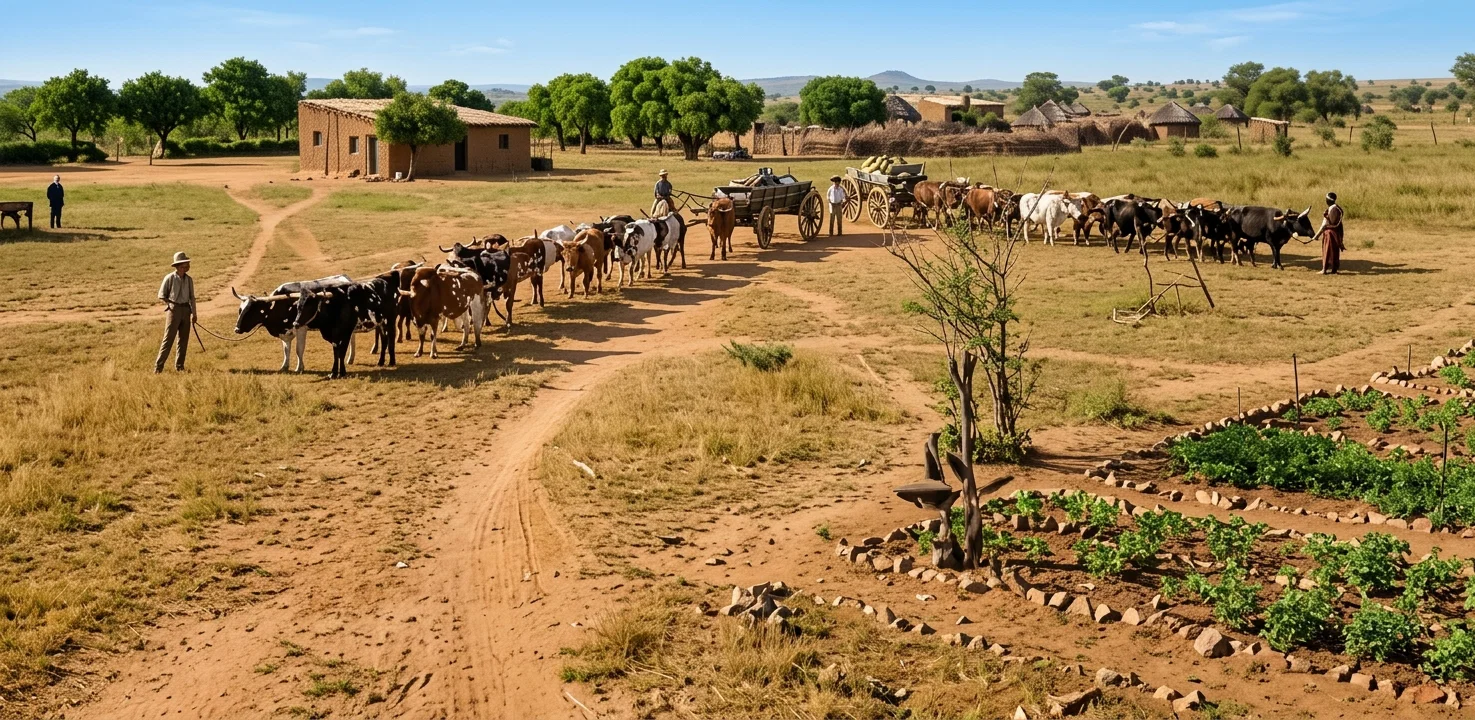
ONE would scarcely think he was in the heart of heathenism in Africa, should he awaken at the Solusi Mission without having had the experience of traveling across country fourteen hundred miles from Cape Town to reach the place. The appearance at the mission is quite like an American farmer’s home.
They are just now harvesting their crops. They have two hundred acres of good mealies (corn). I measured three ears, picked as I passed through the field, and they averaged nearly nine inches around and a foot in length. They have but thirty acres of this variety. The other fields are of a smaller-eared variety, but very productive. At one time it looked as if the whole crop would wither and die for want of rain. After earnest prayers had been offered by the mission family, the rain came in time to save the entire crop. They also have about forty-five acres of Kafir peas, with peanuts, potatoes, sweet potatoes, beans, and other garden produce. On the farm are 145 head of good cattle, four mules, a driving horse, one mule-wagon, two ox-wagons, two carts, one double and three single cultivators, one iron harrow, one breaking plow, two disk plows, one two-horse corn-planter, one mowing-machine, a steel hay-rake, a milk-separator, and a corn-sheller. With this equipment the mission is prepared to do good work in the line of agriculture.
When Mrs. Porter and I visited this mission one year ago, there were thirty-two students at the main station school, and an average attendance of twenty-five at each of the four out-schools. They now have ninety-two at the main station, and seven out-schools, with about the same average attendance. They expect to open another out-school soon. The students are mostly a mature class, their ages ranging from twelve to twenty-five, with the average age above sixteen.
When we began mission work in Africa with small children, who must be grown as well as educated and trained for the work, it looked like a slow way to enlighten Africa with the message. But from that first class have developed our stanch and reliable teachers, who have given character to the work; and they have gained the confidence of the natives, so that now our schools stand in the foreground of native mission schools, both as industrial training-schools and as places to obtain a thorough education.
As the result of the work of this mission we now have a church of eighty-eight members, including the three white teachers. Their tithe last year was £76 9s.; annual offerings, £10 3s. 6d.; Sabbath-school offerings, £8 13s. 9d. This makes a total of $372.37 tithe and $91.80 offerings.
STARTING OUT FOR MARKET FROM SOLUSI MISSION
Twenty teachers at Solusi and nine at other places have been trained at this mission. Thirty-six others who have been students and are members of the Solusi church are engaged in other work. Twenty who live in their kraals are keeping the Sabbath, though they have not united with the church. Another class is preparing for baptism.
One of the older boys now at the school came from Chinde, a distance of over nine hundred miles, and another came a distance of over eight hundred miles. They had not heard of the school before starting; but on reaching Bulawayo they learned of it, and refused good wages in order to attend. They think that the Lord led them to Bulawayo, that they might learn of the school, and become acquainted with the message.
To see the marked change that has taken place in this family of students so recently come from heathenism, and to hear them engage with such fervor in songs of praise to God and in intelligent testimonies and prayers, can not but touch one’s heart. I could not refrain from weeping at the thought of what God has done and is doing for the darkened heathen of Africa.
Thomas Ntaba and wife, with his mother, have recently gone from Solusi to assist Elder F. B. Armitage and wife in opening a new mission among the Zulus. Grandma Ntaba has always been called “the mother of the Solusi Mission.” She is a mother in Israel, and Thomas is one of our best teachers. They will be greatly missed at Solusi, but all were willing to part with them in the interests of the Zulu work.
Elder M. C. Sturdevant and wife expect soon to move to a place near Umtali on the Beira Railroad, where they have selected a new station. They have asked for Mark, one of our best teachers at Solusi, and six other boys to accompany them. The Solusi Mission workers have granted their request, and offered them a donation amounting to about $500 to aid in starting the new station. It is a pleasure to see this spirit prevailing in our mission fields.
It may seem to some that it is unwise to make so much preparation for farming on a mission station; but when one can see that with the preparation made at this station, they are enabled to support twenty native teachers and nearly a hundred students from the proceeds of the farm, without calling for any funds except for the salary of the white teachers, it must appeal to all that it is wise to make thorough preparation to make the industrial work a success. They expect soon to be able to support the white teachers also. Brother and Sister Sturdevant and Brother Victor Wilson have labored hard and managed their work well. Brother Wilson will soon have a new book of hymns ready for the press in the Centibela language.
We have been greatly cheered by what we have seen of the prospering hand of God in the work at Solusi during the past year. Our prayers will ever be for its continued prosperity.
Solusi.