A Trip Through South Bolivia

6%

Review and Herald Publishing Association · Takoma Park Station, Washington, D. C. · Feb 15, 1912

FromReview and Herald, Vol. 89, No. 7.

Read the full edition

A Trip Through South Bolivia

OTTO H. SCHULZ
“COMMIT thy way unto the Lord; trust also in him; and he shall bring it to pass.” Ps. 37: 5.
July 19, 1911, I left home for a four months’ trip through south Bolivia. I planned this journey long ago, desiring to visit several cities, but it has been impossible to do so earlier. The trip was to be not only troublesome, but dangerous.
From Cochabamba, a prosperous city in the semitropical climate, a stage-coach drawn by eight mules was our mode of conveyance for a day and a half; then a ride of three hours on a railway train brought me to Oruro. This is a veritable city of the wilderness, with no shrubs nor green trees, but possessing rich mines of silver, copper, zinc, and a small amount of gold. A large German colony has established stores here of considerable importance.
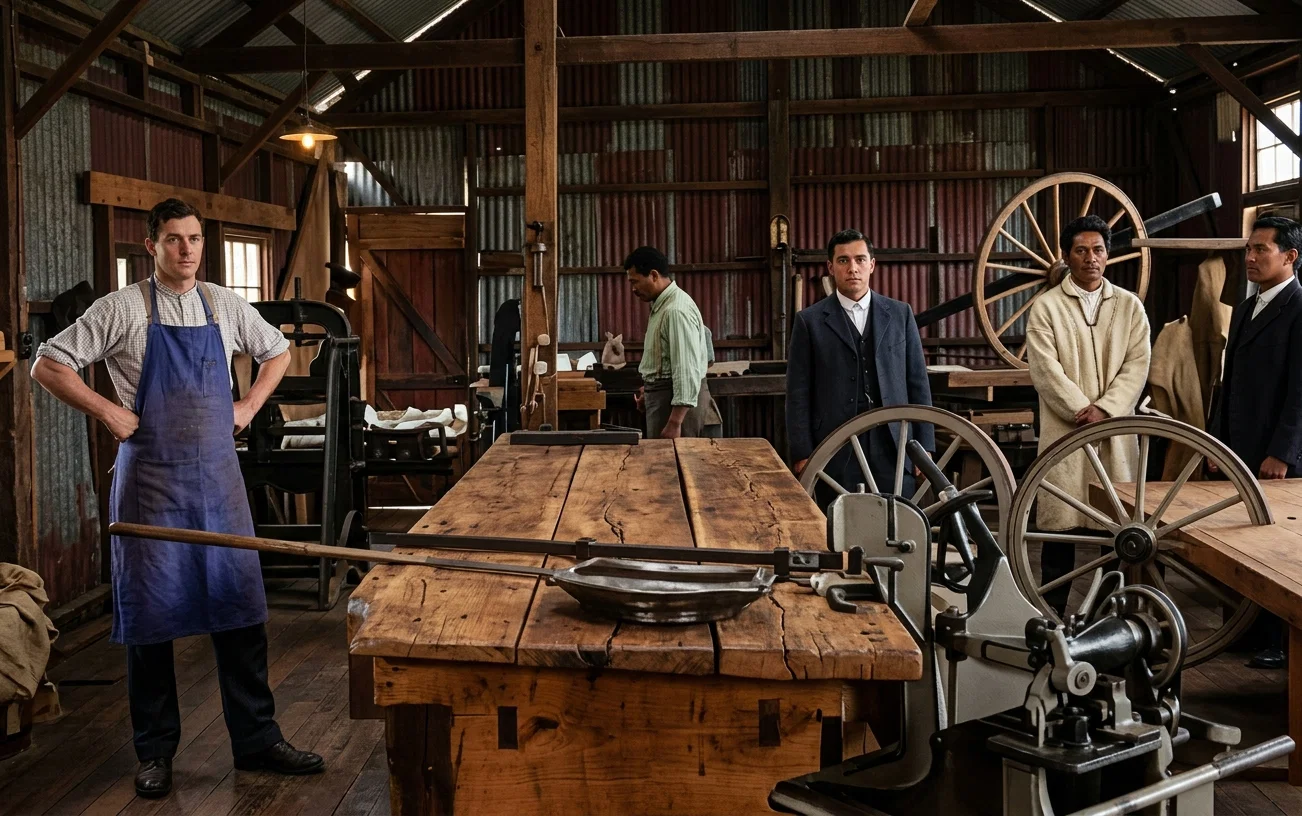
INTERIOR OF WAGON-SHOP AT WATERLOO
Through the bishop’s interference in Cochabamba, I had lost a large number of orders, therefore I continued with the same book in Oruro. I had just made a start when the celebration of the feast of independence began, and it continued for a week. To my regret I was compelled to cease canvassing. The center of attraction was an open-air bull-fight. The whole city went out to view this spectacle, where the blood of men flowed freely. Wild cows and bulls were brought into a large square. Any one had a right to tear off the costly and handsome blankets hanging down from the head or body of the animals, on which gold coins were fastened. The tribunes sounded trumpets and beat drums, making a spirited sort of music to give courage to the people. Many of the people esteem a coin thus obtained more precious than life. The wilder the animals, the better for the spectators.
On the first day several persons received injuries of a more or less serious nature, and two lost their lives. One was stamped by a steer to a shapeless mass; and the other, caught on the animal’s horns, was thrown against a granite fountain standing in the midst of the square, breaking his neck. This sport continued for several days. This old Spanish custom is still in the veins of the Latin race, even the priests saying, “Let the people be merry.”
As Oruro has railroad connection and trading establishments operated by foreigners, especially Germans, this city is more liberal than others. So, without disturbance, I finished canvassing there.
Six weeks later I took train for Uyuni, a city near Chile. This is a small city, but is having a rapid growth. I could stay only two days there, as I did not wish to miss the weekly train going up half way to Potosi. At Uyuni I sold books and periodicals amounting to $25.
The Potosi railroad will be finished in May. The coach now runs between the end of the road and Potosi. The journey is very tedious. Eternal cold reigns at this elevation. A perpetual dusty wind blows. The country is rocky, broken by sandy plains, covered with gray, hard, thorny steppe-grass. Snow, and small lakes with deep blue water, give a change to the otherwise monotonous landscape. The dust inflames the eyes, the head aches, the feet get cold, there are piercing pains in the chest, the heart-beats increase. All these are the results of the high altitude. The road is marked by the bones of animals, and by graves of persons who have fallen prey to the mountain disease. The graves are marked with small crosses.
At this altitude of 15,000 feet only llamas can be used advantageously. They have greater endurance than other beasts of burden, and are easily provided for; but they are very slow and shy. Next are the donkeys and mules. They do not stand so much work as in lower regions, since the tractive power is twenty-five per cent less. Freight is five to ten times higher than in other countries. Horses are unknown here.
The journey by stage-coach was a terrifying one; six mules were harnessed to the coach, and the teamster was drunk and one-eyed,—a shameless fellow, stopping at every opportunity for more drink. We earnestly requested him not to do so, as our lives were in danger. He became very angry; and to show us his skill in driving, he drove with great speed down a narrow mountain pass, skirting the edge of most dangerous precipices, where the slightest accident would have hurled driver, team, and passengers to death on the rocks below. At any minute we could have been tipped over; but I sent up a prayer to the Lord for protection. Under God’s care I arrived safely at Potosi.
This city lies in the department of the same name. The Indian tribe of the Juras with the Quichua tongue lives here. Potosi (meaning “discovered”) is an old city, founded by the Spaniards in the year 1545. Its early name was Villa Imperial. In 1544, the Cerro (mountain) Potosi was discovered by Diego Hualljra. This mighty mountain next to the city, towering one thousand feet above the city, is rich in silver and other precious metals. Much silver was shipped from there to Spain centuries ago. Now it contains over one thousand mines. It is perhaps the highest city in the world, its altitude being about 15,000 feet above sea-level. It has about 25,000 inhabitants; 18,000 being Indians, and the rest whites. These people are very fanatical. The city has thirty churches and cloisters. Many old buildings adorned with the arms of Spanish noblemen bear witness to the Spanish greatness of past times.
As soon as it was known that I was selling books, I was warned to be very careful, as the priests would seek to have me put in jail. I was also told I would need a license, costing from $40 to $100. I laid all my plans before the Lord, knowing that he knows best, as it is his work. I only desired that his will be done. The Lord answered my prayer. Full of courage, I went to the city hall, placed the matter before the officials of the patent office, and gave them a good canvass. But the president of the municipality said, “You are an agent, and you must pay.” I was not satisfied, and told him that for a few weeks’ canvassing it would be too much money. They counseled together, and I began a conversation with the Heavenly Father. Fifteen minutes later a man came out and said, “You are free, but leave two books as presents here; one for the public library, another for the city hall.” I did so, and sold over $175 worth in about three weeks.
I felt a little downhearted on entering that city, seeing all the churches, monasteries, priests, etc. If trouble came, I knew I could not depend for help upon the prefect. He is a strict Catholic, and Protestants are his enemies. I was alone, far from home, a stranger, and no railroad connections nor civilized cities near by. Only through fervent prayers was I freed from this feeling of discouragement. I could feel the satanic power in that city.
Thanks to the Lord, only once was I taken to the police station. This time I was taken right off the street like a criminal. I was questioned about my work, etc., and asked if I was selling books against the faith (Catholic). I said, “No; the books contain the truth of God’s Word.” I was set free again, and the priests’ loop was once more loosened. I could see that Jesus was my unseen Saviour. I owe him much thanksgiving.