EACH year at the close of school some go out from their alma mater having completed their chosen courses of study, and it seems fitting that the event should be marked by special exercises appropriate to the occasion. The graduation exercises in connection with Union College this year were of considerable more than usual interest, due chiefly to the fact that in connection therewith the college celebrated the twenty-first anniversary of the founding of the institution.
The class-day exercises were held in the College View church on Thursday evening, May 16. The graduates, numbering thirty, gave a program that was highly instructive, and devoid of anything of a light or frivolous character. Several of the addresses reflected credit upon the members of the class, as well as upon a school whose mission is the training of Christian workers.
The baccalaureate sermon was preached by Prof. Frederick Griggs on Sabbath morning, May 18, based on the words of the apostle: “Beware lest any man spoil you through philosophy and vain deceit, after the tradition of men, after the rudiments of the world, and not after Christ. For in him dwelleth all the fulness of the Godhead bodily. And ye are complete in him.” The subtle deceptions of vain philosophy, and of science, falsely so-called, were shown to permeate the very warp and woof of society. The ideals of true Christian education were shown to be the demand of the hour, and in accord with the great gospel message for this time. A strong and impressive appeal was made to the class of 1912, as they go out from Union College, to maintain the great principles for which the institution stands.
The graduation exercises proper were held on Monday, May 20. In connection with a fitting program, Prof. H. R. Salisbury delivered an able and instructive address to the class, his subject being “The Place of Education in Protestant Reforms.” It was replete with instruction, admonition, and counsel. The presentation of diplomas was made by President Griggs.
Sunday afternoon and evening and Monday afternoon were devoted to the Founders’ day program. Several addresses were delivered Sunday afternoon, among the speakers being Prof. W. T. Bland, a former president of Union College; Dean Sherman, of the Nebraska State University; and several of those who were connected with the establishment of the college. On Sunday evening an able and very appropriate address was given by Senator Burkett in the church, his theme being “Exultation and Exhortation.” He congratulated Union College on withstanding the storms that beset the early years of a denominational educational institution and gaining her majority. He spoke of the high appreciation in which Union College is held by the citizens of Lincoln, and expressed the hope that as she has now entered upon an advanced career, the work of the institution may be still more successful.
Following the close of the graduation exercises at twelve o’clock on Monday, two hundred seventy-five guests were seated at the college anniversary dinner in the college gymnasium. A model vegetarian dinner was served, with musical selections interspersed between the courses, and followed by short addresses on such topics as “Union College; Its Accomplishments;” “Union College in the Home Field;” “Union College in the Foreign Field;” “Union College; Our Duty to It;” “Union College; Its Alumni.” Words from “Old-Timers” brought out some very interesting reminiscences of the early days of Union College. This was an occasion that was highly enjoyed by residents of College View and visitors from abroad who participated therein. All felt that it was an occasion that will serve to bind Union College closer to the hearts of the constituency from which students are drawn.
On Monday evening the members of the board of trustees accepted an invitation to attend the annual meeting of the College Alumni Association. The college alumni number nearly four hundred, about one hundred of whom are members of the Alumni Association. It was a source of satisfaction on the part of the members of the college board to become better acquainted with the aims and purposes of this association, and the desire was expressed that a stronger bond of affiliation between the board and the alumni might be brought about. A resolution was adopted by the association to the effect that the board of directors of the college be invited to cooperate with the Alumni Association in an organized effort to secure the attendance of four hundred students in the college during the year 1912-13. It was voted that the association take steps to raise an equipment fund of ten thousand dollars with which to provide the different departments of the college with better facilities for its work. Over fifteen hundred dollars was subscribed to this fund at the meeting, and since then they have secured other17subscriptions. One brother also subscribed one thousand dollars to a scholarship fund. There are great possibilities in a strong, united effort on the part of this association of graduates from Union College, in an organized effort to build up the work of the institution.
The presence and counsel of Prof. H. R. Salisbury for several days at the college were very highly appreciated by the board and faculty, and by all who had the pleasure of listening to the talks he gave on different occasions.
Union College was established in 1891. The enrolment the first year was about three hundred, and the second year it was raised to over six hundred, the highest in the history of the institution. Then followed the years of terrible drought which brought great financial depression to the Middle Western States, and very materially affected the attendance, and consequently the financial condition, of the college. It has always been considered due very largely to the careful, conservative management of Brother Joseph Sutherland, business manager of Union College during the first fifteen years of its history, that it was able to survive the stress of those trying years. Somehow we all felt that as long as “Uncle Joe” was at the helm, all was safe.
The indebtedness incurred in the erection of the buildings, and increased during the hard years that followed, amounted to nearly $80,000. During the “Christ’s Object Lessons” campaign this indebtedness was reduced to about $29,000, and later, through the sale by the Nebraska Sanitarium of its present property, the debt was reduced to about $12,000. From about 1903 the financial conditions of the country greatly improved, and the attendance of students steadily increased until, during the college year of 1908-09, the enrolment reached 594. With this large attendance the college was nearly able to meet running expenses. About three years ago the movement to separate the foreign departments from the college was set on foot, which resulted in the establishment of the Danish-Norwegian Seminary at Hutchinson, Minn.; the Broadview Swedish Seminary, at Chicago; and the Clinton German Seminary, at Clinton, Mo. This greatly reduced the attendance of students, and with the greatly increased cost of living, resulted in quite a large increase in the indebtedness of the institution.
At the last session of the Central Union Conference, held in College View last January, the affairs of Union College were studied into in a close and searching manner, and the two union conferences, the Northern and Central, nobly pledged their support to Union College by making provision for taking care of its interest-bearing indebtedness. Provision was also made for the payment of the salaries of several teachers by the different conferences in the Central Union Conference. With the carrying out of these arrangements the board of management is under instruction to keep the operating expenses of the college within the limits of the income from year to year.
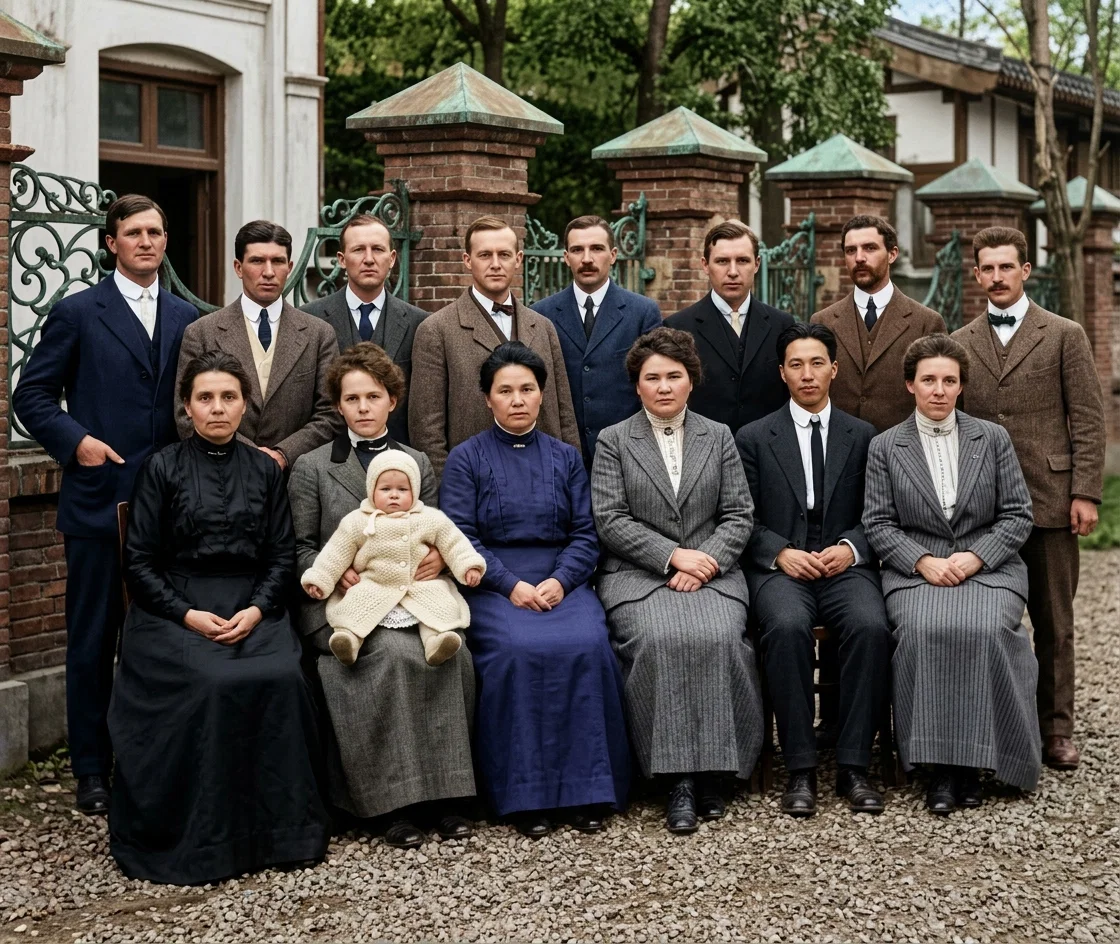
If we should look upon the work of Union College simply from the standpoint of having created several thousand dollars’ indebtedness that must be taken care of, we might draw the conclusion that the college has not very well served her day and generation. But we must not forget to look at another side of the picture. There are assets to be taken into account which can not be estimated in dollars and cents. The college counts a family of over twelve hundred children who have gone out from her walls, and to-day are actively engaged in some branch of work connected with this ever-expanding, world-wide third angel’s message. One hundred thirty-five of these workers are in countries outside the United States. The institution has sent out about four hundred graduates, men and women trained for service, many of whom are occupying positions of trust and responsibility in this cause. The group of Union College workers in China, shown in the illustration accompanying this article, shows the part this institution is acting in supplying workers in foreign fields.
Union College appreciates the opportunity that is now open to her, of sending many of her advanced students to the Foreign Mission Seminary at Washington, where they may receive a special training for service in the foreign fields. It is the policy of the board of Union College to encourage as many as possible to avail themselves of a course of training in the Seminary before entering upon work in other countries.
The establishment of schools in the various conferences in the Northern and Central Union Conferences serves to hold a large number of students in the lower grades who have heretofore attended Union College. While the college has suffered a temporary financial loss because of this, she is beginning to realize gain in another direction, which will be increased as the years go by. The holding of students in the lower grades in the conference schools, many of whom receive an inspiration for a higher education, is certain to result in the attendance at Union College of a more mature class of students, and this is seen already. The young men and women in attendance at Union College during the past year were of a more mature age than those of any former year, and did a higher grade of work.
It is believed by those who have studied the situation most closely that if all our conference schools would adopt the courses of study recommended by the Department of Education of the General Conference, doing the strongest possible work in those grades, and then turn many of their students to our training-schools, it would immensely strengthen the work of our denominational educational system. It is only by compromising what seems to be local advantages for the more common good of a system as a whole, that the highest and best results are obtained. Our educational system, which is ordained of God as an important factor in the third angel’s message, will suffer loss, and we shall not realize the full benefits from the system, until a uniform basis is adopted. If all our intermediate schools and academies would bring their grades into harmony with the recommendation of the General Conference, doing strong work in those grades, all these schools would be filled to overflowing; they would be meeting their operating expenses, would be turning hundreds of students who finish these grades toward our training-schools, thus enabling them to meet operating expenses, and the world would be attracted by the beauty and harmony of the educational system connected with this third angel’s message.