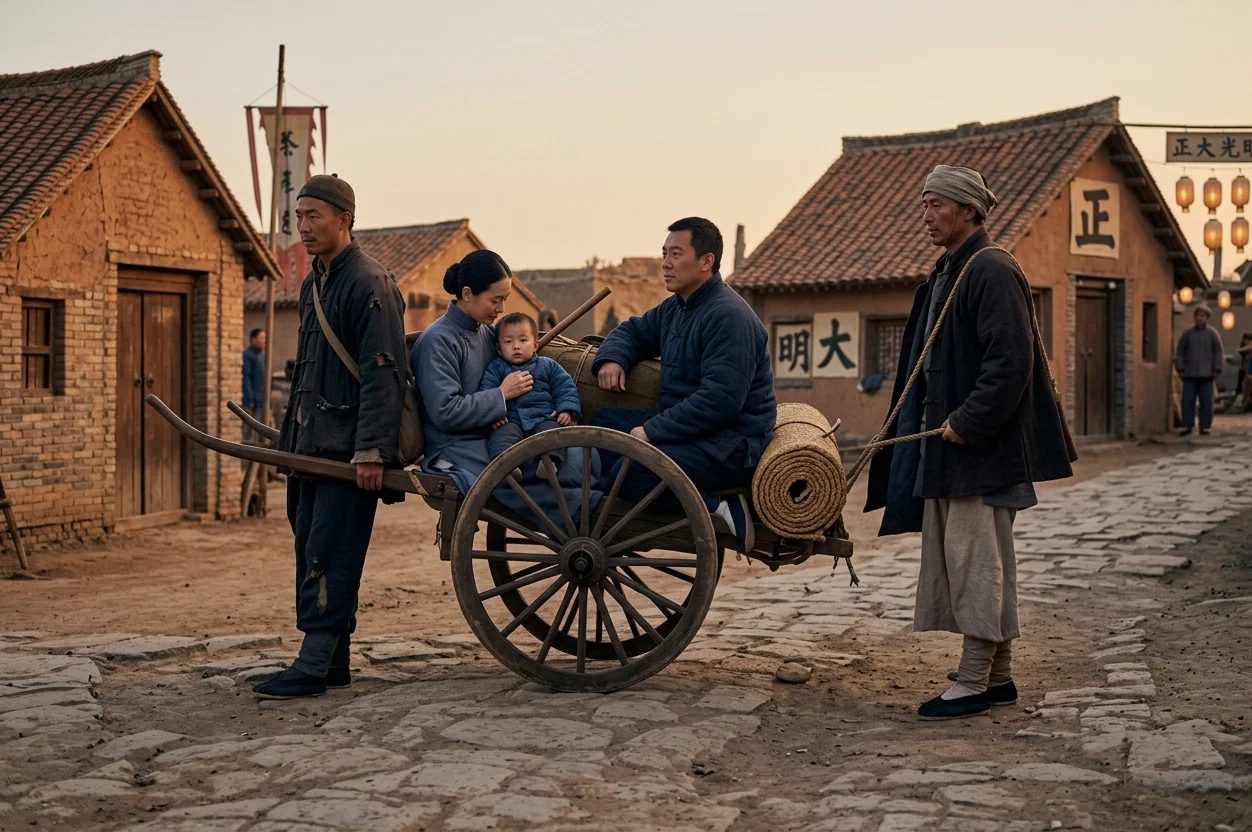
DURING a visit to our mission station in the province of Honan, it was decided to make a short journey to a small city about twenty miles distant, where an interest to hear the truth had been awakened. Our only practical means of conveyance was a Chinese wheelbarrow, which is to Central China what the railroad is to America. It is no uncommon sight to see a train of twenty-five or thirty barrows, loaded with freight or passengers, slowly wending its way along the narrow, rough, and crooked roads of China. Thus communication is kept up between villages, cities, and even remote parts of this section of the country. South China has sampans and sedan-chairs, while in the north mules and carts take the place of wheelbarrows.
TRAVELING BY WHEELBARROW IN CHINA
Our first step was to secure a wheelbarrow outfit, which was a little difficult, it being Chinese New Year, a period of about three weeks at the beginning of their calendar year, during which time all the people as far as possible give themselves to holidayism and vacation, so much so that nearly all the wheels of activity are brought to a standstill. But money has its magnetic power in China, as elsewhere, so our desired barrow was forthcoming when the chief driver was promised twelve hundred cash, worth about sixty cents United States currency, but a stiff price for the trip, which required two days, going and returning.
In general, the Chinese wheelbarrow is like that of the United States, but in point of size the latter is a mere dwarf. It has a frame built upon it large enough to accommodate two persons, with their hand luggage and bedding so distributed as to afford a very comfortable place on which to sit or lie, as inclination prompts. The propelling power is of course human Chinese brawn, under favorable conditions augmented by large sails. Behind is a Chinaman with a large strap passing over his shoulders and attached to the handles, balancing and supporting the load, while in the front is a second man working between handles similar to those behind, balancing and guiding. He, too, has a strap passing over his shoulders and hitched to the body of the barrow, answering to traces, with which the load of four or five hundred pounds is lifted forward.
This, let it be remembered, is first-class wheelbarrow accommodation, a real luxury as compared to second and third. Second class affords less room and speed, the conveyance being smaller, and the propelling power consisting of one man, or, at best, with a boy or cheap man in front, pulling with a rope. The third class differs from the other two chiefly in that it is what we would call a mixed train, carrying both passengers and freight—men, women, or children on the one side, with an equal weight of dried fish, poultry, pigs, or produce on the other.
As stated, ours was first class, which combined both speed and comfort. Thus provided, we—Mr. Pilquist and the writer, accompanied by four native believers —proceeded on our journey across the country, which is beautiful even in February, this great plain beginning at the southern border of this province, and stretching away to the northeast for hundreds of miles, far beyond Peking.
The day was bright and clear and warm, not unlike the sunny April days in Michigan and Wisconsin. It was spring in this part of China, and while very little spring work had yet begun, the rich, garden-like fields, cut up into small crazy-quilt patches, were green with wheat and peas, which are sown in the fall, and harvested about the end of May. Whatever else may be said of the Chinese, one thing is certainly true—they know how to till the soil.
After a short, brisk walk out of our city, across the river, and past many nestling villages, which, as a rule, surround a Chinese city, we found ourselves on the main road leading to the place of our destination. Here our train made its first halt, which was instantly improved by the barrow drivers, who took a few whiffs at their pipes and drank a cup of weak tea, whereupon, removing their outer garments, they set themselves to their task. With some reluctance I was persuaded to mount the wheelbarrow with Mr. Pilquist as a balancing factor. As I have before stated, passengers may either sit or recline, and as the latter seemed most convenient, we took to that. The coolies bent their backs to their burden, and the load moved forward.
As the Chinese never lubricate their barrows, a groaning, creaking noise is made with every revolution of the wheel, which I almost imagined had a softening influence on the jars and jolts occasioned by the wheel bumping over stones and rough places in the road. Thus we were provided with a species of music gratis, which, though somewhat unpleasant and monotonous, served to neutralize other even more distracting features. If one is endowed with the right kind of nerves, or with no nerves at all, it acts with a soporific effect, inducing rest and sleep. I must add that the Chinese omit the oiling element from principle; first, because the groan of the wheel, according to their belief, puts to flight the evil spirits which may be—indeed, are sure to be—skulking about; and in the second place, it is economy in the matter of money, if not of muscle.
If the readers of this paper could hear and feel the ghostly groans of these wheelbarrow trains, it might not be so very difficult to believe that evil demons might be either frightened or disgusted into precipitate flight.
But, to resume, our journey progressed well. The barrow proceeded at the rate of about four miles an hour; meanwhile I felt myself growing drowsy as I lay stretched in the warm, genial sunshine ; and despite these adverse conditions lost myself in sleep. It was only for a moment, when, with a vigorous jolt of the wheelbarrow, I was suddenly and abruptly brought back to the world of sense and consciousness.
Regardless of my rude awakening, the men with steady and firm pace urged on along the tortuous road, here and there turnpiked, varying in width from four to seven feet. It was about as crooked as one can imagine, and this is neither accidental nor incidental. These same evil spirits are believed to travel in a straight line, hence all roads and paths are made devious and tortuous in order to confound the invisible monsters. The same is true of hedges; and even houses are so built that the spirits in seeking to enter are liable to strike their rectilinear heads against some opposing object; which, although it never results fatally, yet so confuses them that in bewilderment they beat a hasty retreat in the same straight line. This is another illustration of how the Chinese bulldoze, browbeat, and bribe their multiform devil, who, by the fear and terror he inspires, becomes the veritable god of the Chinese.15
After a ride of about five miles, we reached a small wayside inn, near a massive, well-constructed stone bridge over a small stream. As is common in China, large, engraved slate slabs fixed in brick columns set forth the name and merit of the man or men who by their liberality and public spirit caused the construction of the bridge. All such matters as bridge building, constructing and repairing roads, receive no attention from the government, but depend on private enterprise. Here our train halted, and we alighted simultaneously, lest our car be capsized. The drivers again filled their pipes, and quietly seated themselves for a smoke on some wooden benches, under a straw canopy provided for just such travelers as we. The rest of our company, except myself, who had not learned the art of improvising a sorghum mill, bought, with two or three cash apiece, a stalk or two of sugarcane, with which, like true Chinamen, they revived their flagging energies.
A short rest, and again we moved on. This time two others had their turn at the soft seats, or more properly beds, on the wheelbarrow. The next halt was for tiffin in a small village. It was about half way. After satisfying our appetites, some time was spent in distributing Gospels among the people who gathered about us; although a copy of any one of the four Gospels was offered for about one-fourth cent, few felt able to purchase. Some, of course, are not able to read.
We reached our destination about 4 P. M., and were at once ushered into humble but comfortable quarters, which had been specially prepared to receive us in the event of our returning with the messenger who had been sent out by a small company of earnest inquirers after truth with the request that a gospel teacher come to instruct them. Without delay the native evangelist who accompanied us sent out his card—a slip of thin scarlet paper bearing the three characters of his name in a perpendicular line down the center—to a number of his friends who hold official positions in the city. Many callers came in response, and they circulated the announcement of a gospel meeting to be held that evening.
When the evening service was opened, the people came in to the number of fully two hundred, or until the standing room was occupied. It was a motley crowd of men and boys, with a few venturesome women, who were admitted because the gathering was in a private house. There were the poor and the rich, docile peasant clad in wadded garments of blue cotton, and dignified mandarins in rich silks and soft furs. All alike listened with rapt attention while the evangelist gave a short sermon on The Commandments of God Versus Traditions of Men. Brother Pilquist followed with an exhortation, after which the evangelist in a most touching and striking manner related his own experience in accepting the gospel message, urging as a final argument that if God could save him, he certainly was able to save these his friends. Early the next morning the chief mandarin of the city sent his card with an invitation for us to call at his yamun, where we were received with true oriental hospitality. He, in common with many other leading men of the place, expressed the desire that a gospel mission be opened in their city.
The Chinese may be far behind the Western world in mechanical invention, science, and art; but as to their need of Christ and appreciation of his gospel of salvation when once it has appealed to their darkened minds, they are on an equal footing with ourselves.