Canton From Day to Day

5%

Review and Herald Publishing Association · Washington, D. C. · Sep 17, 1903

FromReview and Herald, Vol. 80, No. 37.

Read the full edition

Canton From Day to Day

MRS. J. N. ANDERSON
Coming to China has cast us into a strange new-old world so foreign to that in which our lives have been spent as to make us almost feel uncertain of its reality. After several months of study it is still only an occasional word of the ordinary rapid conversation that appeals to our ears. I am therefore unable to form correct estimates of things Chinese in a general way. I can speak only of what I day by day see going on about me,—sometimes things that are strange, much that is charmingly simple and natural intermingled with the grotesqueness of heathenism, and often that which is pitifully miserable.
Our present home is on the south side of the city of Canton, facing the Pearl River three miles down stream from the foreign settlement, known as the Sha-men. For days together we do not see a white face except as we go up for provisions and mail, or visit some missionaries, but are daily surrounded by a teeming native population. It is just the place to study Cantonese,—this multi-millioned metropolis of southern China,—and plenty of people there are with leisure to give “the foreigner,” as he seeks to practice what he thinks he has learned, while he probably speaks but a small fraction correctly, and much there is of interest about us to lead us out into the narrow streets, and to call out all the language we are able to command.
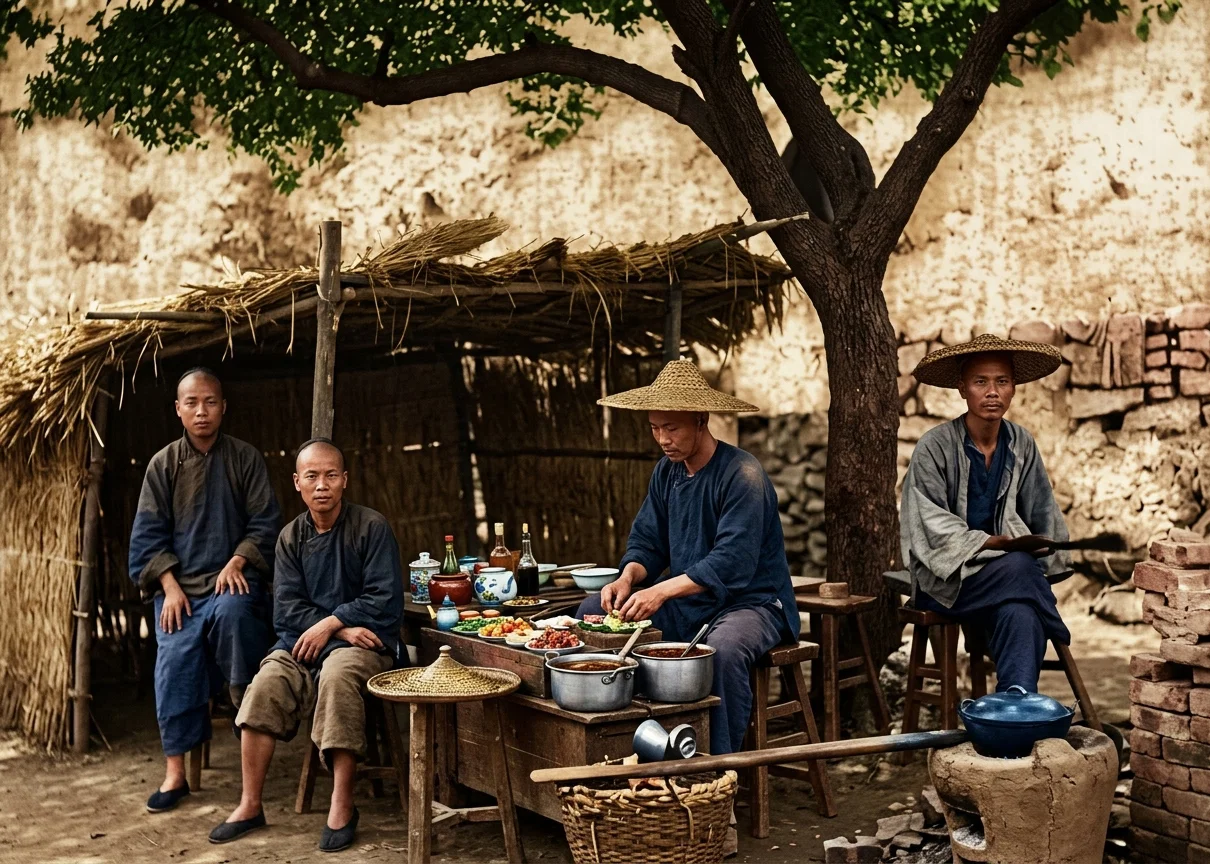
A BOOTH RESTAURANT IN THE STREET
Two days ago we set out in the morning before breakfast for the flower garden, about the length of three city blocks in distance, to get some plants for the small inclosure we call our garden. Passing up the street, the Pearl River, bordered with a deep fringe of house boats along its bank, and its bosom alive with all manner of craft—junks, sampans, fish boats, leper boats, merchantmen, and the largest gunboats of the Chinese southern fleet, from whose flag staffs the great black dragon on folds of yellow silk speaks imperial protection to all,—lay on our left. These sampan people, as that part of the native population which lives in boats is called, are a class by themselves, always full of interest. Each boat is a home complete, supplied with all that is necessary to this mode of life. That small, dirty boat is a local ferry. The woman sits under her broad bamboo hat, one hand on the big oar, waiting for her boat to fill with passengers, when she will take them across the river at the rate of five cash (one-fourth cent gold) per capita.
This boat next the wharf is fairly alive with youngsters climbing over the top, down the sides, and hanging over the deck, the balance of probabilities in favor of a tumble into the water. The tiny maiden, with freshly oiled hair tied with an abundance of pink cord, wears a wooden float dangling on her back, as a precaution in case she should fall overboard, while the wee one of all is fastened into a sort of go-cart, against which he struggles till his spunky cries bring some one to his relief, when he is bound to the back of an older sister or brother, there to join in the general scramble. The wife dips up a bucket of yellow water from the current, and proceeds to wash a dish of rice with one half of it. The other half will be used to boil it in, and this with some green vegetables or a bit of salt fish, with which the father will presently return, will supply a satisfactory breakfast. The chickens, from a coop on the rear of the boat, set up a noisy cackle, thus signifying their willingness to contribute to the family support. In the meantime, as the boat is scrubbed, and the preparations for breakfast go on, the mother as priestess of the family touches fire to a few sticks of incense, and sets them at the bow of the boat, and places another smoking emblem before the wooden idol at the stern.
Presently there is an unexpected stir among the boats, and we hear a panting from behind us, then at a given signal a sedan chair is let down near the wooden pier, and the occupant steps out. A fine-looking specimen of the better class he is,—rather tall, erect, almost commanding in bearing, with well-cut features, clear olive complexion, bright dark eyes, and a heavy, glossy black queue falling down his back. The long, pale-blue silken robe falls down over creamy silk trousers so low as just to clear the feet, which are clad in snowy-white stockings and black satin slippers. Servants bustle about, seemingly anxious to render at least some slight service, if only to lift the silken skirt as he steps from the chair. A bundle of lacquered boxes, camphor-wood chests, bundles tied up in big, bright-colored kerchiefs, and baskets of food, let down near the chair, indicate that he is about to set out on a journey; and now a boat is required to row him to the steamer landing. That one on the outer edge with the decks so freshly scrubbed, the seats covered with fresh, new matting, and the bright interior walls draped with scarlet cotton decorated in gilt figures, is the one that will doubtless be chosen.
A few paces farther on, an old, worn-out house boat rests on the river's bank. The broken hulk can scarcely support the rickety, arched framework, over which is spread the tattered matting roof. Inside is a bunch of straw, over which are thrown the remains of wornout garments, two cracked bowls, a teacup, a pair of chopsticks, a small earthen teapot, a blackened cooking utensil, and a small burnt-clay stove. Here a little, thin, old woman sits all day on her heels, with her long, lean arms hanging over the bony knees. The attitude, together with the almost expressionless eyes, and prominent jaws protruding from between the sunken cheeks, offer a suggestion not pleasant to entertain. This is one of China's homes for the aged, and the sampan people are its principal benefactors.
On that pile of stones under the cool shade of a ban tree a group of sampan girls have gathered to enjoy a rest from the cramp of the boat, and to chat awhile, perhaps about a new bracelet one has bought, or about the gaily bordered suits they are preparing for the coming dragon-boat festival. One rests her head on another's shoulder, and gently strokes her hands, while others entwine their arms in the schoolgirl fashion of more highly-favored lands.
The right side of the street is lined with places of business, most of which have the homes of the occupants either in the rear or overhead, or as is the case in the smaller shops, the place of business is one with the home, and is probablyoccupied by several families.
In that section of the street where it is broadened by a turn in the river, mat sheds have been erected in the middle of the street. Some are open booths occupied as restaurants, but by far the greater part of them are closed in all around, leaving only an entrance, through which an almost constant stream of men and boys is passing, and the click, click of metals and the clank, clank of bone, mingled with noisy and angry voices within, tell us these are gambling booths. So early these places are thronged, and what might appear to be the overflow has gathered in groups here and there on pieces of matting spread on the tile pavement, eagerly pursuing this national vice. Here is a stand where men and boys shake dice for the rice-flour pancakes baked by the man at the griddle. Another stand invites passers-by to venture their few remaining cash at a species of wheel-of-fortune, offering prizes of preserved dried fruits or ginger root, while a runner from the lottery down the street cries tickets of fabulous possibilities, loud enough to be heard above all. Across the street, under a mammoth umbrella made of thatched palm leaves for a top and a bamboo pole for a stalk, is a portable lunch counter, where weary toilers may buy a cup of tea, a bowl of rice with relishes unmentionable, and squat anywhere on the ground to eat it.
We were just at the entrance of the garden, where long rows of flowering plants stood waiting in the morning sun. There were the showy dragon-boat flowers, brilliant with scarlet clusters; long ferns, cool palms, the Bak Yuk Lau (Magnolia conspicua), perfuming all the air with the marvelous fragrance of its white waxen buds tucked away under the glossy green leaves; and there, most of all, the long-coveted beautiful white lotus plants, folding and unfolding their ample green leaves to the play of passing breeze, and lifting graceful, nodding heads of snowy white. It was such a delightful prospect in contrast with the street through which we had just passed that our steps began to quicken with anticipation, when a peculiar sound drew our attention to the opposite side of the street. There, on a pile of logs lately drawn up from the river, crouched nine wretched lepers, each with a brown earthen dish with which to solicit cash or food to eke out the existence of the poor decaying bodies that are literally falling to pieces while they stand on their feet. Two were women, seven were men, and none of them advanced in years. Several had lost parts of their feet, and had left only poor stubs on which to hobble about. Others had so little of their hands left that both were required to hold the dish. In other cases the hands remained red and swollen, while part of the face—the nose, an ear, or a lip—was gone. Their soiled and tattered garments were not sufficient to conceal the fact that from the top of their heads to the soles of their feet they are living realities of Isaiah's picture—“wounds, and bruises, and putrifying sores.” Next to impossible to dress the hair, they neglect also the care of the entire body, in order the better to beg.
Perceiving that our attention had been arrested, one reached out his dish, banteringly calling “Cunnshaw.” Sometimes they become really saucy, and seek by thrusting themselves into close proximity to intimidate people into giving large alms.
Only a few steps away at the base of another pile of logs, sat another victim of some fell malady. His emaciated body inclined against the hard wood, and the shrunken limbs stretched out upon the matting bed upon which he sat revealed the feet, thick and swollen. At the side lay a broad-brimmed splint bamboo hat and a brown earthen dish. He said nothing, only looked appealingly from great black eyes set in sunken sockets. What could we do? We did not know the nature of his disease. Perhaps friends had placed him there to receive the benefit of the morning sun. To attempt to do anything might be considered an interference. Remembering repulses we had met on other occasions, we felt compelled to pass on and leave him to his hard lot. But urged by the memory of those eyes, I again passed that way later in the day. Yes, he was still there, and the street was well-nigh deserted, so I passed nearer, and as the pinched face turned upward, I inquired, “Are you ill?”—“Yes, very ill,” he replied in a hollow voice, and then hesitatingly reached out the dish.
Some boiled rice is just what he needs, I thought, and with a promise to bring him something soon, I started for the nearest respectable eating house, feeling this wiser than to bring something prepared at my own home; but no rice could be had at that hour. The only thing available was some good bread. It will satisfy hunger, I thought, so I took a loaf, but I could see a shade of disappointment pass over the pale face as the trembling hand received the gift.
Next day I came again. He was not there, but the piece of matting lying just where it lay before, the battered hat and the empty brown dish gave clue to the sequel. Seeing me pause, the man at the shop across the way came out. “He died last night,” he replied to my inquiry. “I saw you give him the bread; I gave him some tea, but he was too ill to eat,” he said, as with one foot he brushed aside the paper wrapping to show that but a small part of the loaf had been eaten. And thus he died, died a heathen, alone in the street, at night.
China is dark and desolate. The case I have mentioned of a man lying at the roadside for several days, and finally dying there alone, would be an impossibility in a gospel land. And a group of lepers, all in the advanced stages of the disease, begging about the streets, suffering privation and want, and endangering the health of the community, would not be allowed. But the tender, pitying love of Christ, the sympathetic ministration born of his gospel, have been shut out of men's hearts, and much of pride and selfishness has taken their place, and grasping officials, I am told, squeeze the imperial allowance granted for the support of leper villages, till the inhabitants are forced to the city to beg for support.
Your hearts were touched by the appeal Mr. MacWade, the American consul at Canton, made in behalf of the famine-stricken Province of Quangsi. There have been two successive crop failures. Men are selling cattle, houses, and gardens, yea, and wives and children, that they may be able to buy food. Children sell for five cents a pound (Mexican silver), while rice costs thirty cents. Men, women and children are starving by the cities full. Such was the import of the message he sent the American people several weeks ago, and back over the wires came a swift response that meant five thousand dollars U. S. gold, to buy them food. Boat loads of rice are passing up the river to the relief of the suffering people.
But do you not know there is a famine all over the land? Not one province, but an empire of four hundred million souls is involved. Not a famine for bread,—that were sad enough,—but the spiritual starvation, the soul agony, of a great nation “having no hope and without God in the world.”
Canton, China.