Good News From Sumatra

4%

Review and Herald Publishing Association · Washington, D.C. · Oct 1, 1903

FromReview and Herald, Vol. 80, No. 39.

Read the full edition

Good News From Sumatra

MARCELIA A. WALKER
The Lord has given me plenty of work and excellent success since my arrival here. The people were waiting for relief from sickness. I never knew the treatments to help the sick so quickly as here. Patients with temperatures varying from one hundred and five to one hundred and six and one-half degrees were entirely relieved with one thorough treatment. I know this success comes only through the power of the Great Physician, under whose direction I am working. Whenever a disease peculiar to this climate, and of which I know nothing, is brought to my notice for treatment, all I have to do is to go to the Physician, and he directs me what to do. In this way I have had success where a cure was never before heard of.
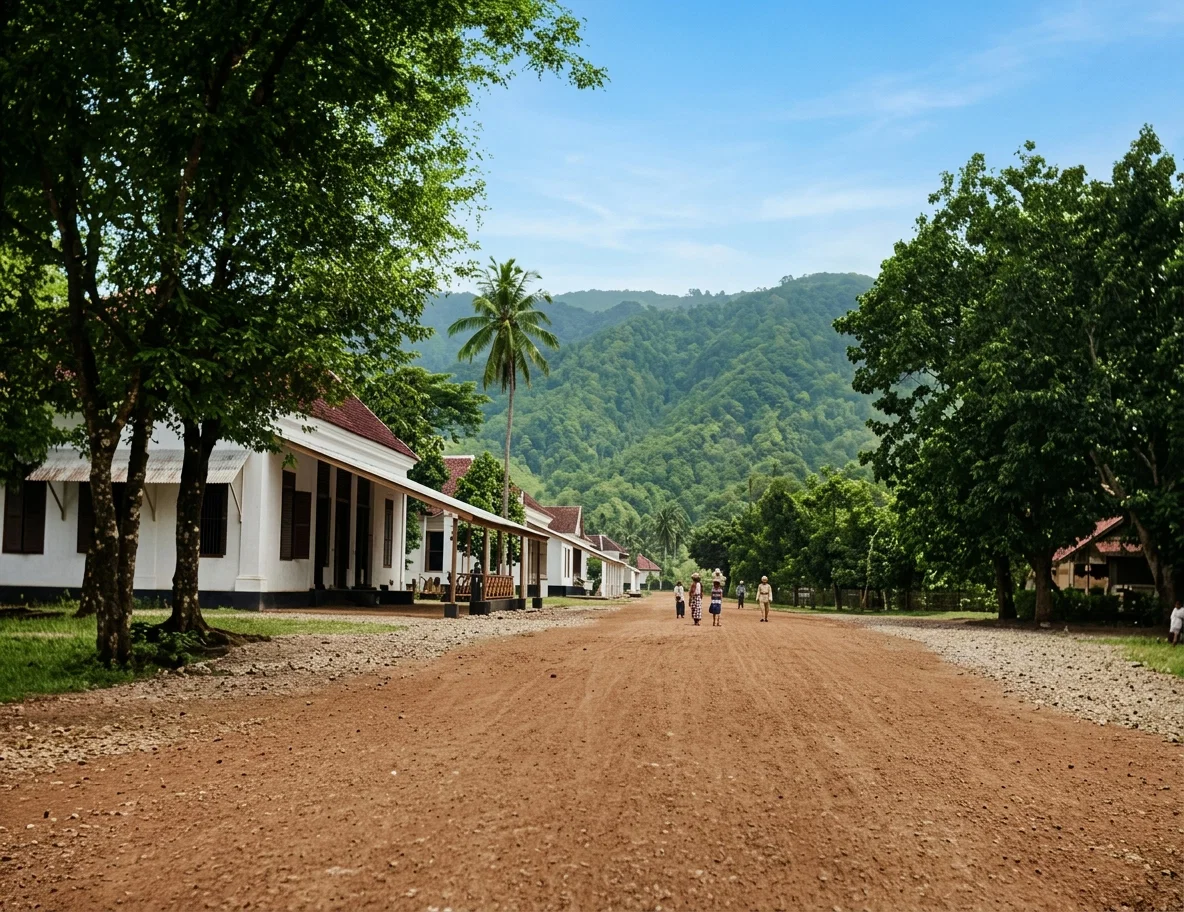
GOVERNMENT HOUSES, WEST COAST, SUMATRA
I enjoy the climate here, and have not suffered the least from the heat, although I am often out during the hottest part of the day. The nights are always cool. I sleep under a double woolen blanket every night, and am none too warm.
The water is pure, though not very cool. The vegetation is luxuriant. I never saw a prettier place than Padang. Each side of the street is lined with beautiful trees. The dwelling houses are usually set back a little from the street, with pleasant drives leading to the verandas. The houses are low, and rather open, with large roofs reaching out several feet beyond the walls. This keeps the rooms cool. The principal parts of the houses are the verandas and bedrooms, the front veranda being used for a reception and sitting room, and the back veranda for a dining room.
The beds are hard, consisting of a cotton mattress, without springs, and covered with a sheet. The blankets used for covering are folded during the day, and laid across the foot of the bed. Each person has a separate blanket. Between each two persons is a long, round bolster. This is much better, and more healthful, than our beds at home, as it is nearly the same as each person having a single bed, as many do have.
The native dress is also healthful. The outer garment consists of a short kimono and a large, straight piece of stamped cloth, folded for a skirt, and held in place by a girdle usually, though pins may be used instead. The women hardly ever wear anything on their heads when going out, as it is much cooler to carry a parasol.
Many friends have asked what we have to eat. We have excellent opportunities to live healthfully. Bananas and rice are two of the staple articles of diet, although we have many kinds of fruits and vegetables not known in a temperate latitude. We also have beans, peas, corn, white bread, squash, and both Irish and sweet potatoes. In nearly every yard can be seen cocoanut trees. Peanuts grow here, so we make our own nut butter. The dammer nut is excellent for cooking purposes. Cocoanut oil is cheap, and when fresh has a very pleasant flavor. From the stores we can buy all kinds of crackers, rolled oats, barley, etc., but nothing can take the place of rice. There are many excellent ways of cooking it, of which we know nothing in America. The best way, I think, is to let the rice come to a boil, then place it over a slow fire until quite soft, then add cream made by pouring a cup of water over fresh shredded cocoanut; press and strain, add another cup of water, press and strain again, pour over the rice, and let it come to a boil.
Meat is used in small quantities by the natives, but they spoil their food by pouring hot curry sauce over everything. They also eat many cakes and sweetmeats, made from a gelatinous rice rich in albumen, and from sweet potatoes, sago, cocoanut, sugar, flour, bananas, fruits of different kinds, etc.; so these are much more healthful than our home sweetmeats.
The Dutch people, as well as the natives, wonder when we tell them we use no meat, fried foods, tea, coffee, peppers, and very little sugar. But they can say nothing when they compare Brother Munson's children, fat and rosy cheeked, with their own thin, puny, pale-faced families. One of the greatest trials we have to deal with in treating the children is their having no constitutional strength. One day they may have a little cough, or may vomit once, and the next day they may be beyond help; so often no help is called. This is especially true of the Chinese families. Out of twelve children the mother will frequently have only one or two left. I am convinced that a proper and regular diet would remove the difficulty. We must first win the confidence of the people. This can be done only by kindness, sympathy, and help in bringing their sick back to health. Then we can teach them how to live healthfully, and of the Saviour's love.
As I can not speak the language well yet, Sister Munson goes with me as interpreter, and carries a Malay Testament, and reads or talks to the people while I treat them. Often we have prayer before we leave. Thus a double work is carried on. In this way a home has been opened where Elder Munson can hold meetings in the Chinese quarters. We had been asking the Lord to show us a place in which to hold meetings, and he used the health work as the opening wedge.
When giving treatments, a crowd will often gather around us. Many disparaging remarks are sure to be made, which sometimes frighten the family. But the good effects of the treatments, if we are allowed to continue them, soon remove all fear.
One mother begged us not to put water on her child, as Chinese children were different from white children. But she still wished me to take the case, as it was her only hope. The child's temperature was one hundred and six and one-half degrees when we arrived. After a thorough enema and bath, with ice to its heart and head, we had the temperature down to normal, and the child slept immediately afterward as it had not slept for four days.
The doctors here are not in sympathy with this work, but can do nothing, as the work speaks for itself, and we charge no fees. The people often give us presents to help support the work. One successful case will be talked about formiles around,—at dinner parties, receptions, on the train, and everywhere. Our work at Fort de Kock, seventy-five miles away, had preceded us to Padang long before we arrived.
Satan tries to put hindrances in the way of the work here as elsewhere. But these, by faith and perseverance, can be used as stepping-stones to a greater work. The result of our work soon shows the people that health reform and hydriatic treatments can do more for them than all the drugs in the apothecary shop, their devil medicines, charms, and prayers to Satan, all combined.
Sometimes we make quite an effort to get the people to discontinue their devil medicines, etc., while I have the case in charge. They often promise Satan to serve him better in the future if he will only give them their child again; and he does restore some to health in a marvelous manner. I have several charms which have been taken from the bodies of the sick and given me before I began treating them.
Ofttimes we can strongly feel the powers of darkness about us. But we know that angels are standing ready to help us at the first cry of faith. I am so glad that Christ has met and overcome Satan, and all we have to do is to take shelter under his protecting arm.
In one of the first cases we had, we felt that Satan was working for hours to keep us from winning success. Sister Munson and I had prayer at the bedside of the sick woman, and immediately the treatments had the desired effect. Afterward I learned that Elder Munson was awake at the same hour, and was praying the Lord to strengthen us and bless our labors. The Lord has said, 'If two of you shall agree on earth as touching anything that they shall ask, it shall be done for them of my Father which is in heaven.' His promise has been proved true by us more than once during the past few months.
Every missionary, either home or foreign, needs a knowledge of these life-giving principles of health reform and hydropathic treatments, in order to reach the people. I for one am thankful that I had the privilege of gaining this knowledge. With it we can reach hundreds of homes which would otherwise be closed to us. We need more help—doctors, as well as nurses. Only those who enter the foreign or city mission work know the blessings of laboring in a needy field. This little station is the only one in this whole island world of fifty million inhabitants. Who will come and help us? If you can not come yourself, you can help send one who can come, and you can ask the Lord to strengthen us and bless our labors. We also need means to send out the native helpers as soon as they are ready. I am thankful that the Lord allowed me the privilege of coming, and thank the brethren and sisters who helped to provide the means.
Elder Munson has a little home school, to help pay the expenses of the mission, and to keep our Chinese helper in the field, and I have the privilege of conducting the class in physiology. It is interesting to see how quickly our Chinese boy catches all thoughts on healthful living, and how he puts them into practise. His father is a doctor. I try to make everything as practical as possible, by illustrating with the native articles of healthful and unhealthful diet and hurtful practises.
We have many interesting experiences each time we go out to visit. I only wish there were more workers to share in them. Jesus says, 'Lo, I am with you all the days, even unto the end of the world.' I know this is true; for we feel his presence and enjoy his blessings. Come and join us in the work, and share the joys with us.
Padang.