THE papal See is not only located in Rome, but here also is the seat of the educational interests of the Roman Catholic Church. Not only one college is located here, but a score of them. From all over the world the students for the Catholic priesthood come to Rome to study. Not all the priests graduate from the schools here, many receiving their training in their native country; but a certain number from each country take their degrees here. There is a college for the American students, one for the English, one for the Canadian, and one each for the French, German, Spanish, Scotch, Austrian, etc. In each of these schools the students are taught in their respective languages, but come together at least once a day for general lectures. These lectures are delivered by the most learned professors of the Catholic Church, who are generally Jesuits. Here the darker doctrines of Romanism are poured into the minds of the young students, and they are inoculated with anti-heresy virus to keep them from catching the disease of Protestantism. And the teachers generally do their work well, as can be testified by those who are working for the conversion of Catholics in every land.
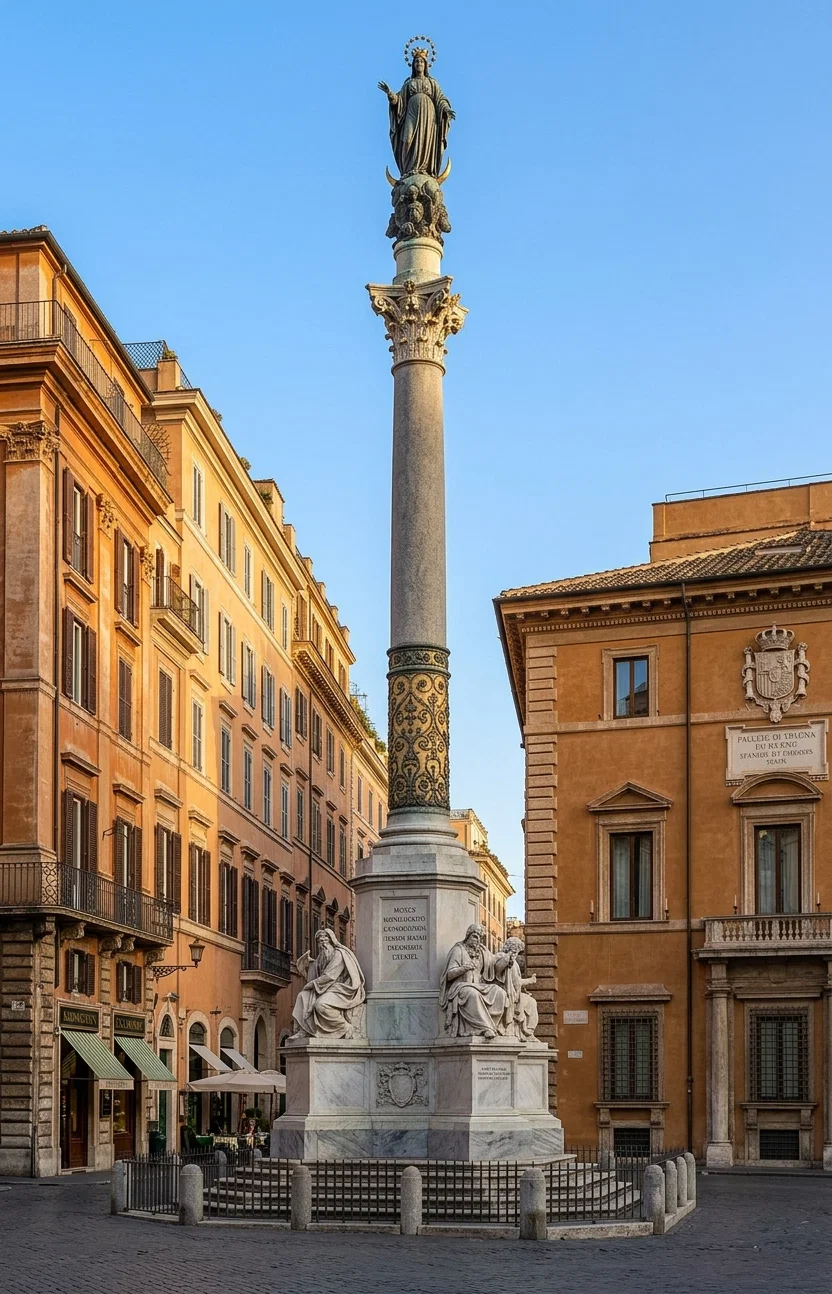
The accompanying picture gives a front view of the building called “The House of the Propaganda,” where these lectures are given, and where several thousand students can be accommodated at one time. The monument in the foreground is a pillar that was erected to commemorate the institution of the dogma of the immaculate conception, which was voted by the Roman Church in 1854. The figure on top is supposed to represent Mary; but any student of the Revelation will recognize in it a representation of the symbol of Revelation 12,—the woman, clothed with the sun, and the moon under her feet, and upon her head a crown of twelve stars.
HOUSE OF THE PROPAGANDA," ROME
One can not fail to be struck with the companies of these students that are a familiar sight in the streets of Rome, going to and from their schools; for they are all robed in vestures of various colors, some in bright red, others in blue, black, and violet, and girded with girdles of as many or more colors. In a place like this where there are brought together several thousands of students from all parts of the world, may we not hope to do something toward winning some of these students for the truth if our efforts are based on correct principles? Many of these students are going as missionaries to difficult places in Africa, India, China, and other fields. Can we say that in this they are all dishonest? May not some be misguided, who would become missionaries for a good cause if they once became converted? There must be some honest ones among so many young men, and the fact that there is a number of ministers preaching the gospel in Rome who were once Catholic priests indicates that there are some who can be converted.
In one of the Catholic churches of Italy there was a parish priest that had a good position, but became convinced that the Catholic Church is not the true church, and his conscience gave him no rest until he left the church; and now he travels over the country with a pack of books on his back, as a canvasser, in order to work for the Lord. There are many who despise the canvassing work, but here is a priest leaving a good position for the self-denying one of canvassing, in order to work for God. So we see that even among the priests there are those who are conscientious, and I believe that some will step out to give the message in these last days to their former congregations. Luther stepped out from the church of Rome, and became a mighty factor in giving the truth to the world in his day. But a greater day than the day of Luther is here, even the day of the Lord. And have we not need of Luthers in this greater day who will leave their priestly robes, and become reformers of righteousness and heralds of the coming of the King?
Not only is one struck in walking along the streets of Rome by the sight of the students for the priesthood, but he can not help but notice the many groups of uniformed children that march in regular order with a Sister of Charity or a Jesuit priest following them. They range in ages from small children to young men perhaps eighteen years of age. They are of both sexes, the boys being in charge of Jesuit priests, while the girls are in care of the Sisters. They march back and forth from their schools and for outings. But they are always in charge of their teachers; for the Catholics have learned that it pays to take good care of the children, and keep them away from adverse influences by watching them closely. On this work of teaching the children, their future prosperity in a country like this depends. They have nothing to expect in way of converting the men and women; for they are already Catholics, or else Protestants that can not be moved. So their great problem is the work among the children. The Catholic education among the children is largely conducted by the Jesuits, who are the deepest-dyed Catholics. They implant in the young, tender minds an everlasting hatred for everything that savors of Protestantism, and consequently the work among Catholics is made very difficult.
This situation shows us the necessity that exists of giving some attention in these Catholic countries to the educational problem among the children. The Methodists have turned their attention in this direction with splendid results. They are conducting a school in Rome where they have about two hundred and fifty students, many of whom are from the finest families in Rome, who are tired of Jesuitical influence over the children. The superintendent of the Methodist work here told me that last year the school paid all its expenses from the receipts from the students, including the salaries of thirty teachers, and then they had a surplus of three thousand dollars to be applied on the debt incurred in building the school. He also said that they had another school of fifty students in another part of the city, and the work was growing on their hands, and this year they expect to use a part of their mission building, where they reside, in which to conduct another school for smaller children.
God has given to us advanced light on15education; and shall we hide this light under a bushel? Here at the fountainhead of the false system of education, should not the light of educational reform have an opportunity to shine forth? Surely the educational work in Rome merits our attention and earnest effort; for it will certainly be a strong factor in developing the work in this place. So successful has the educational work proved among the Methodists, that Dr. Burt told me that the Methodists of America became so enthusiastic about it that they wanted all the missionary efforts bent into this channel; but of course that would be getting the work one sided, and he would not listen to that proposition. But it goes to show that this work is one that should be given serious attention by our people. Let those that are especially interested in this work pray about it, and decide if God is not calling them to the work in “the Eternal City.”