Laboring in Nyassaland

9%

Review and Herald Publishing Association · Washington, D. C. · Dec 24, 1903

FromReview and Herald, Vol. 80, No. 51.

Read the full edition

Laboring in Nyassaland

J. H. WATSON
It has recently been estimated that within the shores of Africa—11,277,364 square miles, exclusive of Madagascar—there is a population of one hundred and sixty-four millions, speaking six hundred languages and dialects. To undertake to give the message of Christ’s second coming to so many millions of heathen people is a work of such magnitude as to seem an impossibility, but God, who directed in the efforts of Dr. Livingstone and other noble missionaries who have succeeded him, has been preparing facilities for the accomplishment of his purpose. Such men as Dr. A. Hetherwick, who has written grammars for two of the Bantu languages, and Dr. Scott, of the Church of Scotland Mission, compiler of the “Cyclopedia Dictionary of the Mang’anja language,” have given us the benefit of their extensive learning; by the aid of such books missionaries coming into the country now have a very great advantage over those who came before these facilities were provided. And yet the question as to how to reach so many tribes speaking almost as many different languages is one of no little importance; it should be well considered by those who desire to come to this country as missionaries, else the fact that it is necessary to learn the language of each tribe for which we expect to do effective missionary work may prove to be a source of some embarrassment and much discouragement.
School work will perhaps always be the most successful branch of work that we can undertake; in fact, it is only by simple, persevering teaching, by those who are willing to work indefinitely without seeing any tangible results, that we can hope to place the truth in its simplest form before these people. It is necessary that they be put in possession of the words and thoughts that would make it possible for them to comprehend the truth.
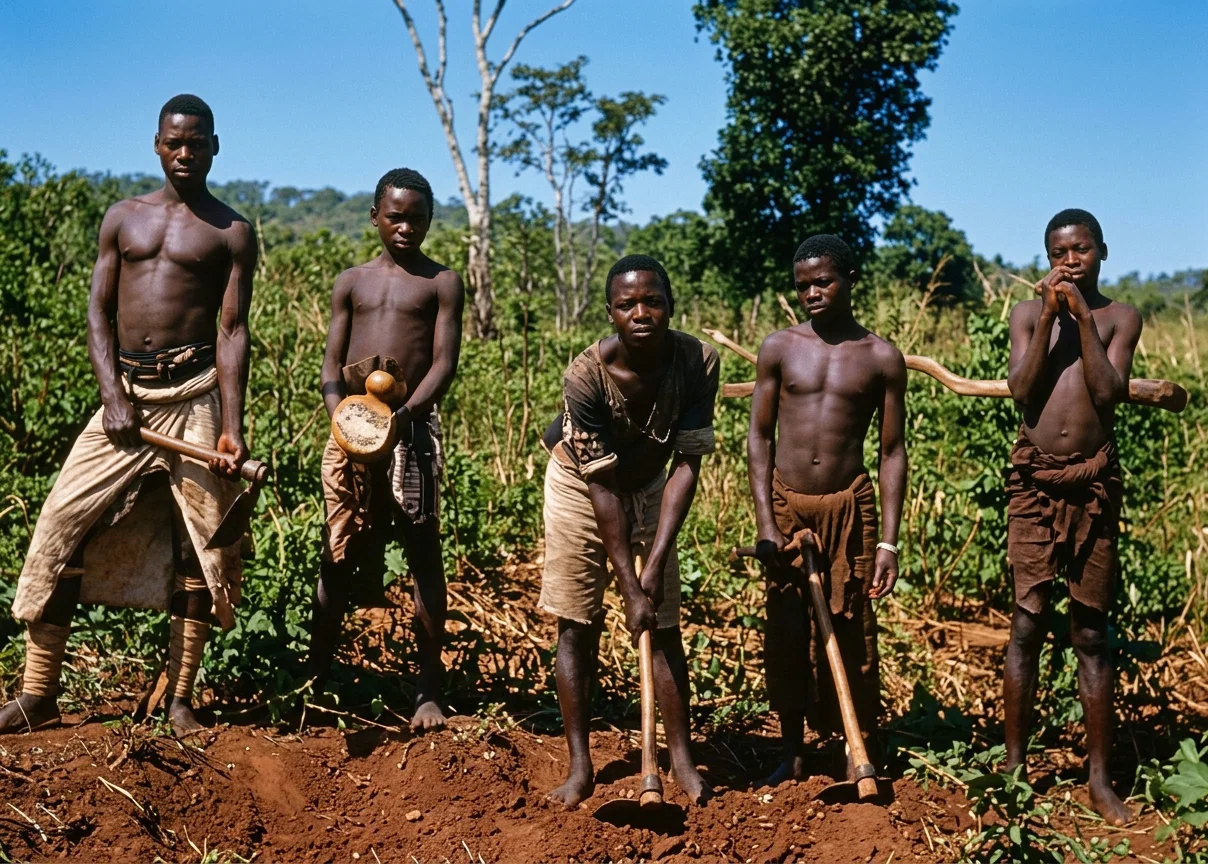
NYASSALAND BOYS PREPARING LAND FOR COTTON
In the locality in which our Nyassaland Mission is established, the Mang’anja or Nyanja language is in most general use. Fortunately, it is spoken not only by the Mang’anja people, but is understood and spoken by at least two other tribes.
Dr. Scott says: “The Mang’anja (people) form part of the great River and Lake branch of the Bantu race, and Chimang’anja is the language of the River or Lake. The dialects of Chikunda, Ambo, Chipeta, Anguru, are but slightly modified Mang’anja. The Mang’anja are related more closely to the Zulu, Kafir, and Congo tribes than they are to the coast tribes as represented by the Swahili, Yao, Lomwe, and others; and their River and Lake descent is well indicated by their name. The first general outlines of the movement and branching of the race are seen in the relation of the languages above mentioned. The movement seems to have been from North Central Africa along lake and river to the south, and the separation from the coast tribes must have been long anterior to the comparatively late separation of Zulu and Congo tribes, and the quite recent branching of the Mang’anja into its various dialects.”
We find many boys from the different tribes who earnestly desire to be taught the English language. While there is a difference of opinion among missionaries as to the advisability of teaching English to the natives, there may be some cases in which this desire may be taken advantage of by using such text-books as teach present truth. When we are prepared to receive them, doubtless the Lord will send us boys who should be trained for missionary work among their respective tribes. This should give opportunity for the exercise of the gift of “discerning of spirits,” as it must constantly be borne in mind that a knowledge of English puts a native in possession of greater money-earning power, and is thus a source of temptation. A native who has a fair knowledge of English can nearly always get work at wages from four to ten times more than the ordinary workman. Nearly all who ask us to teach them English claim that their object is to learn the “words of God,” but it sometimes transpires in a short time that the real object is the pecuniary advantage to be gained.
The chief of a district where we had a native teaching has sent a message asking me to come to talk with him about teaching the children in his village. I am planning to make a trip by machilla. It is about four days’ journey, but I will be able to visit another place that ought to be visited. I have not yet been able to do any traveling, as my time has been taken at the mission. I want to go around as much as possible. It is a severe test for one’s health to travel through the country; as it is impossible to buy any food, one has to carry food with him, and the water to be had is positively unfit for use without being boiled. But we have to risk these things in order to reach the natives.
At present we are conducting our mission and school work on a small scale; even if we were in a position to do more and better teaching, it is not quite clear at present just what is the best course to pursue. Our industrial work, done as it is in the most primitive way imaginable, requires much attention to prevent its becoming a large expense without producing corresponding results. All the work of cultivating and planting the land is done with a sort of hoe with a very short handle. In a civilized country, a man working hard ten hours a day would not accomplish much with this rude implement; the natives can not be hired to work long hours, so it takes a long time for a party of them to prepare and plant one hundred acres of land; but while they are at work, the one in charge should know their language, and “how to speak a word in season to him that is weary.” In the future this industrial mission work may prove to be a favorable opening for those who desire to go to “foreign” lands, but have not had a preparation in other branches, yet who could, with a little assistance, pick up a language and use it as here suggested, thus supplementing the work of the teacher, and from time to time selecting from the workmen for further training in our schools those who might show receptiveness and reliability.
Cholo, British Central Africa.