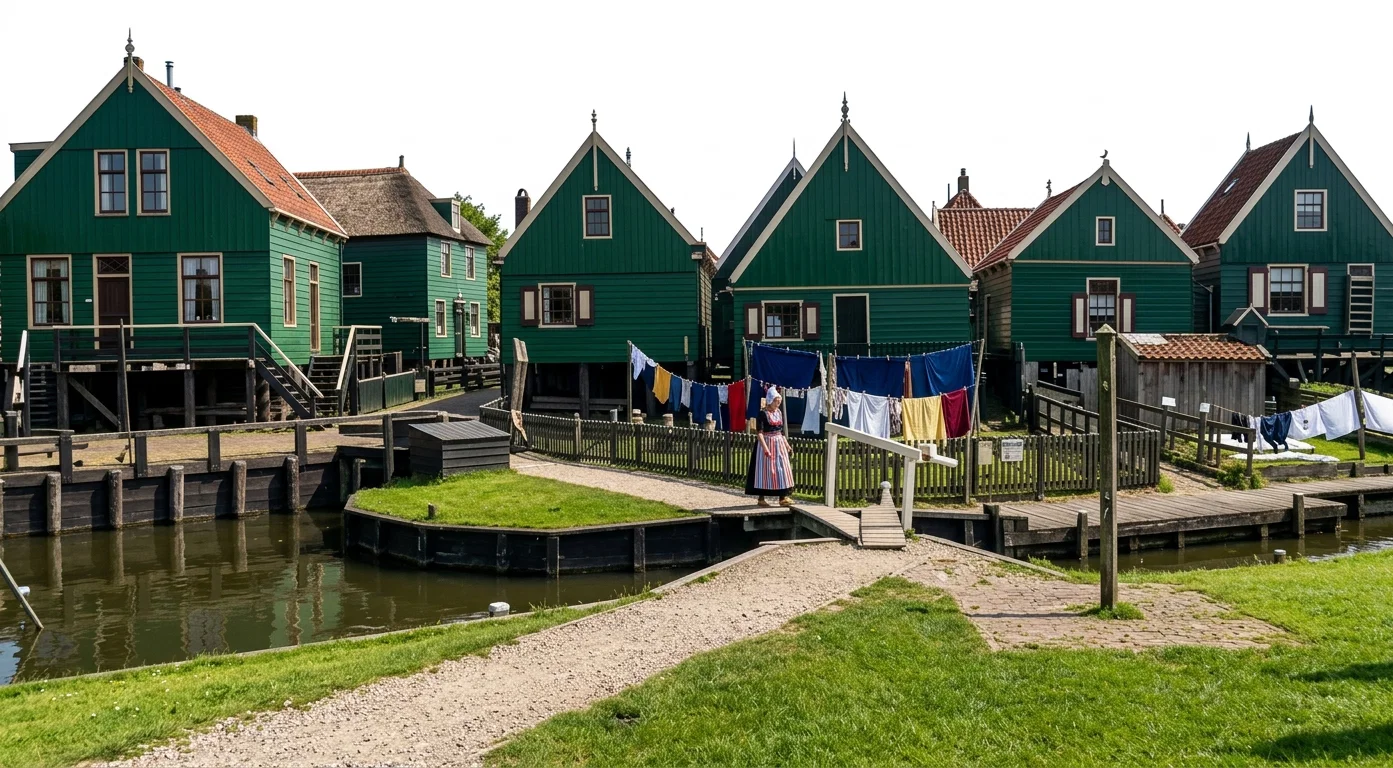
That the reader may more plainly understand our surroundings, as we are here attending the annual meeting of this field, we will give a brief sketch of the city in which we have had the meeting, of the countries of Holland and Belgium, and of the present condition of our work here.
The meeting for the Holland and Flemish Belgium Mission was held in this city, Amsterdam, December 24–27. While The Hague is the seat of the court and government of Holland, yet Amsterdam is the true capital. It contains five hundred and thirty-nine thousand people. It is built on ninety distinct islands, connected by three hundred fine bridges, which gracefully arch the scores of canals that connect with one of the broadest and deepest canals in Europe, on whose waters is borne the commerce of many nations. Most of the houses are erected on piles driven into the wet, sandy ground, so that the inhabitants of the city have been compared to “rooks, or too sandy for use. Wheat and rye, barley and oats, potatoes and beets, are grown; plums, apples, and cherries are the chief fruits. Butter and cheese are the sources of the greatest wealth of the land, which has sometimes been called the “dairy farm” of England. About twenty thousand men are engaged in fishing for the herring, the cod, the turbot, and the soles. England consumes one hundred and twenty million dollars’ worth of Dutch produce every year.
Holland has had an illustrious history. America owes much to the Dutch, from whom came many of their ideas of liberty. The Pilgrim Fathers sojourned in Holland. For the freedom of the Hollanders the noble William of Orange worked and suffered, withstanding the fanaticism and bigotry of the Spaniards in the sixteenth century. It was in behalf of the rights of this country that the sturdy burghers of Leyden endured that famous siege in 1574, when they welcomed the steady inroads of the storm-tossed Atlantic, which they let loose over their low and carefully cultivated fields, to bring nearer the relieving fleet, which brought succor to an almost famished city. During those days of trying persecution, carried on by the wicked Spanish Inquisition, it was the wives of the men of Holland who would “take her stand by her husband’s stake, and while he was enduring the fire, would whisper words of solace, or sing psalms to cheer him.” It was the maidens of these Low Countries, who were able to “lie down in their grave as if they were entering into their chamber of nightly sleep; or go forth to the scaffold and the fire dressed in their best apparel, as if they were going to their marriage.”
As to Belgium, it contains 11,373 square miles, and 6,693,800 inhabitants, fifty-two per cent of whom speak Flemish, and therefore belong to the Holland and Flemish Belgium Mission. The prevailing religion is Roman Catholic; there are about twenty thousand Protestants in Belgium. It contains a number of cities. It is the most densely populated country in Europe. It has rich mines of coal and iron, as well as of zinc and lead. No country in the world is more carefully cultivated than Belgium, and though it is so densely populated, it raises twice as much food as it consumes. It manufactures cotton, woollen, silk, and linen goods, as well as machinery. Since its formation as a kingdom, in 1830, the trade of Belgium has increased more rapidly than has the trade of any other European country. Its chief buyer is France, which receives seventy million dollars of Belgian goods each year. One third of her commerce is transported by water, two thirds by land.
In reference to the country of the Netherlands it has been said: “There is a land where the rivers, so to speak, flow over the heads of the people; where mighty towns rise below the level of the sea, which dominates and almost overwhelms them; where broad tracts of cultivated ground are alternately rescued from, and swallowed up by, the waters.”
From “The Four Track News”
From north to south the country is about one hundred and fifty miles long, with an average breadth of one hundred miles; area, 12,650 square miles (about as large as Connecticut and New Jersey); population, 5,265,000. To ward off the attacks and conquests of Holland’s ever-present enemy, the sea, there are large dunes on the west, and artificially constructed embankments, or dykes, along the rivers; and where the dunes are insufficient along the seashore, dykes have also been built of piles and massive blocks of granite. One of the dunes is one hundred and ninety-seven feet high; some of the dykes are thirty feet in height, and three hundred and fifty feet thick. There are fifteen hundred and fifty miles of these dykes in the country, and it cost over sixty million dollars to construct them. At Utrecht long-continued westerly winds have caused the river to rise eighteen feet above the pavement of the streets. In the spring, when the ice breaks up, disastrous floods are sometimes caused by the giving away of these embankments. The total length of the navigable river channels in Holland is three thousand miles, and there are nineteen hundred miles of canals. Much of the land has been formed by the deposits of the rivers; much of it has been recovered from the bottom of the sea. Between 1815 and 1875 nearly one hundred and forty-three thousand acres was thus reclaimed. To drain the polder of the Haarlem Meer, which contains seventy square miles, required the expenditure of nearly five million dollars; but the value of the produce grown there amounts to about one million dollars annually. They are now draining the Zuyder Zee. The windmill and the steam-engine have a large part to act in this work of wresting the land back from the water’s grasp.
Only thirty-four per cent of the soil of the Netherlands is capable of cultivation; the rest is too low and marshy or too sandy for use. Wheat and rye, barley and oats, potatoes and beets, are grown; plums, apples, and cherries are the chief fruits. Butter and cheese are the sources of the greatest wealth of the land, which has sometimes been called the “dairy farm” of England. About twenty thousand men are engaged in fishing for the herring, the cod, the turbot, and the soles. England consumes one hundred and twenty million dollars’ worth of Dutch produce every year.
Having thus surveyed the territory of the mission, we will now give more minute attention to our own work in this field. There are encouraging omens on every hand. While our membership here one year ago was only thirty-seven, it is now seventy, and fifty of these seventy were at the meeting. The Sabbath forenoon service was conducted by Elder Conradi, and those who desired to confess Christ in public were given an opportunity to do so, and a hearty invitation was extended to backsliders to return. Three went forward in baptism that evening, and three former members returned.16A good social meeting was held in the afternoon.
Brother H. F. Schuberth assisted during the conference. In addition to this, the six gospel workers employed in the field were present, and their experiences strengthened the believers to go forth with more determination than ever to conquer, through the blood of the Lamb. Twelve received permission to engage in the sale of our publications the coming year. The tithe for 1903 in this mission is three hundred and forty dollars; Sabbath-school offerings, forty-eight dollars. Considerable interest was manifested in the German East African Mission, and the First-day offerings during 1904 are to be dedicated to that field.
Since the German Union meeting in Friedensau, we have begun work in Flemish Belgium, at Antwerp, a city of two hundred and seventy-eight thousand inhabitants. Elder Klingbeil, assisted by his wife and a lady Bible worker, has succeeded in securing the regular Sabbath attendance of about six in that city. They have not had a very easy time working among the people, who are in general Catholics. To hear them relate their experiences reminds one of what is told concerning Protestant missionary work in Ecuador, Bolivia, and Peru. Packs of boys have preceded the workers, pushing open the doors, and warning the people against buying the Protestants’ literature. Our sisters have been snow-balled, mud-balled, drenched with pailfuls of water thrown upon them from overhanging windows, cuffed on the cheek by rough and persecuting hands, dragged down the door-steps, insulted and taunted in many ways; but they are of good courage, and have been given grace to suffer and endure patiently, thankful for the preservation of their lives through it all. They find many persons who can not read; some are very ignorant of Christ, and think that, as the mother should have more honor than the son, Mary certainly is entitled to greater respect than is to be accorded to our Saviour.
We believe that more encouraging days are before the workers in Holland. We hope that in Belgium there may be good, strong churches raised up. We trust that the great falling away which occurred in the Holland Mission during the spring of 1902, over the sanctuary question and the binding claims of the law of God, will only serve to impress upon our brethren in Holland, and our friends throughout the whole world, the necessity of our being rooted and grounded in the truth as it is revealed in the Word, for this generation.
The storm is surely coming. We have seen a few manifestations of the power of the enemy of souls; but the unbelief which caused the downfall of about two hundred of our brethren in Holland, will, we fear, still more terribly devastate our churches in general, unless there is a mighty reformation in its individual members, and a thorough return to the prayerful, childlike study of the Scriptures, that, by the power of the Holy Spirit, we may carry out their blessed teachings in the daily life. Persecutions from without assail the church in Belgium, in North Russia, in South Russia, in various parts of the German empire, and in Turkey; but the weapons which will prove our most terrible foes are our own lack of harmony and union and of the study and practise of the Sacred Writings.