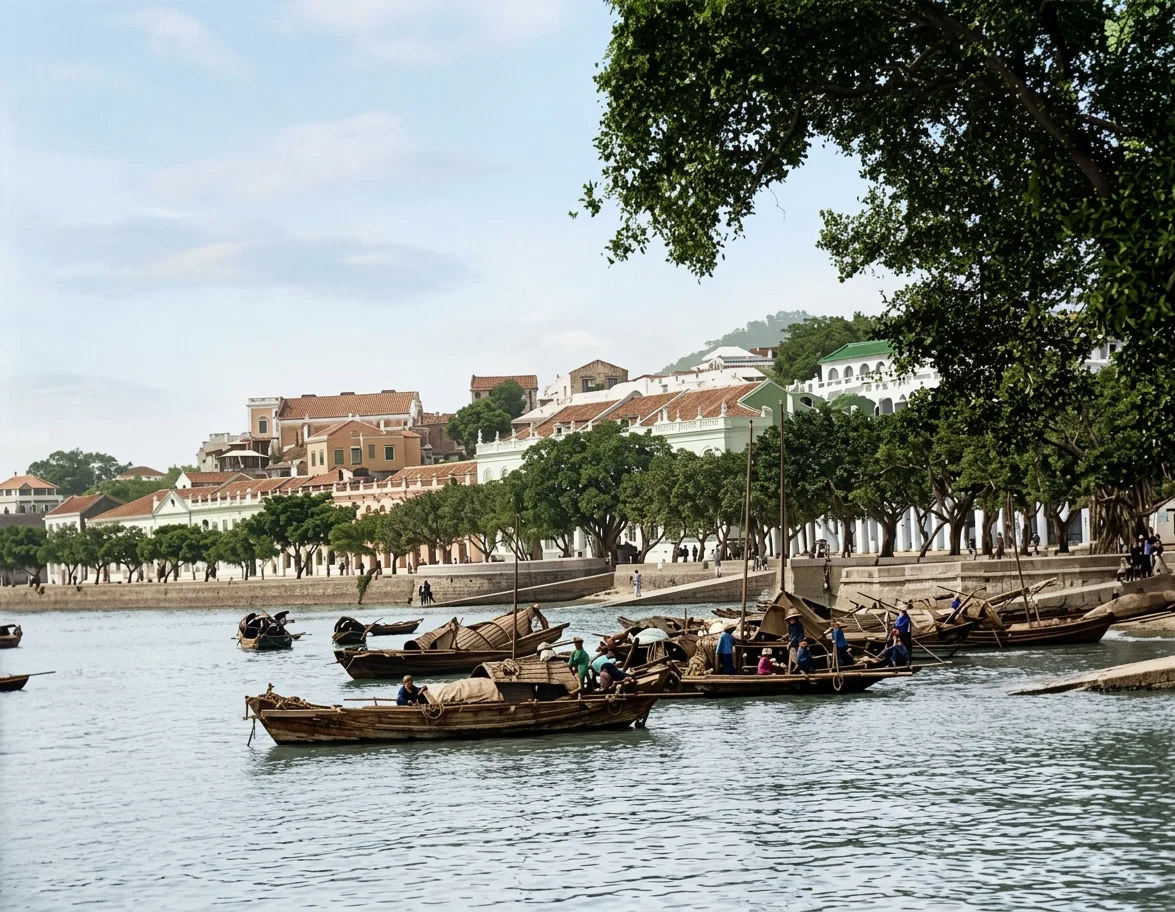
It was my privilege to visit the tomb of Robert Morrison, the first Protestant missionary to China. He was buried in the old Protestant cemetery in Macao. This city belongs to Portugal, and is on a small island near the mainland, forty-five miles southwest of Hongkong, and ninety miles from Canton. When Mr. Morrison came to China in 1807, he stopped at Macao before going to Canton, and the next June, after nearly nine months of hard study of the Chinese language, he was compelled to return to regain his health. The latter part of August he went back to Canton, but as all the English were compelled to leave that city the following November, he again took up his residence in Macao.
PRAYA GRANDE, MACAO, CHINA
It was at this time that he became acquainted with Miss Mary Morton, to whom he was married Feb. 20, 1809. But so strong was the opposition of the Chinese and the enmity of the Roman Catholic missionaries, that he decided to go to Penang and continue his work. Then it was that the East India Company offered him the position of translator of Chinese at a salary of five hundred pounds (about twenty-five hundred dollars gold) a year. This he gladly accepted, as, being engaged in commercial work, he would be permitted to live in either Macao or Canton, and could proceed with his study and work of translation. It also provided a liberal means of support. During the years that followed, his time was about equally divided between Canton and Macao.
Sometimes he was compelled to retire to the latter place for safety, and at other times for the sake of his own health or that of his family. After spending several months of each year at Canton as translator for the East India Company, it was a relief again to be with his family in Macao, to enjoy the refreshing sea breezes, and to have more time for vigorous work on his God-given task of translating the Holy Scriptures into the Chinese language. The first portion to be printed was the Acts of the Apostles, one thousand copies of which were issued in 1810. Other portions were printed later, but under great difficulties, as the Chinese government had made it a capital offense to print books on another religion.
Mr. Morrison had repeatedly urged the missionary societies in England and America to send other workers. The first to come were Mr. and Mrs. Milne, of England, who arrived at Macao, July 4, 1813. But as they came as missionaries, the Roman Catholics influenced the Portuguese authorities to forbid their remaining in Macao, and the Chinese officials did not permit them to stay long in Canton. By this time Mr. Morrison had the entire New Testament printed in Chinese, and it was decided that Mr. Milne should take a good supply of these for distribution in the Chinese settlements at Penang, Malacca, and other East India cities, and look up a suitable location for a mission headquarters, where a printing plant could be set up and an Anglo-Chinese college established.
The trip was eminently successful. A good opening was found at Malacca, and Mr. and Mrs. Milne were permanently located there, a school opened, and later a printing outfit put in.
In 1819 Mr. Morrison, aided by Mr. Milne, completed the task of translating the entire Bible into the Chinese language. The news of the accomplishing of this great work was received with rejoicing by the Christian people of Europe and America. From this beginning a number of other translations have been made, and so great is the demand for the Bible in China to-day that the presses of the American Bible Society and the British and Foreign Bible Society have this year found it difficult at times to print Bibles fast enough to fill their orders.
June 10, 1821, Mr. Morrison's pleasant home in Macao was suddenly broken up by the death of his companion. A son and a daughter, with the bereaved husband, mourned their loss. The Chinese would not permit Mrs. Morrison to be buried in the hills, nor the Catholics in their cemetery, so a company from the English factory purchased a plot of ground to be used as a Protestant cemetery, and her remains were reverently laid there to rest. Mr. Morrison resumed his work with a sad heart, and not long after this sent his two children to England in care of friends.
In 1823 he had the satisfaction of seeing his Anglo-Chinese dictionary published. It filled six large quarto volumes, each equaling in size a family Bible. It contained 4,995 pages, and recorded 40,000 words expressed by Chinese characters. In getting material for this book he had collected a Chinese library of several thousand volumes, which he took with him to England, and placed at the disposal of missionaries. In the “homeland” he was greeted with honors. After his years of almost ceaseless toil in China, he hoped to find some rest, but so cordial was the reception to his native land, and so many the invitations for him to lecture on China, that he had but little time to himself. Not only in England, but in France, Ireland, and Scotland he endeavored to arouse Christian people to the importance of sending missionaries to the Orient.
During his two years' residence in England he was married to Miss Eliza Armstrong, of Liverpool, and in the summer of 1826 they returned to China. They had a tedious voyage of five months. (Now the voyage from England to Canton requires about six weeks.) He again took up his duties at Canton as interpreter, but because of the opposition of the Roman Catholics and Chinese officials he was not permitted to preach publicly. This, however, only impelled him to vigorously proceed with the more enduring work of carrying the gospel by means of the printed page. But it was not long before he was prohibited from printing in Macao, though they could not prevent him from distributing the literature printed from the press connected with15the Anglo-Chinese college at Malacca.
In what strong contrast the work of the Roman Catholic clergy stands to that of Robert Morrison! While he was bending every energy and giving his very life that the people of China might have the Word of God, the bishop at Macao issued an anathema against any one who had intercourse with Mr. Morrison or received his books, and to-day in Macao, as in many other countries, when the people are approached with the Holy Bible, the answer is, “I am a Catholic, and am not allowed to read that book.”
But Mr. Morrison, with undaunted courage, continued his work until, when worn out by years of almost ceaseless toil, he fell a prey to fever directly caused by exposure, and died at Canton, Aug. 1, 1834. His remains were brought to Macao, and laid by the side of his wife. The following words inscribed upon his tomb are so effaced by time that they can now be read only with difficulty:—
“Sacred to the memory of Robert Morrison, D. D., the first Protestant missionary to China, where, after a service of twenty-seven years cheerfully spent in extending the kingdom of the blessed Redeemer, during which period he compiled and published a dictionary of the Chinese language, founded the Anglo-Chinese college at Malacca, and for several years labored alone on a Chinese version of the Holy Scriptures, which he was spared to see completed and widely circulated among those for whom it was destined, he sweetly slept in Jesus. He was born at Morpeth, in Northumberland, Jan. 5, 1782, was sent to China by the London Missionary Society in 1807, was for twenty-five years Chinese translator in the employ of the East India Company, and died at Canton, Aug. 1, 1834.”
“Blessed are the dead which die in the Lord from henceforth: Yea, saith the Spirit, that they may rest from their labors; and their works do follow them.”
Any one desiring to read further on this subject would do well to secure the book by Wm. J. Townsend, entitled “Robert Morrison, the Pioneer Chinese Missionary.”