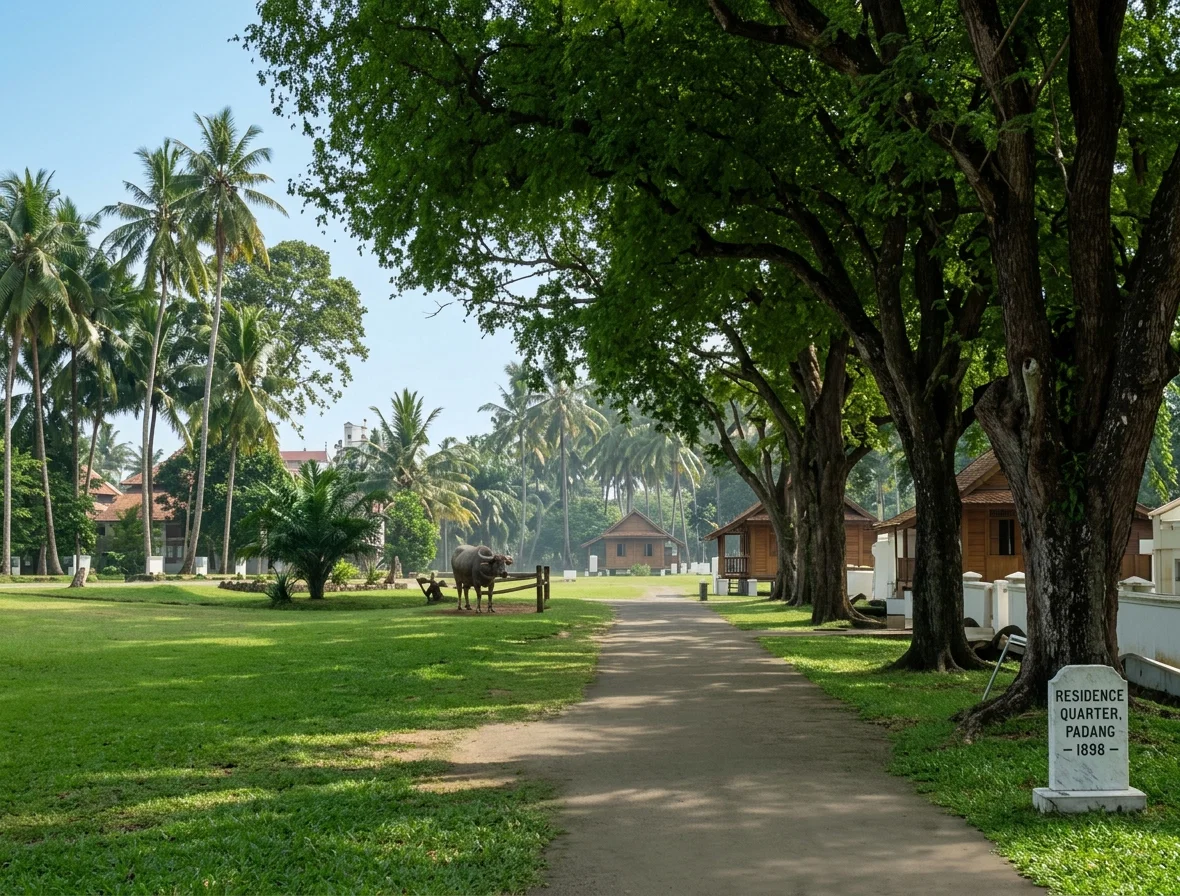
Our Work in Sumatra

6%

Review and Herald Publishing Association · Washington, D.C. · Apr 28, 1904

FromReview and Herald, Vol. 81, No. 17.

Read the full edition

Our Work in Sumatra

R. W. MUNSON
I REGRET that so long a time has passed since my last letter to the REVIEW, but we have had much to try us, and no little sorrow to bear; this must be my apology. We love the dear old REVIEW and all who read it, and sincerely desire an interest in the prayers of God's children, not for ourselves simply, but for this great East Indian field. For some months past Sister Marcelia Walker's health has been showing unmistakable signs of giving way. So intensely was she devoted to her work as a nurse, that she kept on long after she should have stopped.
EUROPEAN RESIDENCE QUARTER, PADANG
She had to give up her medical work in December and go to the hospital. After six weeks it was decided by the doctors that her case was so serious that she must go for some time to the hills in Java, to a beautiful town which is the residence of the governor-general. It is considered the most beautiful and salubrious spot in the whole East Indies. The physicians think that she will stand a good chance there to recover her health sufficiently to make the homeward journey.
It is a matter of considerable uncertainty just how long she must tarry in Java before she will be able to travel, but everything that can be done to contribute to her rapid recovery is being done. Her friends in America need feel no anxiety about her being in the very best circumstances it is possible for her to be in this part of the world.
We are going forward as best we can in the work of proclaiming the third angel's message to the people of this land, and, thank God, we are meeting with some cheering experiences.
Our hearts have been greatly encouraged recently by articles in the REVIEW telling of tokens of the latter rain that have been vouchsafed to our brethren in different parts of the world, and it has intensified our longing for similar manifestations in this field, and for the baptism of the Spirit which we are told will accompany, and in fact constitute, the latter rain. We have been earnestly praying for this, and God has graciously given us some droppings of the bountiful shower which I trust we shall yet receive.
We are in a peculiarly difficult situation. We can not preach to the Dutch; for we do not know their language. We are not allowed to preach to the Malays; for they are Mohammedans, and the government does not allow any missionary work to be done among them. The baba, or Malay-speaking Chinese, are very proud and self-righteous, and think and care only for the things of to-day. The Singke, or China-born Chinamen, are therefore the only considerable number among whom we can work. Here again we are handicapped by the language difficulty. We do not know Chinese, and must work at a great disadvantage because these men, although they have been here for many years, do not know enough Malay to make it possible to readily bring to their understanding the truths of the gospel.
Still we have been greatly encouraged by some singular events in connection with this class of men. They are poor men, and so fall under the category of those to whom Christ said the gospel should be preached. They are not proud and self-righteous, and so are much more ready to listen to the gospel. They are men of more character than the babas, and look further into the future, and are able to see spiritual truths more quickly.
Last June or July when we had but recently come down from Fort de Kock in the highlands, one of these men came to our house one day selling provisions in tins and bottles, such as are imported from Europe, and he asked the privilege for himself and three friends of attending our Malay service, as they could not understand the German missionary who spoke only in Nias, a language which they knew but very little of. I could hardly believe my own ears, and I must add that I was rather suspicious of the motive that prompted the man to make such a request. However, I gladly welcomed them, and these brought others. I think I have already told this part of the story to the REVIEW readers. Their attendance has been regular, and their interest very genuine so far as we are able to discover. I am persuaded that in most of them it is sincere.
This interest on the part of the Hokien Chinese—the men from the neighborhood of Amoy, China—led us to pray for a native preacher who could speak fluently both Malay and Chinese, so that we might be able to speak to them through an interpreter. I have often spoken of our young baba preacher, Timothy, but he knows only Malay. He is perfectly at home in that, however, and so the idea occurred to us that the Lord would put his Spirit upon him and enable him to learn the Hokien, and so give us a splendidly equipped helper; for he knows English very well, and can interpret for me from the English. Accordingly I called him from Fort de Kock, where he had remained after we left, and hired a house in the very center of the Chinese quarter. He began at once to pick up Chinese words and expressions, and to mingle with these China-born Chinamen. When they saw his interest in the language and in them, they showed great kindness to him, and assisted him in many small ways, and best of all, listened with interest to his presentation of the gospel truth. Now and then there would be a man who would offer some word of criticism, but the bulk of the crowd would soon silence him by pointing out his error, and endorsing Timothy's statement. Such experiences tended to deepen his interest in the Word, and quicken his zeal in preaching it. He is a true man of God. Though young, he has a winning way, and gains a hearing where one less wise would be denied a hearing. He found that with his small house and three small children it was impossible to pray and study the Bible during the daytime, and so on going to bed he would often ask the Lord to waken him at two o'clock so that he might pray and study in the quiet of the early morning hours. He has often of late come up to our home at half-past six, and eagerly told us what rich treasures of truth were to be found in Ephesians or James or some other of the epistles or books of the Bible. He found the book of Psalms especially interestingand “filling.” His desire to learn the Hokien Chinese became so strong that he offered to travel deck passage to Amoy if I would consent to his going, in order that he might learn the language. I gave my consent, for it is quite impossible to get a start in the language without going to Amoy. Chinese is the most difficult of all the languages of earth I suppose, and can be properly learned in most cases only by going to China, where every possible advantage is obtainable.
On Thursday, February 18, twelve or more of the men who attend our services regularly, and whom we have come to regard as in a sense belonging to us, and for whom we feel a genuine affection, attended Timothy to Emmahaven, the harbor of Padang, which is four or five miles distant, and must be reached by rail. They brought him presents of food and fruit, and showed such a heartfelt interest in him that it was a pleasure to us to behold it. We also accompanied him, and he seemed very happy in prospect of the privilege he was to enjoy of learning the Hokien. The spirit of brotherly feeling and regard these men showed greatly cheered our hearts, and strengthened our faith that we should yet see an abiding work of grace among these humble people. They are liberal also for their circumstances. They average about six dollars a month in wages, out of which they must live, and yet every week they bring a small offering of from two to five cents toward the little church building we hope to see built ere long.
The last few months' experience has greatly broadened Timothy, and his visit to China and his stay of six months or a year will work wonders in him. He will be a far more valuable man when he returns in more ways than in his knowledge of the Chinese language, for I am sure that he will make rapid progress in it.
There is a baba Chinese widow, to whom he is remotely related, who has been taking a very deep interest in the gospel, and he has frequently visited her and expounded the Word of life to her, showing the folly and uselessness of very many of the Chinese customs. She had a heart like that of Lydia, which the Lord had opened, and she, and her sister and her husband, who live in the same house with her, would sit for hours listening to Timothy as he testified to the grace of God in Christ which is able to save the sinner who submits his ways to him. He often told me how she seemed to be glued to her seat as long as he would remain and talk to her of the love of God in Christ Jesus.
(To be continued)