Arrival in East Africa

9%

Review and Herald Publishing Association · Washington, D. C. · May 12, 1904

FromReview and Herald, Vol. 81, No. 19.

Read the full edition

Arrival in East Africa

OUR party of five landed here safely, Sunday, March 27, one day earlier than we expected. Our missionaries, Brethren Ehlers and Enns, met us on the steamer. They both are in good health, and have made good progress in learning the Swahili and also Wapare. They report favorably as to the progress made on the farm. They have now a good road down to Kihuin, a distance of twelve miles, where there is the great caravan road. They have also turned their creek direct to their house, and have tilled considerable land. Their property is a valley three fourths of a mile long, and from two to three hundred feet wide. They secured some chickens, a few head of cattle, and here we were able to secure two Indian horses, young and small, but it is very difficult to find anything suitable.
Our boat is still discharging its cargo, and if our freight is not unloaded by tomorrow forenoon, it will have to follow the next train. The train leaves three times a week. Ours leaves on the thirtieth, and takes us fifty miles. Then we have still one hundred miles to march till we reach our station. Most of the distance is through the prairie, and the third day's trip is the worst, as there is no resting-place for forty-five miles. We shall need about one hundred carriers to transport our provisions, tools, goods, etc., to the station.
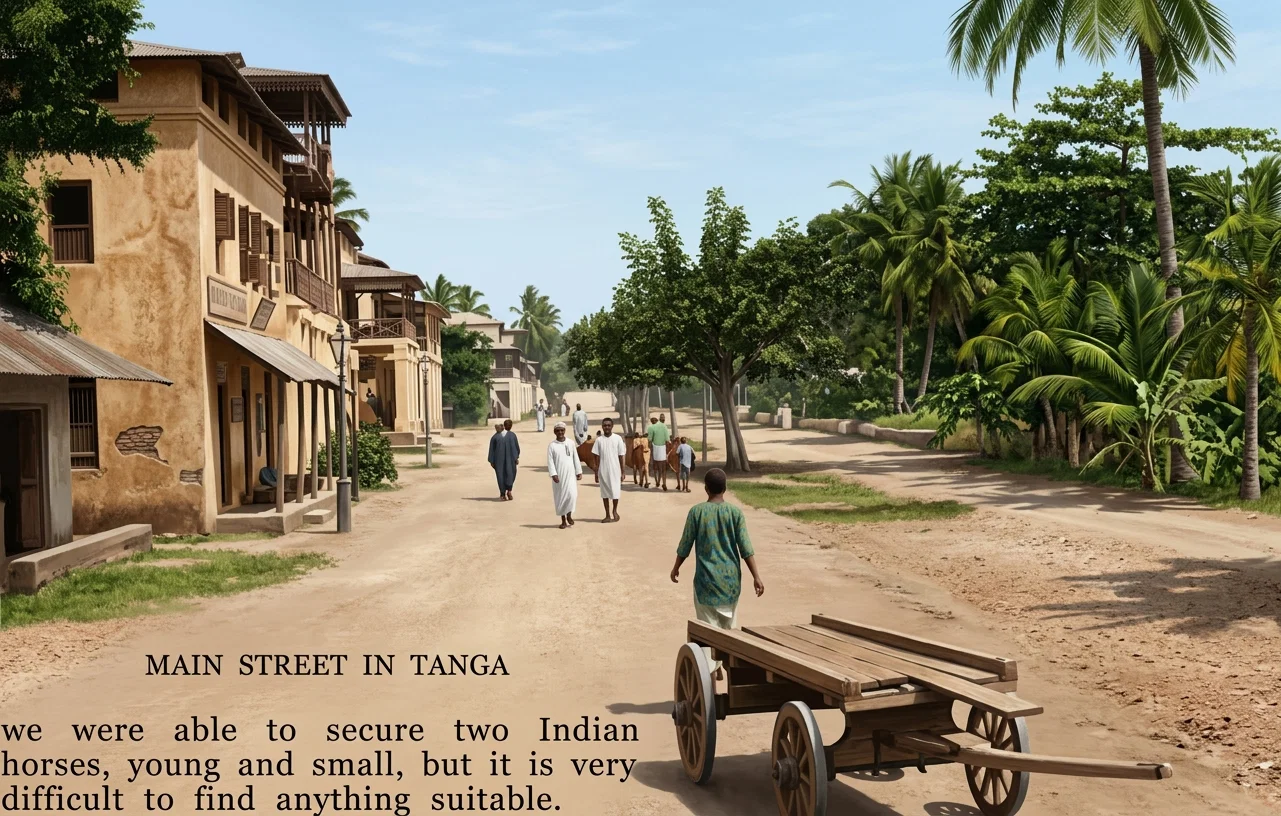
The early rain has failed this year, and not until March 26 was there any sign of the latter rain. But now it has rained one whole night, and there is prospect that we shall enjoy the benefit of the tropical latter rain. The country here presents the nicest landscape I have seen anywhere in Africa. There is quite a range of mountains in full view, all wooded and covered with plantations. Here are fine palm groves, mango trees, etc. The town is well laid out, has nice government buildings, and a number of well-stocked stores and warehouses.
We have nice bananas, pineapples, mangos, etc.; but potatoes are dear and very scarce, also milk. By going with our brethren to the different business houses, one gets a better idea of prices and customs; and we have made different arrangements as to our money, supply of goods, etc.
MAIN STREET IN TANGA
Our brethren employ from sixty to eighty Wapares on their farm. They pay ten resas, or five cents, for grown persons, and half as much for boys; they board themselves, and are glad to have a way to earn something, and secure clothing for it.
Our mission is already well known all around here. The German Lutherans from Leipzig demanded that we leave the field or cede it to them, but they are now ready to divide. The Wapare is a special dialect, and so far but very little appears in print.
Brother Enns found it at first difficult to enter their homes, but as they became better acquainted, they began to call for him, and request medical help. Many are troubled with the sand-fleas, and he finds plenty to do. There are about two thousand persons within a circuit of three miles around their present station.
Thus far we are all well and of good cheer, and I am glad to make the trip and gain an experience in heathen mission work. In the coast towns, the missions do not seem to have much success. The Mohammedans are the leading ones here, and many Germans complain that the Christian boys are often worse than the pagan and Mohammedan. They need instruction in industrial work.
L. R. CONRADI.