The Agitation in Favor of Sunday Legislation in Rome
By Chas. T. Everson
CHAS. T. EVERSON
FOR a year or more there has been a strong movement in Italy favoring Sunday legislation. But in the last few weeks the agitation of the question has been receiving special attention, and has been prosecuted with great vigor.
In Rome large placards were posted conspicuously in every part of the city, advertising a mass-meeting to be held in a leading theater. The subject considered at this meeting was a law favoring Sunday closing. And although the weather was disagreeable, the theater was filled to overflowing by an enthusiastic audience. Several prominent statesmen, legislators, and senators spoke on this occasion, showing the necessity of a Sunday law, and the good results to be derived from legislation of this character.
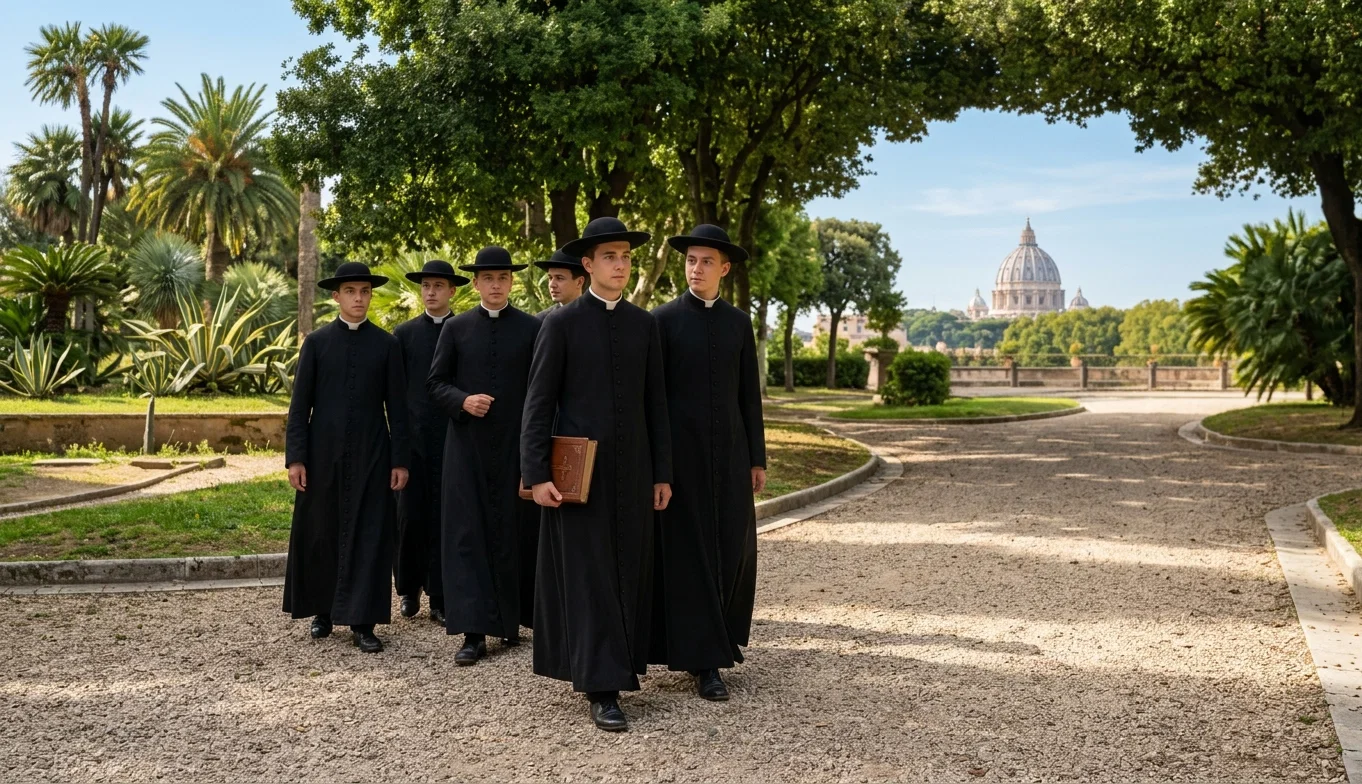
A COMPANY OF STUDENTS FOR THE PRIESTHOOD
Besides meetings held in favor of Sunday legislation, the daily press has given much space to the discussion, and thereby it has been extensively placed before the public. After the question had been agitated in this manner for some time, a law was introduced into the Italian Parliament, having as its object the strict enforcement of Sunday closing. This law was vigorously debated in several sessions of the legislature. But, of course, the same plea was used here as is urged everywhere by the exponents of Sunday legislation, that this legislation is purely civil, and has no religious significance. But the discussion of the question brought out the fact that there is a religious phase connected with it. One legislator who gave a speech on the law, which was greatly applauded, showed plainly that there is a religious significance to the question. He stated clearly that the law in its application must penetrate the consciences of the working men. He then reminded the legislators of the strong respect for religion that exists in the German and Anglo-Saxon countries, and the good results seen from it in these countries. Then as a climax to what he had said in this strain, he read a decree that was issued by Mr. McKinley, ex-president of the United States, in which the people were asked to pray to God for the prosperity of their native country. Loud applause and comments of approbation followed the reading of this decree. This legislator concluded his remarks by stating that there should be religious teaching in the public schools that would serve to re-enforce the conception of "sanctifying the Sabbath day." We also notice that in these remarks the fourth commandment itself was quoted in support of this Sunday legislation.
And another thought that should not escape our attention is the fact that right in the very halls of the Italian legislature the example of the United States is referred to when that body is promulgating a Sunday law. And in this connection we recall the words of the prophecy, which say that “he exerciseth all the power of the first beast before him, and causeth the earth and them which dwell therein to worship the first beast, whose deadly wound was healed.” We know that the United States is here referred to as that power which will influence the earth to render obedience to the papal beast.
In obeying Sunday laws we render obedience to the papal power; for Sunday is a child of the papacy. And not only will the United States, according to this prophecy, enact laws in favor of Sunday in its own territory, but it will also influence the other nations to do the same. Has the United States, which has been such a potent factor in leading the nations away from Rome and from the mingling of civil and religious matters, begun to lead back to Rome? It would seem impossible, but nevertheless it is true that the example of the United States is tending toward Rome. In fact, the example of the United States is quoted in the legislative halls of Rome itself, when Sunday legislation is under consideration. Who can say that the United States is not causing the earth to worship the papal beast? Yes, and in fact it is causing the very seat of the beast, Rome, to render greater obedience to the beast.
The Sunday law has not been passed yet, owing to some disagreement concerning certain parts of the law, but it is sure to be passed before long. And the Catholic Church itself is one of the potent forces behind this Sunday-closing movement in Rome. For over a year the Catholic Church has been waging a vigorous warfare in favor of Sunday closing. The head priests in the different parishes have instructed their members that no Catholic should buy from any firm that refuses to close its place of business on Sunday. As the Catholic trade is such a strong factor in the business of Rome, many close their doors on Sunday for fear of losing this source of revenue; but this Sunday closing is quite characteristic of the Catholic Church where religion is a matter of external forms. For while many close their places of business, yet they continue their work behind the closed doors.
When we came to Rome, we were informed that the people made no distinction between Sunday and the other Catholic holidays; but we see that the conditions have changed rapidly even during our short stay; for it seems that the prophecy must be fulfilled, and Sunday must be accorded the place that the Word has assigned to it. And it is certain that in the near future the "day of the sun" will be exalted again in the place of its birth.