Honduras

9%

Review and Herald Publishing Association · Washington, D.C. · May 19, 1904

FromReview and Herald, Vol. 81, No. 20.

Read the full edition

Honduras

A. N. ALLEN
HONDURAS, one of the Central American republics, extends from the thirteenth to the sixteenth degree of north latitude. On the north it is washed by the waves of the Caribbean Sea, and on the south it has a good harbor from the waves of the Pacific, at Amapala, a small island in the Gulf of Fonseca. The distance from the Caribbean to the Pacific is only one hundred and fifty miles as the crow flies; but as it is all very mountainous, one is obliged to travel about twice that distance in crossing. The distance can not be covered in less than eight days, and in the rainy season twice that time is required, and still longer for the transportation of cargoes.
As only forty miles of railroad exist in this republic, traveling is very slow. Along the coast and up the rivers, boats, dories, and pitpans are used. In the interior, mules and horses form the only means of conveyance, except from San Lorenzo, on the Pacific side, to Tegucigalpa, the capital, where there is a ninety-mile cart road. Here oxen with yokes lashed to their horns draw low, lumbering, two-wheeled carts, the wheels being of solid wood. The heavier imported articles are brought into the country in this way, about a week being required to cover the ninety miles with a load.
This country enjoys one continual summer. Yet the time for planting and harvesting is as fixed as in the temperate zone. The rainy seasons vary as one passes from one coast to the other, and it is by these that the planter knows when to sow. The extreme heat of our summers in the States is unknown. The mercury seldom goes above eighty-five degrees Fahrenheit. Cyclones do not occur. We occasionally have heavy wind-storms, but these seldom do any damage, except along the coast and islands, where plantations are sometimes blown down. Once while we were in the interior, it hailed quite hard for a few minutes, much to the surprise and consternation of the children, who had never seen such a phenomenon before. To many it was the first ice they had ever seen.
The population of Honduras, according to President Sierra's last address to Congress, Jan. 1, 1903, is eight hundred thousand. Of these, only a small proportion can read. But this does not seem so strange when we stop to consider that only thirty per cent of the people of Spain, the country that conquered and populated Spanish America, can read. It must not be supposed, however, that all the people of Honduras are ignorant; for this is not true. There are as intelligent, well-educated, refined, and successful people here as in any other country. Some have been educated in the United States, others in France, and still many others in the schools of the country and the other republics.
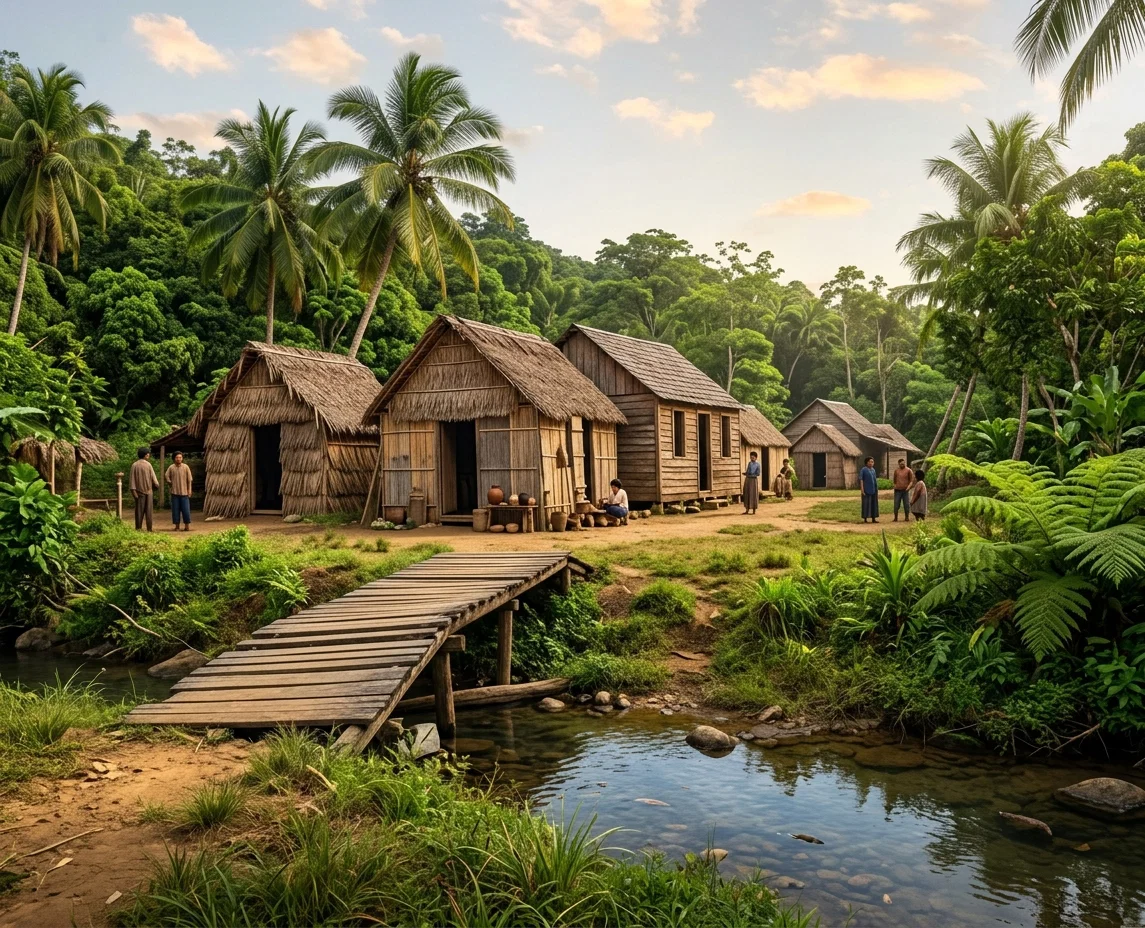
NATIVE HUTS, HONDURAS
A distinct social line is drawn on the basis of wealth, position, and education. The laws of custom among the higher class are rigid, as all know. The more isolated the place, the narrower the minds of its people, and the more rigid its laws of custom. For instance, gentlemen are never supposed to walk into the country, but always to go mounted. A foreigner preferring to walk a few miles rather than hire a mule, is not recognized by the mounted man. But if he were riding, he would be treated as an equal or as a superior. On entering the country, it is wise to observe as much as possible the prevailing customs, and not cross the local ideas more than is necessary. To try to Americanize is dangerous, besides unwise; and if we give the impression that we are freaks, we lose our influence.
The leading native industry is the manufacture of cigars. In the year 1902, there were exported 3,128,800 cigars and several million packages of cigarettes. The same year 15,000 palm-leaf “Panama” hats were made, and sent to the United States. The following is a list of some of the products for the same time: corn, 509,049 bushels; beans, 20,587 bushels; wheat, 15,813 bushels; rice, 38,613 quintals (one quintal, 500 pounds); 19,625 acres of land are producing annually 36,480,000 bananas. The number of plantains raised is not known, as most of them are consumed at home. There are about 1,239,500 cocoa-trees, which annually produce about 14,263,300 cocoanuts. Lemons, oranges, and limes form a fair percentage of the fruit production, from the port of La Cieba alone nearly 1,150,000 being exported to the United States. The coffee crop was 44,284 quintals. There are under cultivation 13,263 acres of sugar-cane. From this are made sugar and rum. About 9,000 acres are producing indigo. The number of cattle exported is 20,691. The total valuation of cattle, horses, mules, hogs, sheep, goats, etc., is 12,154,180 pesos. The value of the silver and gold removed from the mines of Honduras each year reaches the millions.
All the principal towns are connected with one another and the capital by telegraph. There are one hundred and eighty offices, and six hundred persons are employed in this service. The system comprehends 3,250 miles of lines. The country dollar, or sol, is worth only forty cents United States currency, yet these are on a par with the United States dollar.
Here is a country to which the Reformation of Luther's time never reached. God is blessing his Word in Utilla. The past week two souls have been liberated from the bondage of sin, and are now rejoicing in the freedom and peace of Jesus, their Saviour. God is striving mightily with several others. Some who have been members of the church, but through temptation have fallen, are preparing to return. We have just finished our first month's school. We have an enrolment of sixty-five. Much sickness prevails at present, and God has blessed our efforts to relieve some. To him be all the praise.