The Bible in India

8%

Review and Herald Publishing Association · Washington, D. C. · May 26, 1904

FromReview and Herald, Vol. 81, No. 21.

Read the full edition

The Bible in India

FOUR short words, but how much is in them! India—a “country” we call it, and think, perhaps, that it is simply a country like France or Germany, with one people and one language; but really it is as much a continent as Europe is, with many peoples and many languages. A card has been prepared which gives an outline of India on a map of Europe. In this card Kashmir is on the arctic circle, and Ceylon on Greece; Karachi is in Ireland, Calcutta near Moscow, and Rangoon near the Caspian Sea. An outline of India on the map of America would show Kashmir at Winnipeg, and Ceylon at Mexico; Karachi is in the west of Dakota, Calcutta at Washington, and the coast-line of Burma running many hundreds of miles south of Nantucket. India is as large as all Europe outside of Russia; its population is about as dense, and it has as many languages as are spoken in Europe. If we include the languages of the various hill tribes in India, the number is far larger than those spoken in Europe.
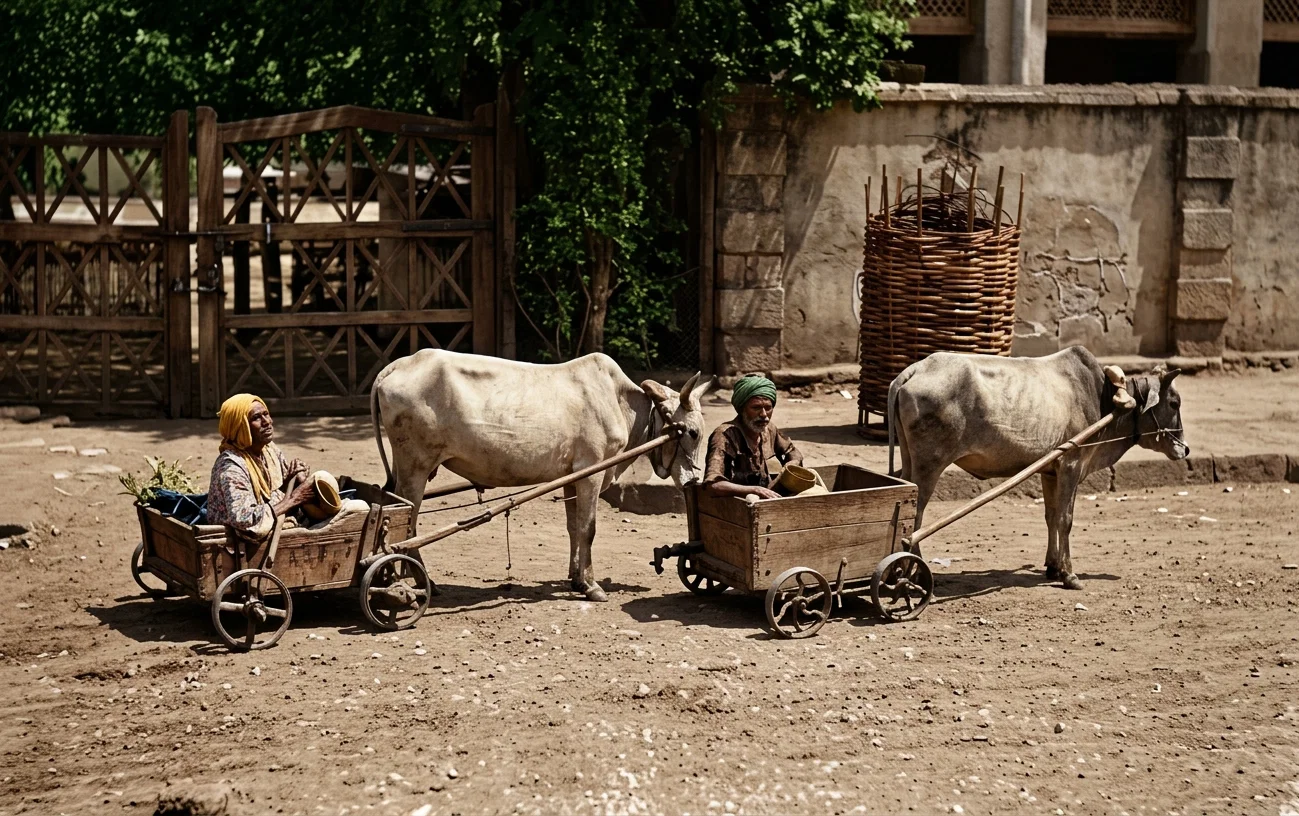
STREET SCENE IN INDIA: BEGGARS WHO RIDE
The population of India by the last census was about 300,000,000 (three hundred millions!). Leaving out of consideration for the present the languages of the hill tribes, those spoken on the plains of India may be divided into two main classes: the Sanskritic languages of the north, and the Dravidian languages of the south of India. Sanskrit, as is well known, is a language somewhat akin to Greek in its inflections and in its phraseology. It has long ceased to be a spoken language, and is important only as being the sacred language of the Hindus and the basis of the north Indian languages. The most important of the spoken languages of India is Hindi. This is spoken throughout the Gangetic Valley, except in Lower Bengal, and also in Rajputana and the central provinces. When the Mohammedans invaded India, this was the center of their authority. They therefore had to learn the language of the people; but while adopting its grammatical structure, they introduced a large number of their own Persian words, including many Arabic words which had been adopted in Persian. This mongrel dialect was called “Urdu,” and as it was the language spoken by the conquerors, it gradually developed into one of the most polished of Indian languages, and its literature is probably more extensive than that of any other tongue in India.
In some respects it has become a sort of lingua franca of northern India. It is specially the language of the towns in Northwest India, while Hindi, in one or other of its dialects, is spoken in the country districts; it is also the special language of educated Mohammedans. As Hindi and Urdu have practically the same grammatical structure, and differ only in phraseology, the two merge into one another, and the common people speak something which is neither pure Hindi nor pure Urdu, and is sometimes called Hindustani, though by some the term “Hindustani” is regarded as a synonym for Urdu. It is difficult, for this reason, to say how many people speak one language as compared with the other; but we may safely say that Hindi, in one or other of its dialects, and Urdu are, between them, spoken by fully ninety million people. In its composite character and its general hardiness, Urdu reminds one of English.
The next most important language of India is Bengali, spoken in the fertile and thickly populated country of Lower Bengal, the delta of the Ganges and the country to the north and east of it, of which Calcutta is the chief city. Bengali is, in its phraseology, as near the mother tongue (Sanskrit) as any other language, if not more so. A large number of pure Sanskrit words are in constant use in Bengali—even many compound words. Forty million persons speak Bengali, of whom about half are Hindus and half Mohammedans.
In the east of Bengal the Assamese language is spoken by between one and two millions, and to the south Oriya is spoken by nine millions. These languages are so akin to Bengali that sermons delivered in one language will be understood by people speaking one of the others, yet so different that separate versions of the Bible are needed in each. On the slopes of the Himalayas to the north of Bengal lies the country of Nepal, an independent State, but so friendly that it furnishes some of the best troops in the British Indian army—the Goorkhas. For fear of annexation, no Europeans are allowed to cross the boundary of Nepal, but the Bible can go there. The language of the people is akin to Hindi and Bengali, and active work is carried on by the Church of Scotland Mission among the numerous Nepalis who live in British territory.
On the northwest, beyond the Hindi-speaking population, lies the Punjab, and the Punjabi language, akin to Hindi, is spoken by seventeen million people. South of it is the small country of Sindh, where two and a half million people speak the Sindhi language. To the southeast of Sindh, on the shores of the Arabian Sea, lies Guzrat, and the Guzrati language is spoken by ten million. South of this comes Marathi, the chief language of the Bombay Presidency, which is spoken by eighteen million.
All the languages thus far enumerated are more or less Sanskritic. Coming now to south India, we have as the most northerly language Telegu—sometimes called the Italian of India. This is spoken by twenty million people on the coast of the Bay of Bengal, south of the Oriya district, and inland in the native State called the Nizam’s Dominions. South of the Telegu district comes that in which Tamil is spoken by fifteen million, reaching down to Cape Comorin, the southernmost point of India. On the western coast, below the Mahrati-speaking district of Bombay, two other languages are spoken—Canarese by ten and Malayalam by five million. All these south-Indian languages are called Dravidian; they belong to the same family of languages, with altogether distinct characteristics from the languages of northern India.
To the east of the Bay of Bengal lies Burma. The chief language spoken there is Burmese, the vernacular of five million; but various dialects of Karen and Shan languages are also spoken in Burma, so distinct as to require a separate religious literature, including, of course, separate Bibles.
Ceylon is not part of British India, but a separate colony; it is, however, naturally so connected with India that we may include it in our present survey. The Cingalese language is Sanskritic, and is spoken by about one or two million. As we have already said, besides these important languages of the plains, there are a great many hill languages, into all of which the Bible, or portions of it, need to be translated, if these tribes are to be evangelized.
So much for the country “India.” It will be seen how large the country is in its area and the vastness of its population, and what a babel of languages it contains.—Rev. George H. Rouse, D. D., in Missionary Review of the World.