Our Peruvian Field

8%

Review and Herald Publishing Association · Washington, D. C. · Jun 9, 1904

FromReview and Herald, Vol. 81, No. 23.

Read the full edition

Our Peruvian Field

E. W. THOMANN
PERU is one of the republican States of South America. It is a large country, located on the west coast, and extending from the fourth to the eighteenth degree south of the equator, and from the seventieth degree west to the Pacific Ocean. On the northern border it touches the republic of Ecuador; on the east, Bolivia; on the south, Chile; and on the west, the sea.
It has about three million inhabitants. These are of different nationalities. First, there are the native Indians; second, the descendants of the Spaniards that governed the country for several centuries; third, the negroes who have been brought there as slaves by the Spaniards, and who, after gaining their freedom, remained in the land; fourth, a mixed class, between Spaniards, Indians, and negroes; and fifth, foreigners, who for different purposes (generally that of making money) settled in the land. Among these foreigners the Chinese and Italians form the largest number, but nearly everywhere people may be found who speak English, French, or German.
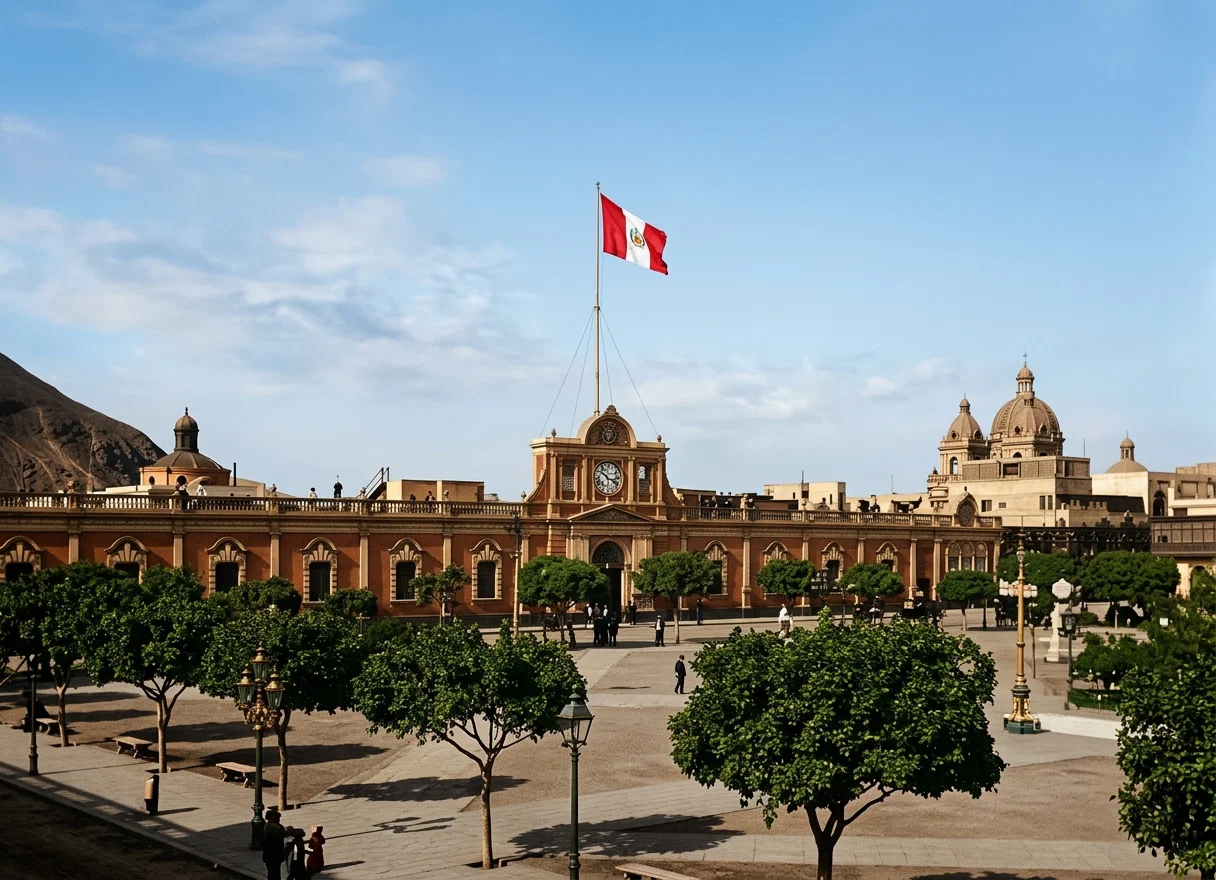
VIEW IN LIMA
VIEW IN LIMA
Like all Catholic countries, Peru is one of the most retrograded to be found in the so-called civilized world, notwithstanding its natural riches. The people, trained and governed mostly by priests and nuns, know but little of what liberty is or means; and when some of them do get free, they do not know what to do with liberty. The next thing one finds is that they have gone over to infidelity (or what they call freethinking ), or to some other perverse system, as spiritualism, theosophy, or something worse if possible. They are all in a condition where they need the Son of God, the Saviour, to be truly free. John 8:36.
As will be understood, there are not in Peru as many facilities and things which conduce to comfort as there are in the United States or in other advanced countries. Yet there are several lines of railroads, steamboat and sailboat lines, telegraphs, telephones, postal service, daily papers, etc. Roads and traveling facilities can everywhere be found, if one will be satisfied with what there is. Where there are neither railroads nor ships, traveling is generally done on horseback or muleback, and in this way baggage is carried too.
In some parts can be found different kinds of factories, mostly managed by foreigners. The principal agricultural products of the country are sugar, rice, cotton, and tobacco; but many kinds of fruits and other agricultural products may be obtained. The soil is generally very fertile and productive. As rains and sunshine help in cultivating the ground, much can be obtained with very little work. Cattle are raised in great numbers in different parts. In minerals Peru is also very rich. But as the people generally are accustomed to receiving nearly everything from mother nature without work, they do not like to do much. Where hard work is required, one will find mostly strangers or negroes. A traveling scholar, describing Peru, said, “It is a beggar sitting on a bank of gold.” And that is nearly true.
Ever since Spain began to send soldiers to subdue these countries or regions discovered by Christopher Columbus, the agents of the Vatican have been oppressors and usurpers over all the people under their dominion. Many of the more enlightened are tired of the Romish priests, and desire something better. They, like the Athenians, raise an altar to the unknown God. Acts 17:16-31. But they can not find him if they that know him go not to tell them what kind of being he is. The liberal political parties are already working to separate the church from the state and to secure religious liberty, but on the other hand there are movements to impose the mark of the beast. There are already some local laws that require Sunday-keeping to some extent in commercial and industrial matters. They take the United States for their example in this. Rev. 13:11-17.
It is high time for us to take to them the light of the message that God has given us to carry to all nations, kindreds, and people. Rev. 14:6-14; Matt. 24:14.
Until the present time very little has been done for Peru. Some of our brethren have been there a short time, and about thirty have already accepted the truth. If we could have workers there, many would accept the last warning, and stand ready to meet the Lord when he comes in the clouds of heaven, in the glory of his Father, with all his holy angels. Luke 21:36; Matt. 25:31.
Brethren, we are debtors to this people. 1 Cor. 9:16; Rom. 1:14. It is our privilege and duty to let the light shine among them, that they may glorify our Father in heaven. Matt. 5:14-16. Not only should colporteurs and ministers be sent, but the brethren who can work in mines, engage in business, agriculture, or the trades, etc., would be a blessing; they would be blessed if they would come here to stand among our new-born brethren as backbone home Christians, that the strong winds should not overthrow those who are not prepared to stand alone. Eph. 4:14.