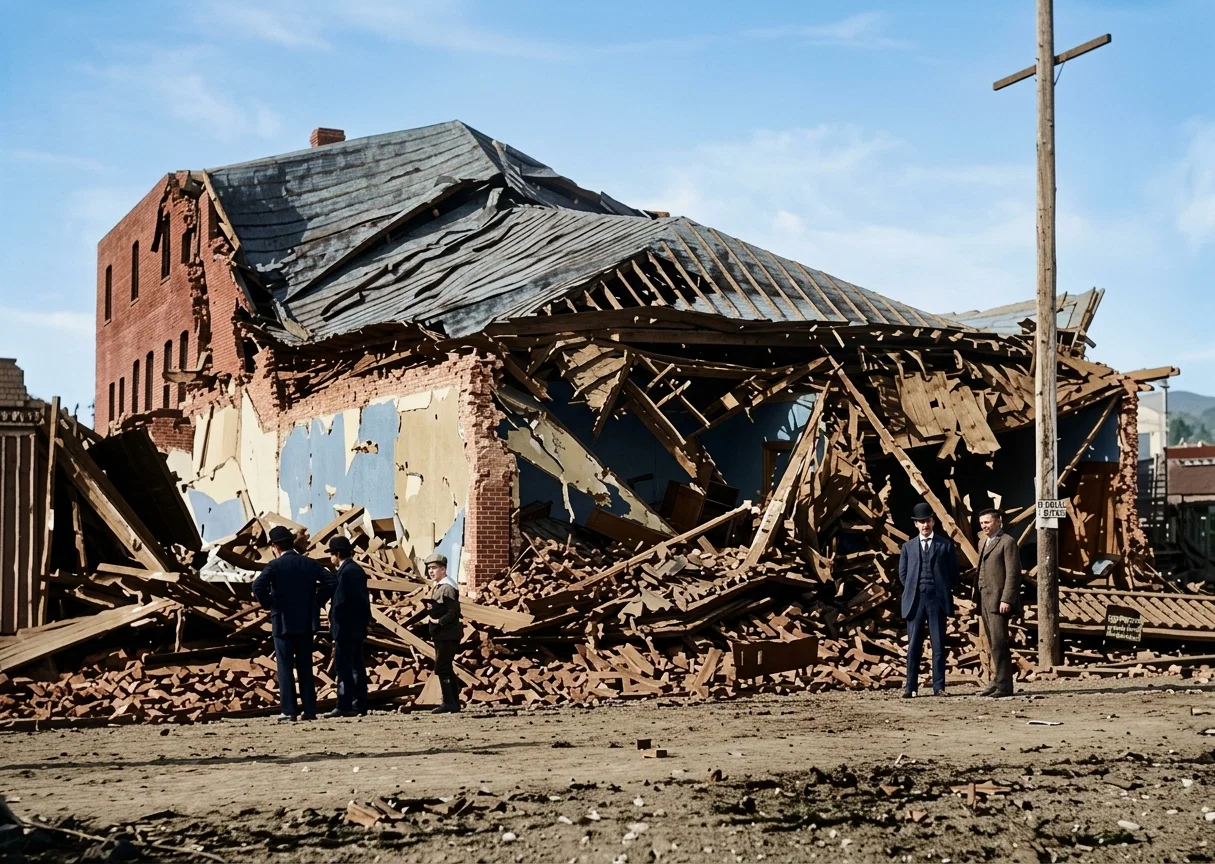
HEALDSBURG had its share of the visitation by earthquake on the morning of April 18, but it escaped with comparatively little injury. This is the northernmost town that was seriously affected, but its people think they were as near the center of the most violent disturbance as they cared to be.
Our friends are doubtless solicitous to learn how it fared with Healdsburg College, especially the students’ home. Briefly speaking, not a hair of our heads was touched by way of injury, neither was there the smell of fire upon any of our garments. All the members of the home family were nervously shocked as the plaster left the walls in great patches, and our four-story building reeled to and fro like a drunken man, making all its occupants likewise drunk. Our college home is the sky-scraper of Healdsburg, and stands upon one of its highest eminences. The people of the town expected it to be one of the wrecks, and looked the first thing toward the site of this conspicuous landmark. But although the building staggered, its walls and joints seemingly swaying from one to two feet out of plumb, it did not fall, and our lives were wonderfully preserved. Those who arose from their beds could not keep their feet without clinging to something, and everything to which they tried to cling was also swaying. Some did not leave their beds, some returned to them and covered up their heads, some staggered to the windows to see the trees do obeisance to Mother Earth, with the characteristic whir through the branches so common to earthquake breezes, and to see the neighboring chimneys leap bodily to the earth, or fall over the roof and rattle to the ground, or crash into the rooms below, while the roofs of the houses, viewed from our higher outlook, appeared to move in undulations like the surface of the sea. During those few awful seconds, which seemed like minutes, some prayed, some confessed their sins, some moaned, some were speechless—all were nauseated and awestruck.
The worst being quickly over, the members of our family hurriedly dressed themselves, the rising bell rang a few minutes later, on time, and the students addressed themselves to the situation creditably, some setting to work under the direction of the matron removing the debris from the dining-room, serving room, and kitchen, clearing out the fruit room where rows of glass jars with their contents had been precipitated in a mass upon the floor, and otherwise assisting to prepare breakfast. Morning worship was held on time; breakfast, which was prepared on two small borrowed gasoline stoves, since not a stove or chimney in the house could be used, was but twenty minutes late; and our regular school session opened just ten minutes past the hour.
ONE OF THE WRECKED BUILDINGS IN HEALDSBURG
The fire in our kitchen range had just been made, and at least three others would have been started had the earthquake occurred a few minutes later. As it was, falling bricks drove soot and ashes all through the kitchen and study rooms, and before the matron could reach the basement from the second floor, smoke was filling the corridors on the upper floors, and students were shouting fire. Every spark was soon extinguished, and we were providentially saved from the added horror of fire.
Unfortunately the president was away from the family that night, and spent that dreadful morning hour in the heart of San Francisco. Upon retiring to rest, at half past eleven, in a room on the fourth floor of a hotel, a block and a half from the business center of the city, he was impressed to remove only his coat, trousers, and shoes—a thing he can not remember ever having done before under ordinary circumstances—with the thought that he might want to dress quickly the next morning. He was waked just in time to see by his watch that it was a quarter after five, when the first fearful shock set six stories of brick and plaster to rocking toward every point of the compass like a row boat in a choppy sea or the walls of a tent when stirred by a whirling gust of wind. Buried in his bed by the falling debris, he essayed to extricate himself, with the prayer of Peter on his lips, “Lord, save me.” Gathering his few belongings together, and forcing the door into the hallway, he clambered down the stairway still open, and among a score of others in their night-robes succeeded in reaching the street, through which he picked his way among live wires, fallen and falling wrecks, kindling and blazing fires, the upheaved and sunken paving-stones, water and mud oozing up from beneath, explosions on this side and that, amid the cries of wounded and dying, accompanied by a man wearing but a hat and an overcoat, and with blood trickling down his face and body from two ugly gashes on his head—escaping through scenes of destruction and confusion on every hand, to the waterfront a mile away, without a scratch of any kind upon his person, but expecting every moment that a tidal wave would set in and complete the destruction. Providentially the Ferry Building was spared from collapse, and the ferry-boats ran on time, affording a means of escape to Oakland, and later to the regular train for Healdsburg, which arrived an hour and a half late.
The college classes were found reciting under the trees in the yard, as subsequent minor shocks created uneasiness in the building. The familiar faces of friends and loved ones never seemed dearer than in that greeting on the college lawn on that memorable day.
Our broken family united, every one felt a strong sense of deliverance and a deep sense of gratitude to our merciful Father, who knoweth them that are his, and who placed his hand over them while he shook terribly the earth in these parts.
When evening came we were made sensible, however, that we still live in the flesh, and most of the family preferred to sleep out of doors. Accordingly the preceptress and the girls made up pallets on the front lawn of the home, a little distance from the building, while the president and one of the teachers placed their couches near by—all in their day clothes and some in their wraps and caps. Most of the boys took their blankets and pillows to the rear of the building and slept, some on the ground, some in the shop, and some in a wagon. We were aroused but twice in the night by the dreaded tremblors, which lasted only long enough to produce the nausea which invariably accompanies these shakings of the earth. More than forty minor shocks have occurred up to the present writing.
The supply of gasoline in the town22being soon exhausted, our next resort was to cook out of doors on a small furnace improvised from fallen brick, until our range chimney could be repaired. Our baker’s brick oven being disabled, he moved his portable oven near the wall, put the pipe out the window, and went on with his work without losing a baking.
It is now three weeks since the earthquake, and the last of the sleepers out of doors came in just the other night, and we are once more settled down to our regular mode of living. Under these extraordinary circumstances for a school home the ladies have conducted themselves with commendable propriety, and the gentlemen have held their own with little exception.
Among the many anxious hearts throughout the land during the days that followed this great calamity, perhaps none were more so than those of the students regarding their parents, relatives, and friends, and of the parents and relatives for the students. Communication by mail, telegraph, or telephone was cut off in every direction. Railroad traffic was interrupted in some quarters. Fathers, mothers, and brothers came from as far as seven hundred miles north and five hundred miles south to ascertain the welfare of members of the family in the college home. In two instances, after seeing that the children were absolutely unharmed, parents could not refrain from taking them back home. Only one student left the school for his home of his own accord, and has not returned. With wild, exaggerated rumors flying in every direction, our students were very courageous regarding the welfare of their loved ones, some receiving no word for a week. Many an earnest prayer was sent to the throne of grace.
The college building was damaged slightly. At the home, the plaster in the basement and in the study rooms, parlor, offices, and corridors of the first floor, was shaken off by the square yard; window-glass and a few dishes were broken; our two large five-flue chimneys were demolished to the roof, but not seriously cracked or injured below that; door-frames were loosened in the joints so that some doors pinch and some will not latch; cracks and seams may be seen about pillars and steps; and the valves on our boiler were wrenched until they leaked steam. Our manager regards one thousand dollars as a very conservative estimate of the damage done to college property.
To a knowledge of the present-day message, and to the faithful and sympathetic co-operation of Christian students and teachers, is due our ability to have gone steadily forward in our work without missing a regular exercise of the school since that eventful morning in April, while the two great universities in California and many of the secular schools closed for the rest of the current session, and even the public schools of Healdsburg lost two weeks. In our college building we are now housing the commercial department of the Healdsburg High School, and are accommodating one of the town’s local organizations twice a month.
The lessons learned from this experience, the impressions made upon the minds and hearts of the young people, the revivals of consecration and zeal, are too numerous to mention here; but suffice it to say, that prophecy has a new force and the precious promises of the Word a new meaning to every Christian who passed through these stirring times. We thank God feverently for the mildness of his warning and the wonderful deliverance of his people.