Missions in German East Africa

4%

Review and Herald Publishing Association · Takoma Park Station, Washington, D. C. · Jun 14, 1906

FromReview and Herald, Vol. 83, No. 24.

Read the full edition

Missions in German East Africa

L. R. CONRADI
By looking at a modern map of Africa, one sees that British East Africa, with Uganda, right under the equator, and adjoining the Sudan on the north, forms the northern boundary of German East Africa—a colony extending from about one degree south to nearly twelve degrees south of the equator, and including in its territory the northern part of Lake Nyassa. Thus British and German East Africa are the connecting links between the Egyptian Mission (which includes the Sudan) and the territory of the South African Union.
German East Africa has an East Indian Ocean coast line of about 620 miles; the British island of Zanzibar lies right before it; and its area is about one-half more than the whole German empire in Europe, although its population is not quite seven millions, mostly Bantu negroes. The well-watered and alluvial seaboard is inhabited by the Swahili, who dwell in a malarious climate, and are surrounded by a luxuriant vegetation. The language of this people is enriched by an intermixture of the Arabic, and is the general medium of intercourse among the interior tribes, so that, as far as the area over which it is spoken is concerned, it is one of the twelve most important world-languages, and it possesses, besides the Bible, a number of religious works, and a general literature.
On going inland, after one leaves the coast, he gradually ascends, crosses a great plain, and a high plateau, until he comes to the Nyanza, Tanganyika, and Kiwu Lakes, forming the western border of the colony, while to the north is the great Victoria Nyanza, the northern half of which belongs to British East Africa.
Besides ours, there are the following societies working here: The Berlin, the Leipsic, the Moravian, and the Church Mission societies, the Universities Mission, and the Roman Catholics (who are very strong along Tanganyika and Victoria Nyanza Lakes).
The capital of the country is Dar-es-Salam (the city of peace), a most beautiful place, with a population of about twenty-five thousand. It has a lovely port. A railway is now being rapidly pushed inland from this town, with the expectation that before long it will extend to the lakes, a distance of about nine hundred miles. While I was in the capital, I had the privilege of calling on the governor, Graf von Goetzen, and his wife, a Washington lady. They received me very kindly, and were much interested in listening to the principles of our truth for two or three hours.
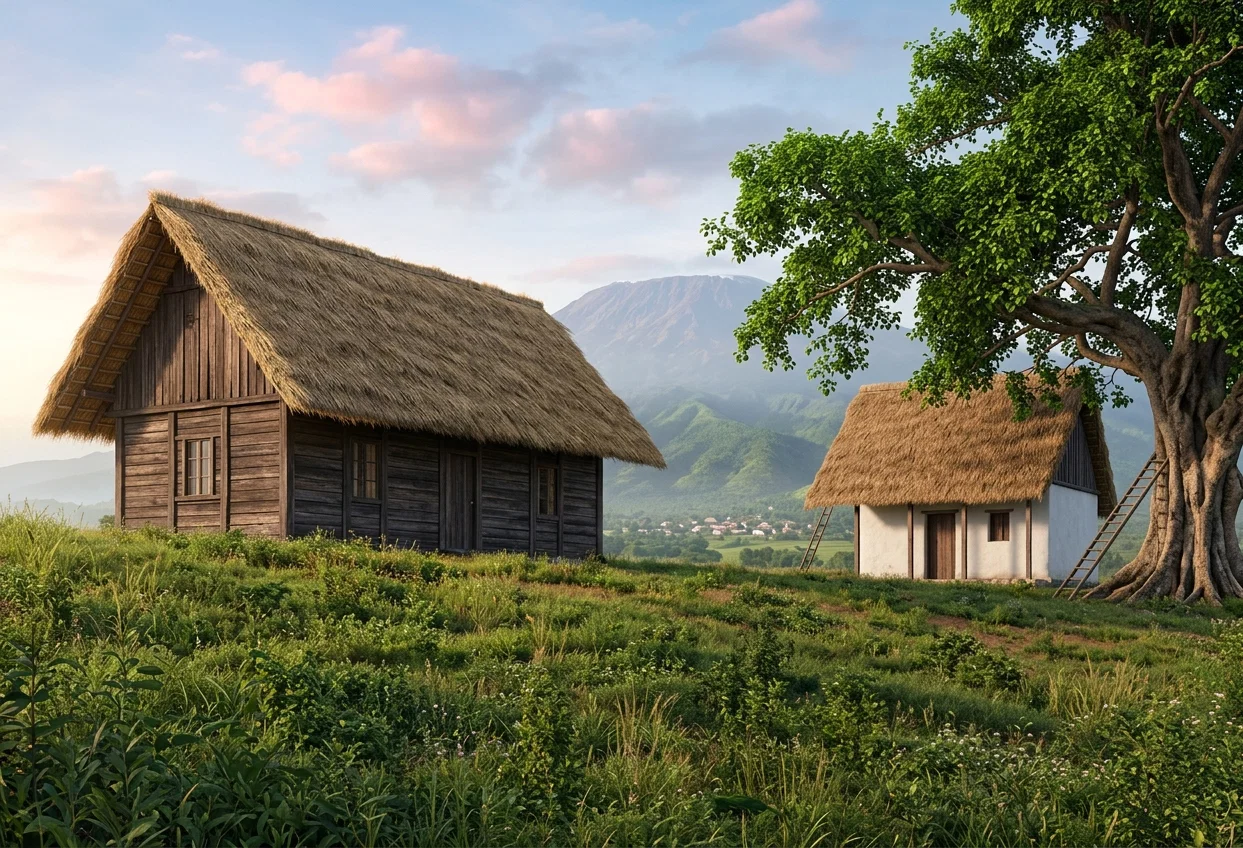
MISSIONARIES' DWELLING AND KITCHEN AT KIHUIRO
(Friedenthal is at the base of the mountain in the distance)
MISSIONARIES' DWELLING AND KITCHEN AT KIHUIRO (Friedenthal is at the base of the mountain in the distance)
The port which concerns our work most, is the northern port, Tanga. It has about six thousand inhabitants. It is nicely situated. The government has erected fine post-office and hospital buildings in this city. From here the first railroad was built, and now it extends about eighty miles inland. When I was there the road had been constructed only along the southern base of the Usambara Mountains, which attain an elevation of about seven thousand feet. In this region the Germans have a number of nice plantations, and in this neighborhood there are some fine mission stations belonging both to the German and also to the English societies. While I was still in Africa, the railway was extended some thirty miles farther inland, on the western side of the mountains, with the expectation that it might some day be extended either to Nyanza, or to Kilima-Njaro. Thus while our mission is now about 110 miles from the coast, we can make eighty miles of the way by rail, and in one night more, push through to our nearest station, at Kihuiro.
We are located in the Pare Mountain district. The Pare Mountains are about one hundred miles long, extending from the south to the north, and ten to fifteen miles broad. This short range is divided into the South, the Central, and the North Pare region; the last really forms the base of Mt. Kilima-Njaro, the highest mountain in all Africa, reaching an altitude of nearly twenty thousand feet.
Our first missionaries, Brethren Ehlers and Enns (the latter being a nurse), left Europe in the autumn of 1903; and by the kind assistance of the German governor, who gave them letters of recommendation and introduction to the German Commissioner at Tanga, in charge of that district, they were able to secure a location in the South Pare Mountains at an elevation of about four thousand feet. The Bantu tribes throughout this country are not very populous, and they are more or less mixed. As the roving Massai often raided them, these mountainous tribes were somewhat shy, and our missionaries found them only in scattered huts in the valleys between the hills. Up to an elevation of about three thousand feet, the mountainsides were rather unfruitful; yet after reaching that altitude, one finds here and there well-watered and productive valleys.
It was in one of these valleys that our first missionaries decided to locate, and on Nov. 25, 1903, they telegraphed us: "Pare Mountains," meaning that they had decided to start a station there. They leased about sixty acres of land from the government. We first paid the natives about fifty dollars for their rights, and now we pay a nominal rent of about seventy cents per annum for the entire tract of land, our contract being something like the homestead laws of the States. At once we had to take possession of the land, and began to improve it, until half of the land is in good shape. Then we may ask the government to sell us the tract for about fifteen dollars.
The brethren immediately pitched their tents, and began to clear off the land. At first they had trouble to secure provisions from the natives, some of whom had never before seen a white man. But as Brother Enns went among them, doing medical missionary work,they soon became more friendly, until they finally even brought their provisions to the station. Later on, after our missionaries had sufficiently mastered the native language to enable them to be understood, from one to three hundred natives would attend the Sabbath services.
In the spring of 1904, the writer started for German East Africa, accompanied by two brethren, and two sisters, missionaries. One of these, Brother Wunderlich, was a builder and general mechanic, who assisted in the erection of the buildings, which we planned for while there. They now have at the first station, Friedenstal, a schoolhouse on the top of the hill; a little lower down, is a place for the black boys; then comes the dwelling for the missionaries; and finally the stables for the cattle and donkeys are lowest down the hillside. We have constructed a good road from this station down to Kihuiro, a distance of about ten miles; our land has been placed under much better cultivation.
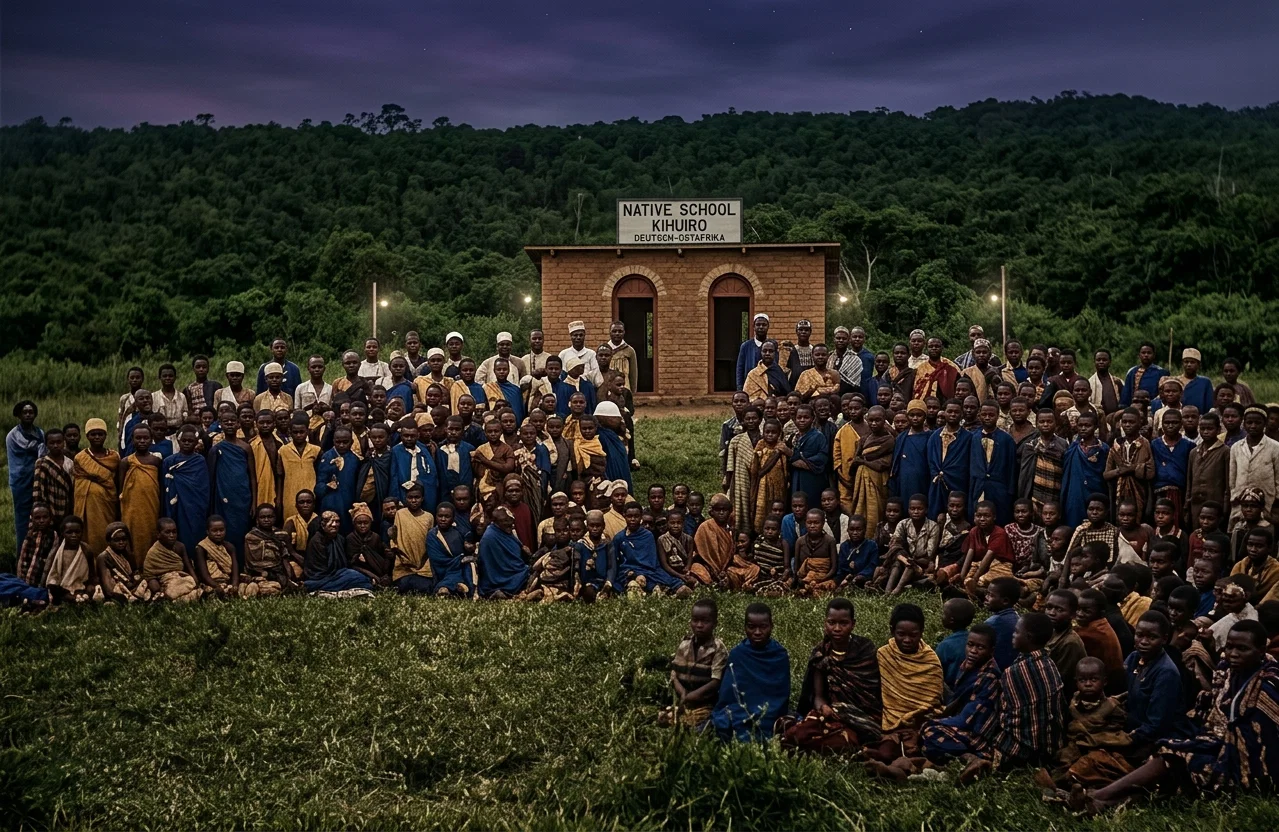
NATIVE SCHOOL AT KIHUIRO
While in Africa, we looked over the whole region surrounding our station. When we first entered the Pare district, there was no other station within fifty miles of ours; but a few months later the Leipsic Mission, which had occupied the North Pare Mountains, wrote our missionaries, asking them to leave that territory. We had previously been very careful to assure ourselves that we were settled in virgin missionary soil. But in view of this protest we went, although it was during the rainy season, to visit the Leipsic station, which was rather hard for us to find, as our boys did not know the exact location—they had been informed only of the general direction in which it lay from us. We had no regular road to guide us. We found that the Leipsic missionaries had rather primitive dwellings. These friends received us very kindly, and we agreed on a boundary-line. Since then, I have visited their missionary director in Leipsic, and had a very pleasant chat with him.
Before leaving, we went up an elevation of eight thousand feet, whence we could see one hundred miles southward into the German colony, and as many miles to the northward, into British East Africa. We were prospecting as to favorable openings for future stations. As the people in the mountains are scattered over a wide area of country, I urged upon the brethren the necessity of opening a station at Kihuiro, a village containing about two thousand people, and located on the caravan road. This place is situated on the river, and is about fourteen hundred feet above the sea. The brethren at first thought that such a location would be very unhealthful, but as thriving missions have been established by other denominations even farther down toward the lowlands, they finally decided to open a second station at that place. From the accompanying pictures, you will see that we have erected a nice schoolhouse in the village itself. We have one hundred and fifty students here now. The dwelling-house is about a mile farther up the valley, away from the village and out of reach of the mosquitoes. To open this station, we sent three missionaries—Brother and Sister Ohme, nurses, and Brother Kotz, who has a good classical education. Both brethren spent over half a year in the Oriental Seminary in Berlin, studying the Swahili, under a good teacher. The Lutheran professor spoke very highly of Brother Kotz’s linguistic abilities, and promised to help him later on, if he should desire to bring out a grammar or dictionary in the native African language, seeing that it would be published free of cost to Brother Kotz. These three workers left for Africa the middle of May, 1905.
We have now arranged for Brother and Sister Langholf to have charge of the upper station, at Friedenstal, where they will look after the cultivation of the land, and see to instructing twelve or more boarding pupils we have, with the forty-five day scholars. Below, at Kihuiro, we have about the same number of boarding pupils, and about one hundred and sixty day scholars. At the time of the dedication in Kihuiro, about six hundred natives were present. In both stations, the Sabbath services were well attended.
But we have now begun the opening of a third station—on the other side of the mountains, where there are about seven thousand people. Brother Enns is to conduct the work there, until some one else can be supplied to take his place.
The natives worship snakes, hyenas, etc., secretly; it took us some time to find this out. Some of the chiefs are more or less influenced by Mohammedanism, and they have ten to thirty wives.
While thus far we have had no direct conversions, the following translation of a letter written by one of our pupils will be of interest:— “Kisuaheli: Mimi mwanafunzi Senamwaye bin Semboja nataka nifuate maneno ya Muungu nikuwe Mkristo na mwanafunzi wa Yezu.”
When translated, this letter reads: “I, pupil Senamwaye, son of Semboja, will now follow the words of God, becoming a Christian and disciple of Christ.” This youth is only fourteen years of age. We are glad for this omen of a better day, when our faithful missionaries there will see fruits of their labors.
When we first began to think of opening this German East African Mission, we expected to have to call on our American brethren to help us with about five thousand dollars, as at that time the German Union was not entirely self-supporting. But as the Mission Board was cramped for means, we decided to take hold of the matter over here; and God has so wonderfully blessed us that up to the end of 1905 we had been able to expend about eleven thousand dollars for the transportation, wages, and outfits of missionaries, and for the buildings we had erected. Not only have we been to such expenses, but we have today a nice capital to go toward starting further stations. We feel very grateful for the help various friends have rendered us from the States; they may be assured that the money they have kindly sent us has been put to a good use.
Brother and Sister Ehlers have had to return to Germany on account of failing health. There is no hope of his being able to return. Brother Wunderlich, our faithful builder, after superintending the erection of the mission buildings, succumbed to a fatal sickness. He returned to Friedensau, where he had left his family, and was permitted to be with them only about two weeks, before death took him from us. He had returned with no intention of remaining in Germany, but had thought to go back to Africa with his family. This seemed to be his chief concern, even during his illness, as his whole soul had been stirred by the needs of the African peoples. While he now sleeps in Jesus, a valiant soldier of the cross, yet his modest tombstone in the Friedensau graveyard will only serve as an incentive to our students, urging them to devote their lives to the noble work of the self-denying missionary.