A Ko-Nien Trip

5%

Review and Herald Publishing Association · Takoma Park Station, Washington, D. C. · Jun 21, 1906

FromReview and Herald, Vol. 83, No. 25.

Read the full edition

A Ko-Nien Trip

JOHN J. WESTRUP
The Chinese New-year celebration began this year on January 24, and lasted eighteen days, during which time it was almost impossible to travel. There is a complete suspension of every kind of business; and the less one does, the more “loyal he is thought to be; and every Chinaman wishes to be very loyal.
It had been decided last year that we should hold our Honan conference during the first part of Ko-Nien (the Chinese New-year). We started so as to be sure to reach Sin-tsai Hsien before Ko-Nien began. Hence, on the twentieth, at 5 A. M., our Chinese “lightning express” arrived, and all being ready, we started on our two long days’ journey.
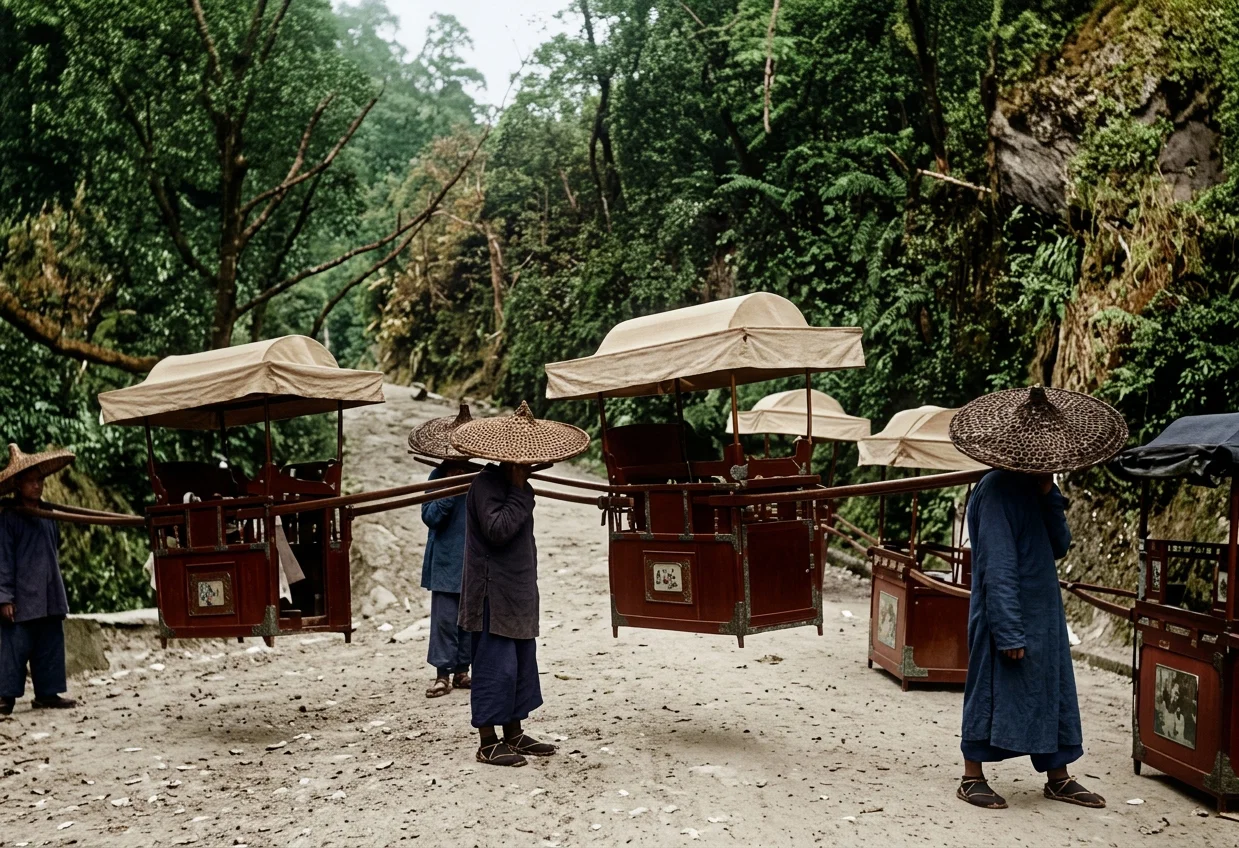
Elder Pilquist rode in his sedan-chair; and a clumsy cart, drawn by a mule and a pony, was to furnish accommodation for Elder Anderson, myself, our bedding, and some dry food we were going to eat with our warm rice and other food which can usually be bought at the inns.
Our paper lanterns furnished us a little light on our path, through the muddy road, until daylight. The cart does not furnish a very safe ride, as the animals—one ahead of the other—are guided by only one line, and can not be easily controlled in crossing the many narrow bridges, or in going by the ditches, but will dodge hither and thither, trying to find better foothold. Elder Anderson rode for about fifteen minutes, and hadall the shaking he wanted, and I rode for about one hour during the day. On we walked through the mud, step by step, the animals having all they could do to pull the almost empty cart. We traveled one hundred and twenty li (three li make a mile) the first day. At noon you should have seen us trying to eat some Chinese soup with chopsticks, laughing at one another on account of the ludicrous effort in trying to get it into our mouths.
At 5:30 P. M. we lighted our paper lanterns, and arrived at that day’s destination at 7 P. M. The name of this city was Cheng Yang Hsien. Having walked for thirteen hours through mud, with little to eat, you can imagine how tired we were, and how well we rested on our hard boards during the night. Next morning it was snowing. And as the Chinese do not want to travel in snow or rain, we were afraid that the snow might detain us for some days; and it being so close to Ko-Nien, we might have to spend many days in that dreary and dismal inn. Hence we thought if we could only reach Roo-Nan-Poo—a distance of fifty-five li—that day, and the next day get to Sin-tsai Hsien—forty-five li distant—we should be thankful.
We consulted our driver, who was willing to go on. But the bearers could not carry Brother Pilquist in the sedan-chair, for it was slippery. Elder Pilquist was promised that he could have a cart the next day. We all agreed that, owing to the approaching New-year, we had better not wait for Elder Pilquist, but go on with our cart, our driver assuring us that he knew the road to Sin-tsai Hsien.
After eating our breakfast, which cost us about four cents, and was the best we could get at that time, we commended one another to God’s loving care, and, separating, started off with but one cart. As soon as we got outside of the city, we discovered that we had the snow and a strong north wind right in our faces. The wind was blowing the snow on our bedding in the cart. So there was no opportunity to ride that day, but we must walk, to keep warm. Everywhere people regarded us as a curiosity, wondering what kind of people we were that would be out traveling in such weather.
After trudging through the snow all day, wet and hungry, not having had anything to eat since 7:30 A. M., we decided, about 4 P. M., to stop in a village overnight. This inn was like a dilapidated barn, with large openings for doors, the cold wind blowing through our compartments, the animals feeding in one part, and we sleeping on some bean-stalks in another part. You can imagine our feelings on entering this place, wet and hungry, a cold wind blowing on us, and about fifty persons crowding into this so-called inn, scanning us from head to foot; and in addition to it all, we discovered, with our meager vocabulary, that our driver had lost his way, so that while in the morning we were only fifty-five li from Roo-Nan-Poo, in the evening, after walking about forty-five li, we were eighty li from the same place, instead of ten li, as we naturally expected.
CHINESE SEDAN-CHAIRS
As soon as we got rid of the crowd, we made our bed, then brought corn-stalks, and made a good fire close to it, which felt very comfortable, although our eyes were running over on account of the dense smoke. After some waiting, our hunger was pacified, and being of good courage, we committed ourselves to God’s loving care, earnestly imploring his protection, as everything around us looked quite suspicious. In the morning we learned that some food had been stolen from the driver. Hence, although it was still blowing and snowing, we were glad to get away from this place, not waiting for any breakfast, as in winter the Chinese stay in bed till eight or nine o’clock, to keep warm.
At about eleven o’clock I felt very hungry, and asked my Father for food. In a few minutes he sent a man—a direct answer to prayer—who had been in town buying some raw carrots and another food article, for his family. He wanted to give us some, when we asked him; but we would not accept his generous offer, but paid him for what we needed, and walked in the strength of that until we had our supper at 5:30 P. M. In the evening, to our great encouragement, we learned that we had come thirty-five li nearer to Roo-Nan-Poo. We enjoyed a good night’s rest.
Next morning the sun shone bright. We bought a wooden shovel to use in the snow-drifts, and, hiring a guide, we started off, and after eight hours’ continuous walk, reached Roo-Nan-Poo. After some pounding, the large inn gate was opened. We were somewhat unwelcome; but the innkeeper, being a very kind man, treated us to a good New-year’s eve dinner at 7 P. M., and we were really surprised that Chinese food could taste so good. We had not eaten anything since eight o’clock that morning.
Knowing that on the next day no inns would be open, and no food—not even boiled water—could be bought, and it would be almost impossible to travel, we bought a supply of mo mo (bread). We learned that our driver was willing to go on, but that he did not know the road; and we thanked God most heartily, who helped us to hire a guide, and this when every Chinaman is supposed to celebrate at least the first four days of Ko-Nien.
After a good night’s rest (although heavy firecrackers were being shot off all night), we were ready to start at five o’clock in the morning. We crossed the river at half-past six, the driver taking his team across it, and we carrying our bedding and other articles across three boats that had been tied together during the night so as to form a bridge. At about nine o’clock we lunched on some dry bread, as we were walking. At noon we came to an inn, but could not get so much as a cup of boiled water. Everywhere the people, attired in their best clothing, hurried to come and stare at us; and the very dogs seemed to think, judging from their angry manner, that we were infringing on the country’s monotonous tranquillity.
We were nearing our destination. From our time and other signs, we knew that the walls of the city would soon appear in the distance. About three o’clock we saw them; and although we knew that it would take us an hour longer to reach the place, the very sight of the city seemed to take away our fatigue and give us new strength, joy, and determination to press onward; soon we would meet and embrace our brethren, who were longing and waiting for our arrival. In the same way, the prophecies and signs tell us plainly that we are nearing the New Jerusalem. And, although the struggle is hard, the very consciousness of the nearness of our dear Saviour’s coming really takes away our tired feeling, and gives us new strength, joy, and determination to press onward to the glorious home in the New Jerusalem.
I know that Elder Anderson will write the particulars about our good meetings, hence I will only say that the old adage proved true even in this case—the more effort required to procure a thing, the greater its value. These meetings were indeed valuable to us. I have attended many meetings and camp-meetings, but have never felt the presence and power of the Holy Spirit more than here. “The ‘loud cry’ will come and pass, and the latter rain will fall, and many of our people know nothing at all about it.” Dear brethren, the end is very near. These foreign fields are ripe for harvest, but where are the laborers? There is a deep longing for something better, and the calls for the gospel areso many that they can not all be filled. O that the brethren at home would lay their lives and means on the Lord’s altar, and then say, “Here am I; send me”! O that hundreds would come now to this vast field, to study this fascinating language, that in two years they might have such command of it that they could go from place to place and gather in the great harvest that will come from Sinim’s land!
The last meeting of the session was marked by a touching incident. At the beginning of the meeting, Dr. Miller told us, with tears, that he had just learned that one of his helpers, who had gone to visit his home, forty li from Sin-tsai Hsien, was not coming back to go with him to his station. The young man had been intimidated by his father and friends, who told him that if he did not separate from the foreigners, he would be killed with them in the coming revolution. We prayed earnestly for the young man, with hearts and eyes running over. At the end of the meeting Dr. Miller said that he had sent for a guide, as he felt strongly impressed by the Spirit that he must give the young man one more chance. As the doctors had already hired their conveyance, and were to start at two o’clock the next morning, Dr. Miller decided to start in the evening for the young man’s home, and, walking all night, meet the others at some point on the road. So he started on his night trip as we went to bed.
Although the night was dark, and a strong northeast wind was blowing in his face, Dr. Miller went on to find the lost sheep. Brethren, such earnestness is sure to be blessed. Such earnestness would take many Christians away from their easy chairs and Pullman sleepers, and send them to the most remote parts of the earth. Such earnestness, by divine grace, shall take us safely through these sifting times, and land us in the New Jerusalem. None will reach heaven on flowery beds of ease.
At some other time I will write of our experience coming back from the meeting. Dear brethren, pray earnestly for the work in these remote parts of the earth.
Lo Shan, Honan, Via Hankow, China.