Alaska

5%

Seventh-day Adventist Publishing Association · Battle Creek, Mich. · Jul 22, 1902

FromReview and Herald, Vol. 79, No. 29.

Read the full edition

Alaska

MRS. OTHNIER
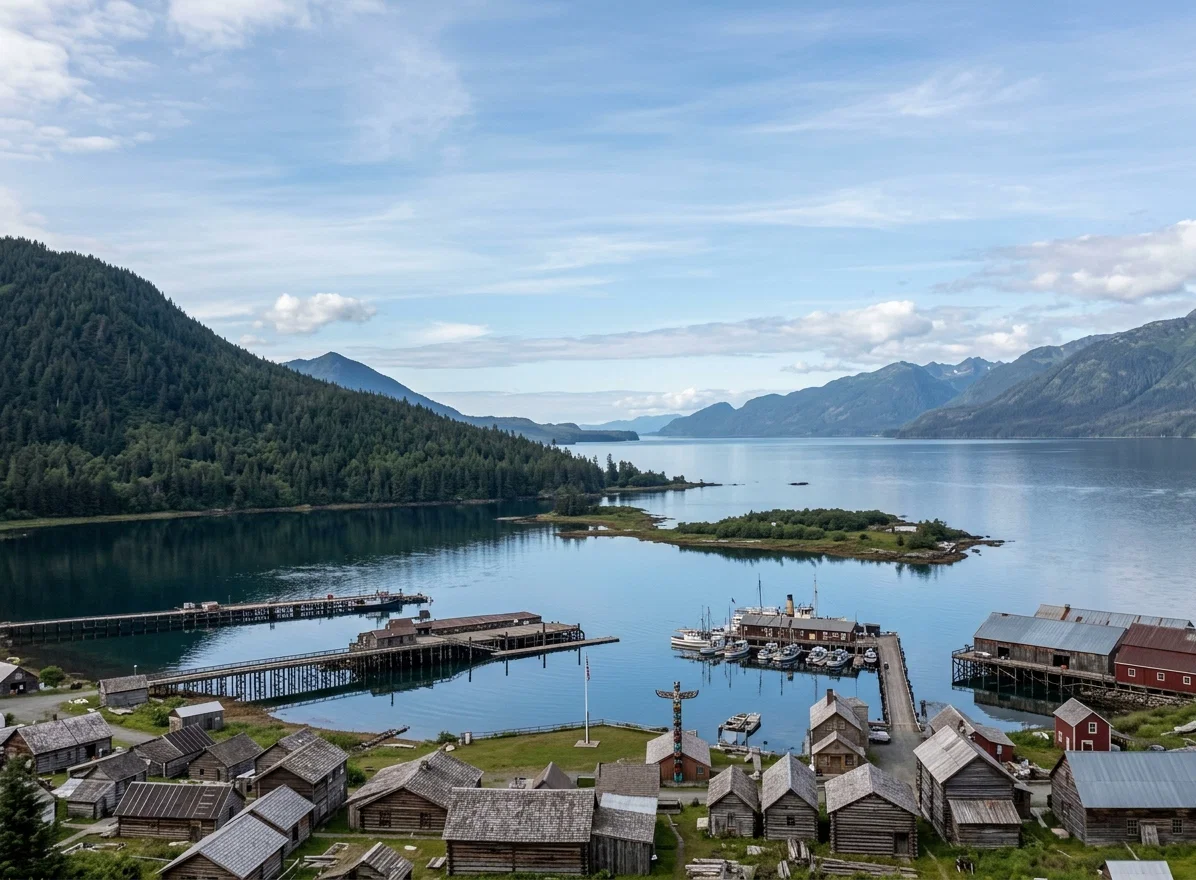
ONE of the most interesting of the old towns in southeastern Alaska is situated at the northern extremity of Wrangels Island. In 1834, sixty-eight years return ago, Baron Wrangell, then governor of Russo-America, also chief director of the Russo-American Fur Company, sent Lieutenant Dionyrius Zaremba from Sitka to establish a small stockade post at this point, which he called Ft. Dionyrius. Their principal object was to prevent the Hudson Bay Company from building a fort on Russian territory. However, it became the chief trading station of the two companies.
WRANGEL, ALASKA
WRANGEL, ALASKA
In 1867, when the United States bought the Territory of Alaska, two companies of United States infantry were sent to this place, the name having now been changed to Ft. Wrangel. The buildings of the soldiers were quite interesting. A two-story log cabin with two wings extending at right angles with each other, formed two sides of a parade ground, while other buildings used as officers' quarters, formed the third side, leaving the southern exposure free to see the approach from the water.
A blockhouse, fifty feet high, the sides of which were perforated with loopholes, was an imposing structure. The buildings were all erected in such a substantial manner as effectually to guard against surprise or assault from the Indians.
In the center of the parade ground stood a flagstaff, and near it one of the most unique specimens of totem poles found in Alaska.
The troops were withdrawn after three years.
In 1871 we again have Ft. Wrangel as one of the most important points in Alaska, as in that year occurred the first mining excitement in the interior of this country. Rich placer gold was discovered in the Cassiar district of British Columbia, near the head of the Stikine, a river navigable for about one hundred and fifty miles from Wrangel. All supplies were transported on it by light draft steamers, and then to the mining camps by pack train.
The old miners tell of stirring times when the men returned from the gold fields to spend the winter in Wrangel.
In 1875, as people had gathered there in large numbers, it was thought best to return the militia; they remained two years this time.
In a few years mining in that locality with gold pan and rocker ceased to pay. It was the opinion that sometime the mines would be operated under the hydraulic system; but fields so much richer have been found that to-day Ft. Wrangel is a village, with a population of five hundred and seventy-five, probably second in number of natives to Sitka, and always a place of much interest to the tourist. It is the first stopping place in Alaska of any importance, for the north-bound steamer.
The totem poles are found here in greater numbers and variety than at any other native settlement. The final resting place of some "good Indians" is also here. A great variety of curios may always be found at this place.
One article in which there is some trade is the garnet stone. There are two mines about four miles from Wrangel. In the rough these stones are half imbedded in a brittle slate and sandstone, but when cut and polished, they are quite handsome. A brilliant specimen of Alaska diamond is also found near here.
The chief industries of this place at present are carried on by means of a sawmill and fish canneries. On the waters embraced in the Wrangel district are eleven canneries and thirteen salting stations. To keep up this supply there are three salmon hatcheries, which turn out nine million young salmon annually. Wrangel is still one of the largest fur-trading stations of southeastern Alaska; in fact, it is the hunter's paradise. In one season 400 bear skins, 300 beaver, 200 land otter, 500 martin, 5,000 mink, besides wolves, wolverines, hairseal, and deer, were caught and sold to the merchants.
Ten years ago the Catholics and Presbyterians each had a mission at Wrangel; but when the population decreased, the Catholic church was abandoned, and is now a mass of ruins. The Presbyterian church burned down, but has been rebuilt. Services are held on Sunday mornings for the natives, by the aid of an interpreter, and in the evening for all who care to attend. But six white people are members of the church.
Some of the Indian houses present a neat appearance, but inside are devoid of comfort, and in some cases several families occupy one room with a general fireplace in its center.
There are the Thlingit Indians, divided into two clans, Wolf and Raven, and these into various tribes. A native never marries one of his own clan. They are quick observers, imitative, willing to work, handy with tools, and shrewd bargain drivers. Their curios rapidly advance in price when the tourist season approaches.
They have many vices which have not been checked by contact with civilization.
One of their chiefs will occasionally give a potlatch, though not so elaborate as in former years. Dancing, feasting, and drinking are freely indulged in at such times, and presents of food, calico, and money are distributed among the natives.
Some of the finest timber in this section, is in the vicinity of Wrangel. The spruce, hemlock, red and yellow cedar, birch, and pine are common varieties. The yellow cedar will admit of a beautiful polish, and will probably be used for furniture and finishing purposes.
There is a pretty, sandy beach, forming a semicircle of about three quarters of a mile; and when the people return home, in the late fall, from their season's work, the different craft lying at anchor present a novel and interesting scene.