AFTER finishing our work in Medan, Sumatra, Brother Munson and I sailed for Singapore, via Penang, a city on a small island a mile or two west of the mainland. This is the most northerly of the English settlements on the Malacca Straits, known as the “Straits Settlements.” The other towns and provinces included in these settlements, are Province Wellesley, the Dindings, Malacca, and Singapore. Province Wellesley is a narrow strip of country on the peninsula opposite Penang; the Dindings comprises a small territory and some small islands farther south than Penang; Malacca is the name of a small province, as well as the name of a city one hundred and ten miles north of Singapore; Singapore is the name of a small island, as well as of a city, off the south point of the peninsula.
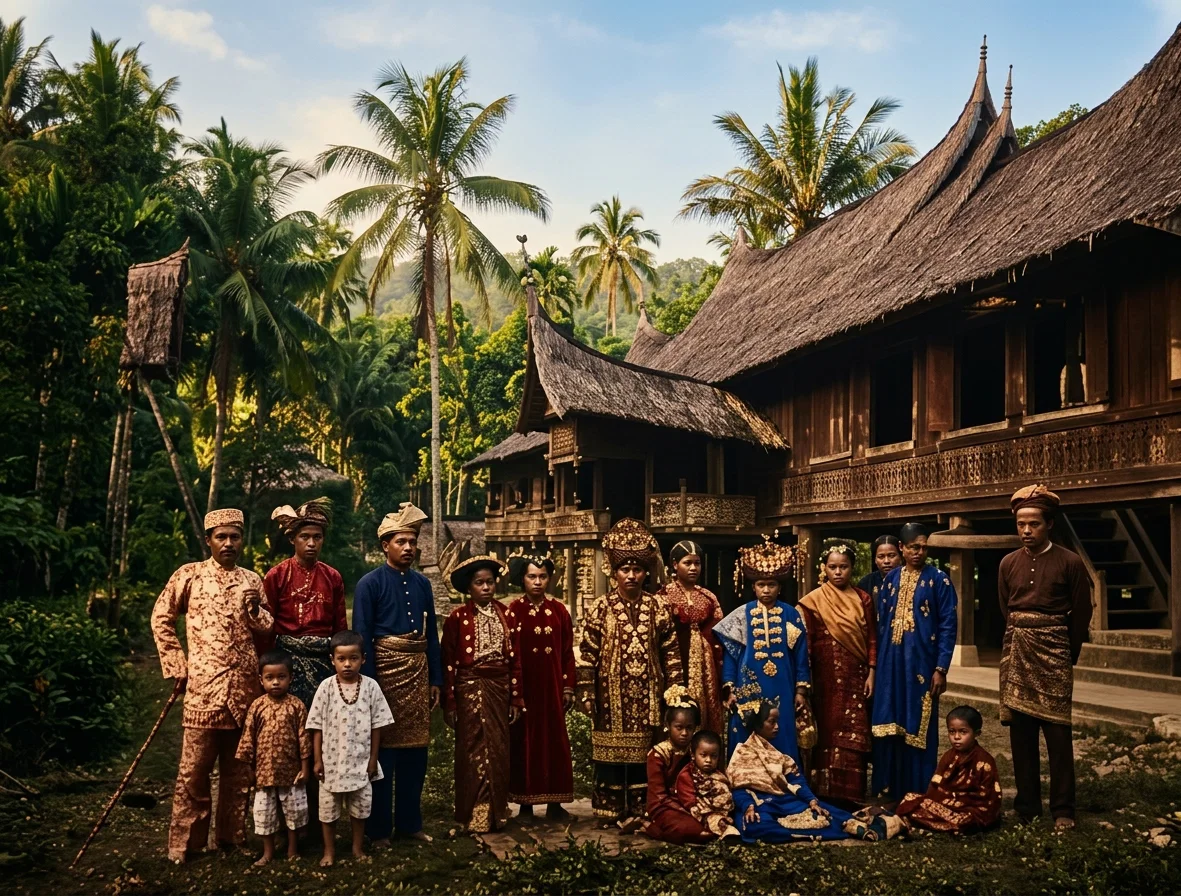
A GROUP OF MALAYS
In all these places, nothing has been done to give the present truth, except as some of these places have been canvassed by Brother Meyers now of Burma, for “Great Controversy” and health books. As a result of this work, one Eurasian lady accepted the truth at Penang, though I did not know it till after my last visit there. We placed publications in the hands of some of the English-speaking people there, and sent other matter later.
When proceeding to Singapore along the west coast of the peninsula, we passed close to the city of Malacca, which is the oldest European settlement in the far East. This place was settled by the Portuguese in 1511 A. D., during their splendid era of discovery. The inhabitants are a mixture of Malays and Portuguese, and are mostly Catholics. St. Francis Xavier, who was sent to India by Ignatius Loyola, the founder of the Jesuits, soon after the formation of that organization, labored here with his “burning zeal” for the “conversion” of the Malays. And without doubt they were “converted.” From our ship we could plainly see on the hill the old cathedral where this “saint” carried on his work, and where, after his death (which took place on the coast of China), his body lay in state before being carried to India for burial. A silver tablet marks the spot in the old church where his body lay.
Malacca has had a checkered history. After being held by the Portuguese for over one hundred years, it was captured by the Dutch in 1640 A. D., passed into the possession of England in 1795, was restored to the Dutch in 1818, and in 1824 again became English possession by exchange for territory in Sumatra.
The principal political divisions of the Malay Peninsula are the federated states of Perak, Selangor, Pahang, and Negri Sembilan, known as the “Federated Malay States.” These are administered under the advice of a British resident general, but governed by native rulers. The inhabitants are principally Malays, and the religion is Mohammedanism. The peninsula contains some extensive tin mines; gold is also mined to some extent. The exports of the country are tea, coffee, rice, sugar, pepper, sago, gutta percha, spices, tobacco, gums, etc. Railways have been built in some parts of the country, and plans are on foot in Singapore to run a railroad from that place through the whole extent of the peninsula into Burma and India. Thus the way is prepared for the rapid spread of the gospel message among the millions of Malay Mohammedans.
In the extreme southern part of the peninsula, which is the most southern point of Asia, is the state of Johore, still ruled by a native Mohammedan sultan. This state will probably sooner or later come under British rule. Just before leaving for my home, I had the privilege of spending a few days in the town of Johore, the guest of one of the leading English citizens. Johore is a lovely spot, being pleasantly located on the narrow strait that separates the peninsula from the island of Singapore. My host called Johore the pleasantest spot in the world. It certainly was not so hot nor enervating as Singapore. The wife of my host was the daughter of the Rev. Keasberry, one of the very first English missionaries to open up gospel work in Singapore, while her mother was an American.
While at this place, I visited the palace of the sultan, and also the magnificent mosque erected by him. This is by far the finest one I have seen. The palace grounds were beautifully laid out with all manner of tropical trees and flowers, while the interior of the building was splendidly furnished with all that wealth could purchase. I was permitted to visit the room containing the sultan’s regalia and treasure, and there saw ornaments of gold and jewels probably worth millions of dollars. But how valueless did these baubles seem in comparison with the “treasure” which every child of grace may have “in earthen vessels”!
While to human appearance it seems a hopeless task to try to place the spiritual truths of the gospel before Mohammedan Malays, we know that some of this nationality will swell the great company around the throne of God. One needful thing for this people is an abundance of wisely prepared literature, to remove, if possible, the bitter prejudice that has for centuries been cherished against the gospel. Since my return to Australia, Brother W. R. Munson has written and put through the press our first tract in the Malay language. This was written primarily for the use of the Chinese of Sumatra and the Straits Settlements, who nearly all speak the Malay language; but this will do as well for the native-born Malays. The subject of this publication is the Second Coming of the Lord and the End of the World. The money for this enterprise was furnished by the Sabbath-schools of Australasia, which also supplied other funds to be used in sending European literature into the benighted regions of the East.
Singapore is so located as to be a natural base of operations for our work in this field, as well as in the great East India island field. From this place ships run to all parts of Malaysia, the Straits Settlements, the Philippines, Siam, Burma, British India, as well as to Europe, Japan, China, and Australia. In fact, Singapore is one of the great commercial centers of the world. War ships of all nations put in here when in the East. No better place could be found for ship mission work. At present there is as much liberty to propagate the gospel message as anywhere in the world. Our doctors would have full liberty to practice here, there being no restrictions on medical practice. On account of the enervating climate and the unhygienic habits of the people, much sickness exists, which calls for consecrated nurses. Shall we not rise and occupy this field before greater difficulties close up the way?