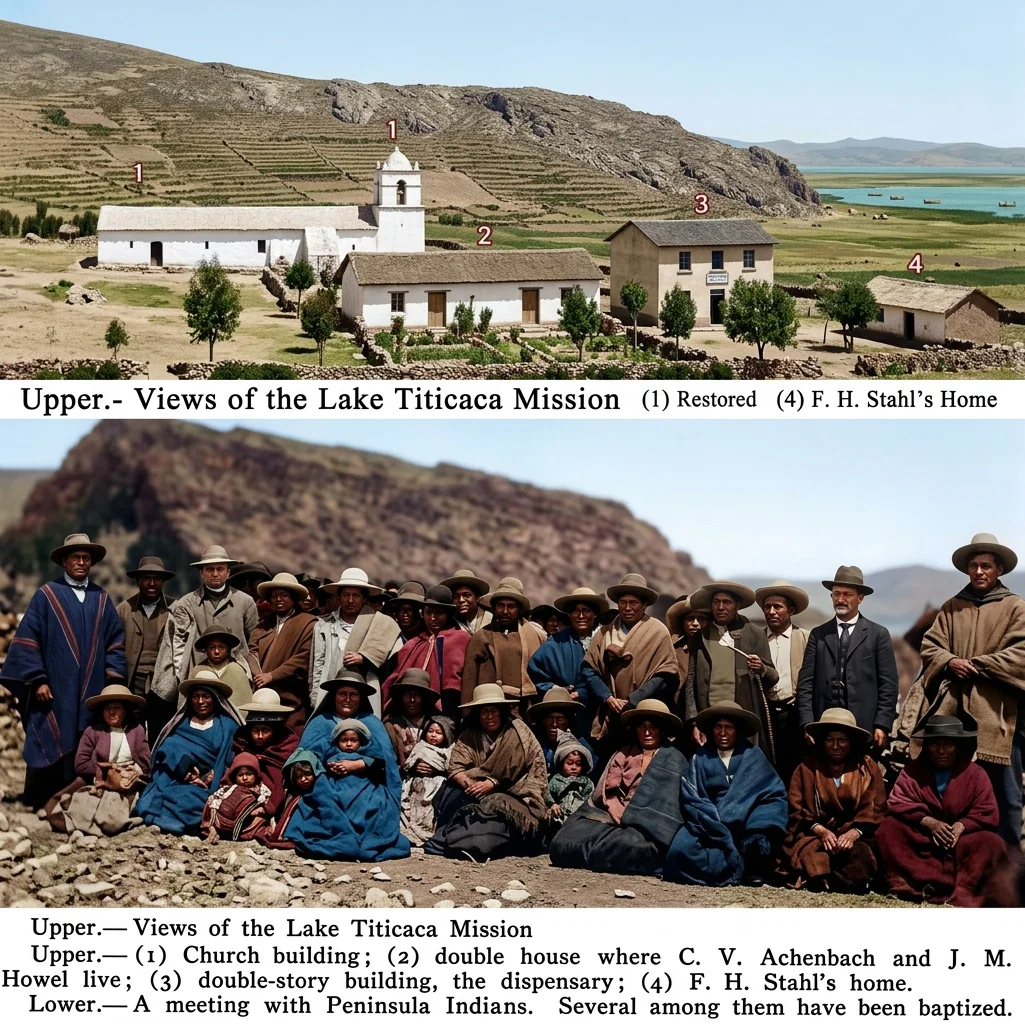
THE mission is situated at the foot of a mountain overlooking a large plain which is studded with small grass-covered Indian huts. The plain is about fifty miles long and six miles wide. We can see the shores of Lake Titicaca from the mission. Puno is about twenty-one miles distant, and is the station where we get off the cars for the mission. This journey must be made on horseback, as there are no vehicles of any kind in this part of the country. However, the trip is delightful. To our left we are continually in sight of Lake Titicaca, the highest navigable body of water in the world. We see the small Indian boats, which are made of grass which grows in the lake. The owners are either fishing or crossing the lake. To our right we see high mountains and ragged rocks with their strange, fantastic shapes. Along the side of the mountains are a great many Indian huts.
The children run toward us and ask for bread. Brother and Sister Stahl have made it a practice when they pass that way to give the children something, and it has helped greatly to make friends among the Indians. For those who are not used to riding on horseback, it is rather a tiresome trip, as it takes about four or five hours to make the journey.
The country looks rather barren, as there are no trees to be seen except a few small ones that are set out around the houses. The sides of the mountains are very rocky, and contain a network of stone fences. Every available space of ground is cultivated. Barley and potatoes are the chief products. The Indians also raise many sheep, llamas, chickens, and a few cows.
The leading highway between Puno and La Paz passes in front of the mission. Scores of Indians and Spaniards go along this road daily. The influence of the mission has extended far and wide.
We find the Indians of a very kind disposition. Although oppressed for centuries, they take delight in manifesting the spirit of kindness to others. They are very appreciative of any act of kindness shown to them. They speak the Aymaran and Quichuan languages. There are four hundred thousand who speak these languages, and every effort that is put forth to get the language into writing or in print is opposed by the priests, who realize that the missionary speaking these languages will gain the confidence of the Indians, and they themselves will lose their hold upon the people.
The work the mission is doing is known far and wide, and people are coming many miles for spiritual and medical help. The other day a man came hobbling to the mission. He was very tired. He told us that he had come thirty miles. He desired an electric treatment. I gave him the treatment and some medicines, and a few sandwiches. It is sometimes rather amusing to have them come into our dispensary, requesting us to remove their lungs for them, as they are hurting them very much.
Photo by F. H. Stahl
Upper.— (1) Church building; (2) double house where C. V. Achenbach and J. M. Howell live; (3) double-story building, the dispensary; (4) F. H. Stahl's home.
Lower.—A meeting with Peninsula Indians. Several among them have been baptized.
A few days ago two Indians of the Quichuan tribe came to the mission and asked us to send them a teacher, that they might learn to read God's Word. Such requests come quite often, and it reveals the fact that the harvest is ripe. As a people we have done nothing among this tribe of Indians, which numbers three million.
We have a church here of over three hundred members. Our attendance ranges from six hundred to seven hundred persons every Sabbath. The building is far too small to accommodate the people decently. The Indians use no chairs, preferring to sit on the floor; so for this reason we have only a few benches. Our Sabbath school is very crowded, and we also lack sufficient teachers. Some of the classes have seventy-five students, and one can imagine how difficult it is for the teachers to teach a class of that size. In fact, we have only ten teachers, eight of whom are Indians, for the seven hundred persons. We hope that we shall soon have more Indians trained to help in our Sabbath school. However crowded we are, the people take a deep interest in learning the truths of the Bible. We pray that many of them may be fitted to take some active part in proclaiming the truth to their fellow men.
We are surely glad that Brother and Sister Howell have come. They will take charge of the school. We expect that at least two hundred students will attend this year. Brother Howell will have two native assistants. All the children speak Aymara, but as there is no literature in that language, we teach the Spanish language.
We have four Indian workers connected with the mission, who act as teachers and interpreters. Some also are sent out to preach the gospel to their fellow men. These workers are very earnest, and do a good work for God.
Just a few weeks ago the lawmaking body of Peru passed a bill granting religious liberty to all Protestant denominations, assuring protection to all Protestant sects. The president was showered with petitions asking him to veto the bill, but he failed to do so. We are glad for this omen of God's providence. Surely, under such favorable circumstances, we must carry the banner of the cross to all Peru. The governor of one of the small towns near the mission has posted notices warning the people against abusing us in any way, stating that if they did they would be fined and imprisoned. This shows a far different11sentiment than that which has been manifested in the past. Two years ago, in the same town, Brother Stahl was stoned; but now as we go through the place the people are glad to see us. They say that the work of our mission has made it possible for the bill for liberty to be put through congress.
Photo by F. G. Hinkley
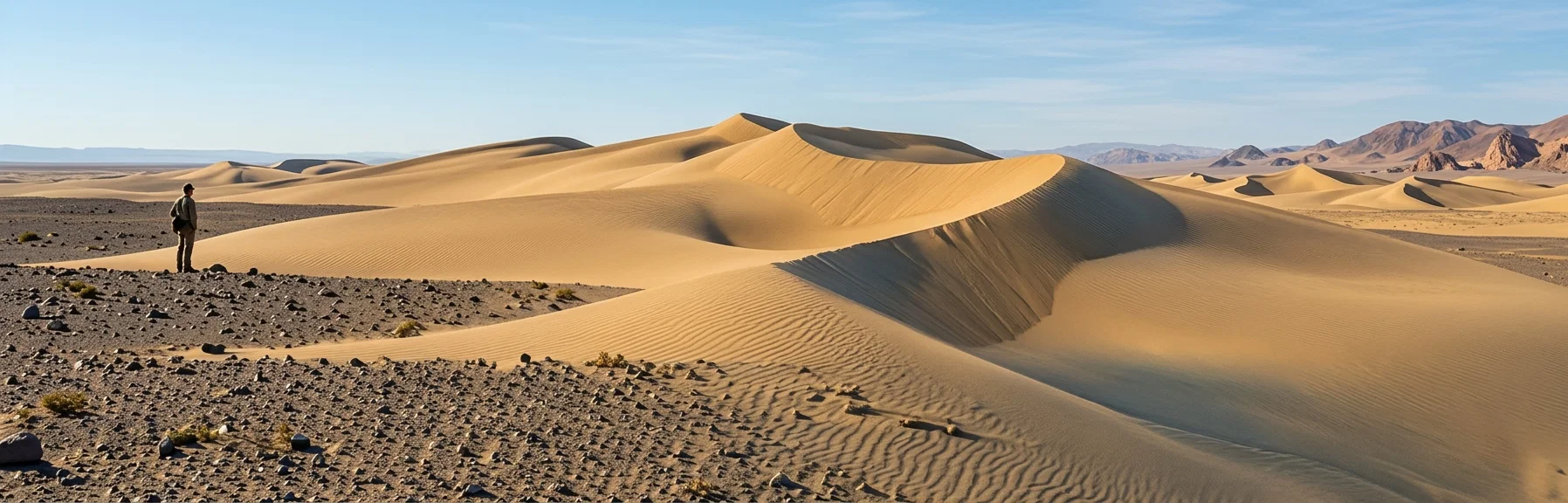
One of the many moving sand piles in Peru. The crescent is always in the same direction. These great piles of sand are constantly moving.
Our Indians are far different from those of other places. The gospel has made a wonderful change in them, and the people cannot help noticing the difference. Thus they are beginning to look upon our work in an altogether different light than they did some time ago.
The medical work has been a great entering wedge to reach the hearts of the people. The Indians never had the privilege of receiving any medical attention whatever. The Spanish doctors do not treat Indians, and so the medical work of the mission has opened up the way to come in touch with hundreds of them, and to give them the gospel. The Indians know practically nothing of the principles of health. They live in filth, and there is a great deal of sickness among them. Our medical work is increasing continually. A few days ago a call came to the mission for some one to go to see a sick man about seven miles away. Brother Stahl was busy, so Brother Howell and I, with Wallace Stahl to act as interpreter, went to attend to the man. When we had finished our visit with him, and were ready to leave, we found a number of persons waiting outside the hut, all wanting medical help. Before we left we had treated nineteen patients. We arrived home late that night, yet glad for the privilege of helping these dear people. We generally pray with the people and invite them to the mission. Our prices are very reasonable, as the Indian cannot afford to pay much, a day's wage being only from fifteen to twenty-five cents. But we gain their confidence and love, and are thus able to get them to accept the gospel.
We also perform some very serious operations, although under conditions most people would think very unfavorable. A few weeks ago we operated on a young man's knee. The hut inside was dark, so we performed the operation in the yard. Even the priests come here for medical assistance. The Lord is blessing our efforts for the restoration of the physical ills of the people, as well as our efforts for their spiritual restoration.
A few days ago, while Brother Stahl and I were returning from a trip, we noticed to our left, about a mile away, a display of different colors. It looked to me like a blanket show. Brother Stahl recognized it at once as an Indian wedding. So he suggested that we go to see it. As we came near, many of the people recognized us, and came running to us. The women and some of the men were dancing to music made by tin flutes. Quite a number of the Indians who were present belong to our church, but they did not engage in the dancing and drinking as did the rest.
We dismounted, and every one wanted to shake hands. There were about three hundred present. After we got through hand-shaking, we went to see the bride. She and a number of women were sitting on the ground in a circle, in the midst of which was a blanket spread, having on it some boiled potatoes and some wedding cakes. We each presented her fifty centavos, or about twenty-five cents gold. In return, she gave us each a wedding cake. The women were dressed in their best. The Indian likes bright colors, and all the colors were represented at the wedding. They make their skirts as full as they can gather them at the band. They are made of heavy woolen goods which they make themselves. On festive occasions they wear as many as twelve skirts at a time. Women sometimes wear skirts weighing as much as fifty pounds. Each skirt worn is of a different color, and as the wearer wants each one to show a little, each comes a little below the one over it. The men wear shawls, or penchos, many of which are very pretty.
Before we left the wedding, we offered prayer. The groom then gave each of us a glass of fruit juice; and after wishing them both a happy future, we left for home.
By the time the next missionaries come, we hope they can travel from Puno by boat, as Brother Stahl has ordered a small boat from Michigan for the use of the mission. Our work for the Indians will center around Lake Titicaca, and many mission stations will undoubtedly be started near the lake, so the boat is a real necessity.
You can see by this that our needs are great, and that we need many more young men and women to help in this great work. We have barely made a beginning in the work. The many thousands who are waiting for help should be supplied with teachers and medical evangelists. Men and women who know God are needed here. We are praying that the Lord of the harvest will send more consecrated men and women into this part of his great vineyard.