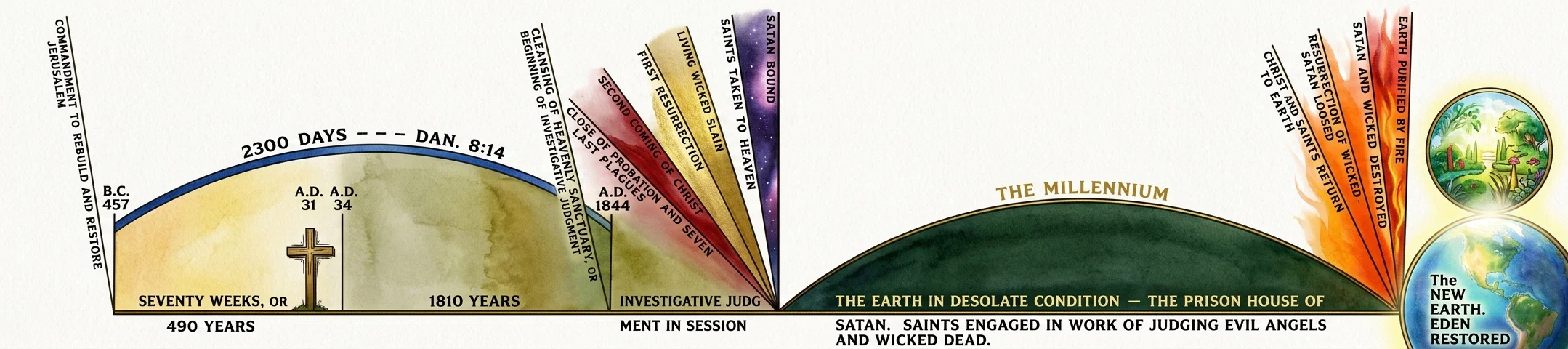
THE EVENTS LEADING UP TO AND CONNECTED WITH THE END OF THE WORLD AND THE RESTORATION OF ALL THINGS
The twenty-three hundred days (years) of Dan. 8: 14 begin with “the commandment to restore and build Jerusalem” (Dan. 9: 25), which was issued by Artaxerxes Longimanus, 457 B. C. (Ezra 6: 14; 7: 7, 12-26), and extend to A. D. 1844.
The seventy weeks (490 years) of Dan. 9: 24 begin at the same time, and extend to A. D. 34. The remainder of the full period, 1810 years, covers the time from A. D. 34 to A. D. 1844.
In 1844 our great High Priest began his ministry in the most holy place of the heavenly sanctuary. This marks the beginning of the judgment hour in which the eternal destiny of all the inhabitants of the earth is decided. While this work is in progress, the judgment-hour message (Rev. 14: 6-12) is proclaimed.
The close of this period, whose limits are not definitely fixed, which is also the close of probation, will usher in the events connected with the personal coming of Christ to this earth. At this time will occur the resurrection of the dead in Christ, the overthrow of the wicked then living, and the entrance of the saved into the heavenly Jerusalem, while Satan is left upon a desolate earth without access to any living being.
The coming of Christ to this earth for the saints indicates the beginning of the one thousand years (the millennium) during which the earth remains in a desolate condition, while the saints unite in determining the punishment of evil angels and of those inhabitants of the earth who have been accounted unworthy of eternal life. 1 Cor. 6: 2.
At the close of the millennial period Christ will return to this earth, accompanied by the saints. The wicked dead will then be raised, and with Satan as their leader, will attempt the capture of the New Jerusalem, which has come down from God out of heaven. The rebellious host is destroyed by fire, which purifies the earth. Rev. 20: 7, 9. The new earth, upon which the saints will dwell eternally, becomes in a special sense the dwelling place of God. Rev. 21: 3.