Our Malaysian Mission Field

2%

Review and Herald Publishing Association · Washington, D.C. · Jun 3, 1915

FromReview and Herald, Vol. 92, No. 27.

Read the full edition

Our Malaysian Mission Field

OUR voyage from Calcutta to Singapore took us across the Bay of Bengal and down the Malacca Strait, a distance of 1,630 miles. All the features of this voyage—the weather, sea, steadiness of the ship, passengers, food, and general service—combined to make this one of the most enjoyable sea trips I have ever had. As I was very anxious to write my reports on India and to catch up with my correspondence, I greatly appreciated these excellent conditions for hard work. Our steamer, “Kut Sang,” left Calcutta the tenth of February and arrived at Singapore the nineteenth.
On arriving at Singapore we found our people, with the rest of the citizens, in a rather serious condition. On the fifteenth a regiment of 800 Indian soldiers mutinied. Without the slightest warning they left their barracks about three o’clock in the afternoon and began shooting the Europeans in the streets. In a short time the whole city was filled with consternation. The loyal soldiers in the city were few, but they were joined by the men in the business houses, and by very prompt, heroic efforts they saved a general massacre of the European population. The women were quickly removed from their homes to steamers lying at anchor in the harbor, and the men who did not join the fighting forces were gathered into a well-protected area. Our sisters were taken to the steamer “Nile,” and our brethren were safely housed in our church building, which was located in the safe area.
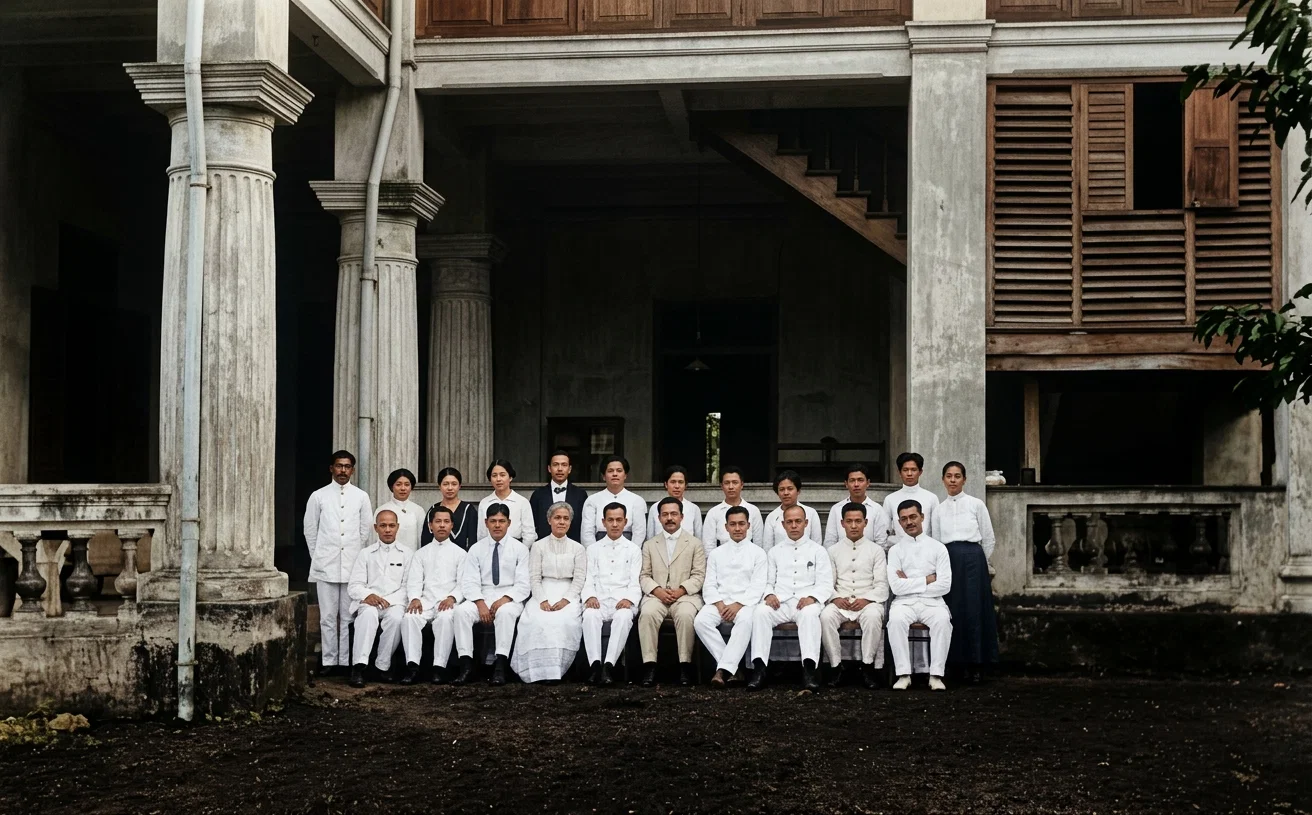
The outlook for a general meeting of our workers in the Malaysian field was not very encouraging, but we decided to make the best of the situation. The mutineers that had not been shot or captured were in hiding, and it looked as if it was a matter of only a few days when they would all be captured. After advising with the military authorities we decided to go on with our meeting, and by sundown we were nicely located in our large, well-ventilated mission building. There were twenty of us, making a large, happy family. We had no thought of danger, although for three or four nights we could hear shooting in different directions around our building. We had all looked forward with great expectation to this gathering, and we felt that the Lord would care for us as we prayed and planned for the advancement of his cause in this part of the great harvest field. This was the biennial council of the Malaysian Mission field.
Owing to the general disarrangement of the shipping schedules caused by the war, it had been impossible to plan definitely just when we could meet and how long we could remain together, but after a great deal of uncertainty and delay, we had all succeeded in reaching Singapore about the same time.
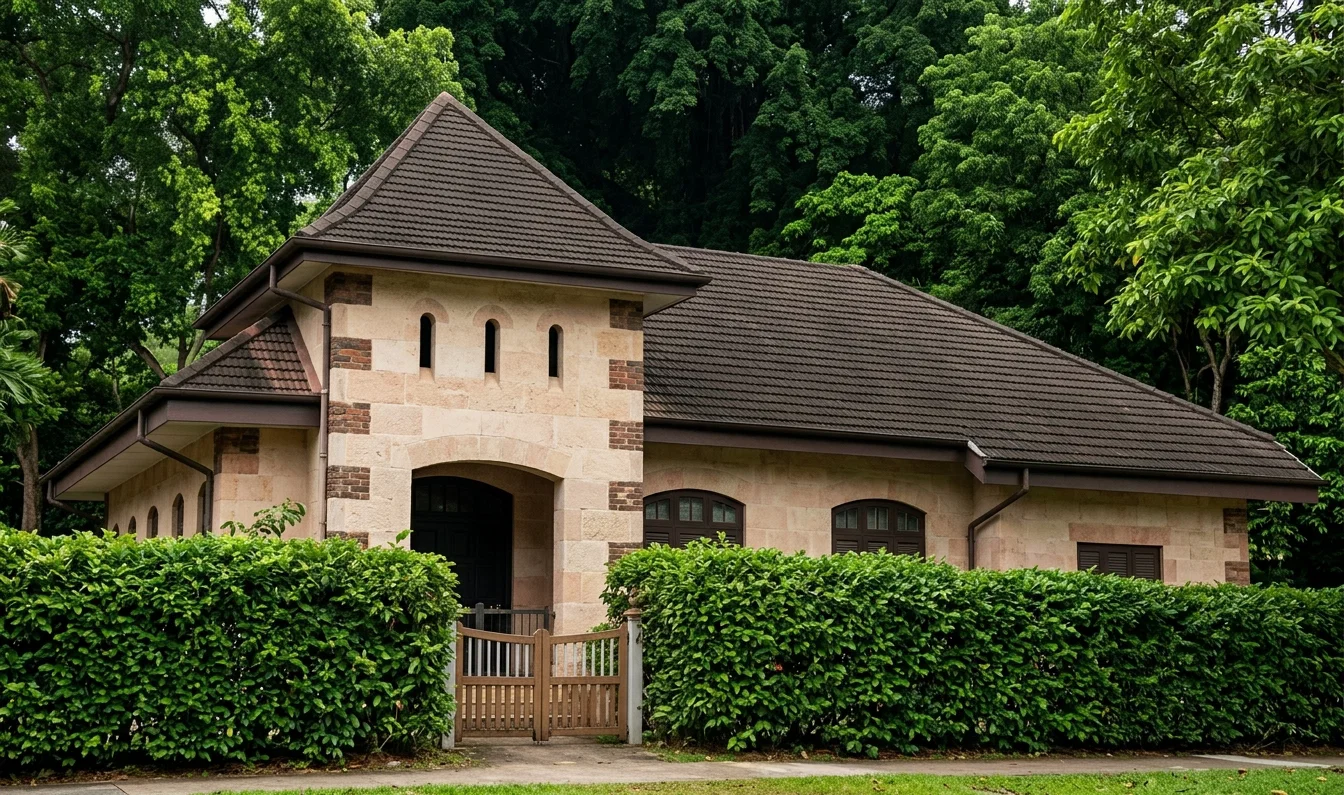
SEVENTH-DAY ADVENTIST CHURCH BUILDING, SINGAPORE
Our meeting continued one week. Elder R. C. Porter, president of the Asiatic Division, was with us to aid in shaping the work of the council, while the burden of carrying out the daily program rested upon Elder F. A. Detamore, the superintendent of the Malaysian Mission field.

Malaysian Mission Territory

The territory of this field embraces the Malay Peninsula, Dutch East Indies (except Dutch New Guinea), and British North Borneo. The Malay Peninsula is a long, narrow strip of land lying between the China Sea and the Malacca Strait. Only a small portion of the peninsula is British territory. The British territory is called the Straits Settlements because it is made up of detached blocks of land along the Straits of Malacca. In the early days these were the principal European settlements on the peninsula. These settlements are composed of,—
a. The island of Singapore, at the extreme south end of the peninsula.
b. Malacca, a strip of land on the west coast of the peninsula about one hundred miles north of Singapore.
c. The Dindings, a piece of the mainland, and a number of islands 350 miles north of Singapore.
d. The island of Penang and Province Wellesley, a strip of territory oppositePenang on the mainland, 480 miles north of Singapore.
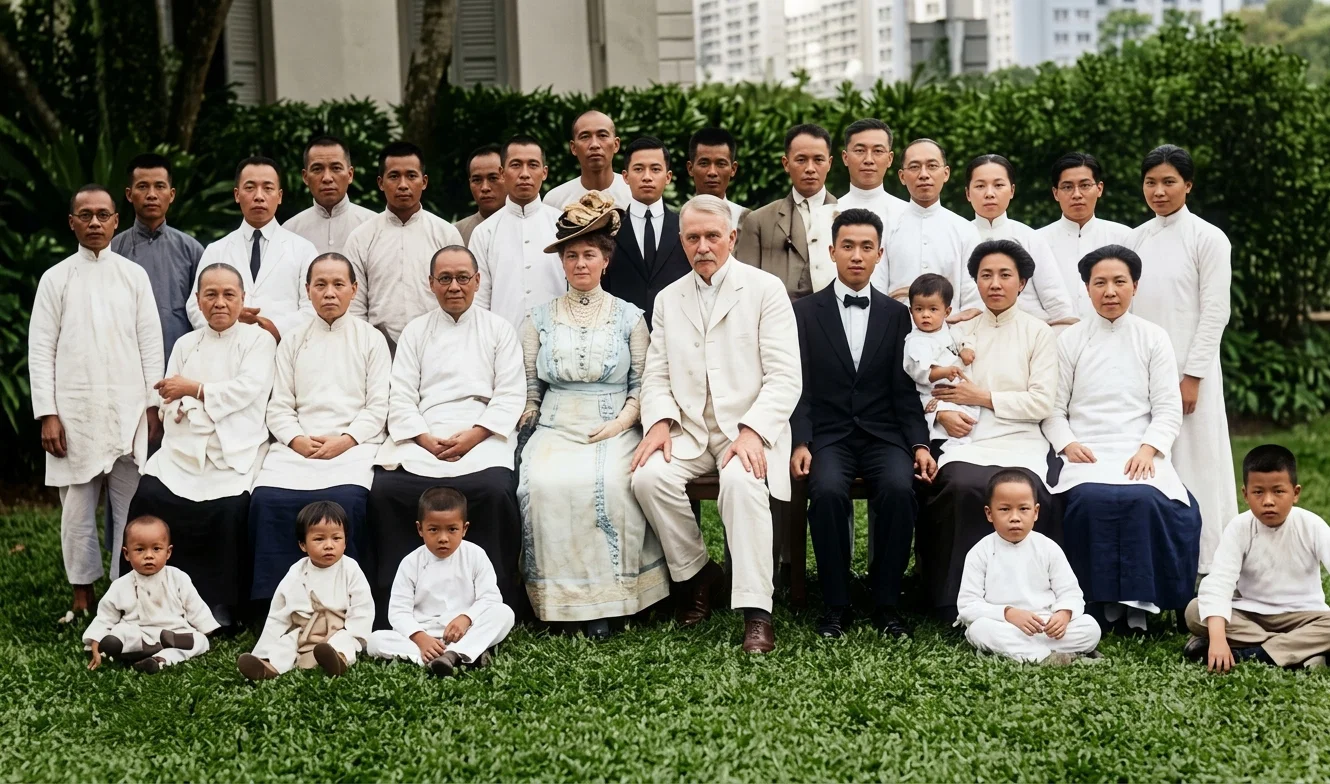
ELDER AND MRS. A. G. DANIELLS, WITH THE MEMBERS OF THE CHINESE CHURCH, SINGAPORE
The remaining territory of the Malay Peninsula is divided into nine states, all under British protection. Four of these states have united under a federation by which they are known as the Federated Malay States. By special arrangement Great Britain administers the governmental affairs of these federated states. The other five states are separate and independent. They have placed themselves under British protection, but each administers its state affairs under the advice of British counselors.
In the organization of the Malaysian Mission field our brethren have created six division missions—the Straits Settlements, the Federated Malay States, Sumatra, West Java, East Java, and British North Borneo. The remainder of the territory in the Malay Peninsula and the Dutch East Indies is practically unentered, and is under the watch care of the Malaysian general committee. This mission field is beset with many difficulties. It extends over a vast sea area, and lies along both sides of the equator, making it rather warm, with but little change of temperature throughout the year. Yet the climate is not nearly so trying as the plains of India or parts of China farther north.
The population of this mission field is at least 50,000,000, representing many races, languages, and religions, and a great variety of conditions, from the highest degree of culture and civilization among the British and Dutch, to the wild tribes of Borneo, whose greatest achievement is reckoned by the number of heads one can gather during a lifetime. While these conditions make the task of the missionary exceedingly difficult, yet our workers are all of good courage and are greatly attached to their fields.

Borneo Mission

All our regular laborers in the Malaysian field were present at this meeting.
Brother and Sister R. P. Montgomery were over from Borneo to tell us about the progress of the cause there. Their report was of thrilling interest to me. I wish it all might be given fully to our people in the homeland. They went to Borneo nearly two years ago and settled at Sandakan, a town on the northeast coast of the island. They now have a church of twenty-two members. Brother and Sister Montgomery are the only Europeans in the church; all the rest are Chinese, and eighteen of the membership embraced the truth in Borneo, and were baptized there. Four of these new converts are now giving their entire time to evangelistic work. Brother Montgomery has the language so that he preaches in the Chinese.
Of course they put in a plea for more workers. Borneo is seven hundred miles wide and eight hundred miles long, about the size of Texas, and has a population of 2,000,000 or more. It is the third largest island in the world. It has vast forests, great mineral resources, and large rivers navigable for long distances. They know of no good reason why many churches like the one they now have cannot be raised up in Borneo. But they need help. Brother Montgomery has been overworking and must have a furlough as soon as some one can be secured to take care of the field in his absence. We cautioned him most earnestly, but he wanted to know how one could keep from overdoing with so much to be done and no one to assist. Surely Borneo ought to have at least two ministers to work for its two millions. Some State in America can share with Borneo and still get along all right, and this sort of thing must be done to a far greater extent than it has yet been done if we do our duty by these lost millions in these mission fields.

East Java

Brother and Sister Wood came over from East Java. They are from Australia and have been working in Java for a number of years. They are located in Surabaya, the principal town in the eastern part of the island. Here we have a church of some twenty-five members who are active in missionary work and faithful in supporting the work with their funds. The Sabbath school offerings for the biennial period were $430, Mex.; week of prayer offerings, $182, Mex.; the tithes, $1,360, Mex. This church disposed of 300 copies of the last number of the Harvest Ingathering Review, receiving for them $122.80. When the war broke out, they printed 5,000 copies of a tract entitled “War in the East.” Nearly all these have been sold at four cents each. These items assure us of earnest fellow believers in the East Java Mission.

West Java

Sister Tunheim is our superintendent of the West Java Mission. For eight months she has had a hard struggle with malarial fever. But she was at our meeting, and is full of courage. The one church in the West Java Mission is at Batavia, and numbers between forty andfifty. Here are a few items from her most interesting report: Number of baptisms in 1913, fourteen; in 1914, nine. The missionary work has greatly increased during the last two years, there being 2,000 tracts and 20,000 papers sold, and 128 subscriptions obtained; Harvest Ingathering Reviews distributed, 570; cash received, $352 gold, a little more than sixty cents for each paper. This church is in need of a building, and its members are working very earnestly to raise enough money to pay for one. They now have on hand $1,293.60 gold. This is the result of hard work and real sacrifice.
MALAYSIAN MISSION BUILDING AND WORKERS
Sister Tunheim reported the following to show how believers are being raised up in different places where the living messenger has not yet gone:—
A short time ago three of our sisters went to the southern part of Sumatra to sell tracts and take subscriptions. They had very good success, and found one of their relatives who had heard the truth in Java and had worked against it, but the Spirit of God had since worked upon his heart and made it tender and teachable. He has fully decided to obey all the commandments, and has written a very pleading letter for me to come and teach him and several others who are anxious to hear more about the message. From several other parts I often get letters entreating me to come or send some one to teach them the good old way. Thus we often hear the Macedonian cry, “Come over . . . and help us.”
A man who is working in the resident’s office in Mabon, recently received one of our tracts with our mission address on it. He then wrote to us, ordering a whole case of books, which we sent to him. These have been sold by him and others to whom he has sent them in different adjacent islands. He has ordered many more tracts and books since, amounting to another case in all. The most of these he has paid for. He believes firmly in the soon coming of the Lord, and confesses that the seventh day is the Sabbath of the fourth commandment. He also gathers some of his neighbors to a meeting on Sabbath afternoon.
There is a man in Timor who has sold more than $20 gold worth of books and tracts, and has paid for them. A man from a near-by island has written me that he has read some of these tracts and books, and feels convinced that the seventh day is the Sabbath, and wants to keep it. Thus we see the way is opening up faster than we can follow.
Unless the Lord raises Sister Tunheim up to health and strength very soon, she must leave the field on an extended furlough. The workers here are anxiously awaiting the arrival of a laborer who has been selected to work in West Java.
It was a pleasure to meet at our council Brother Richard Sisley, who is doing self-supporting work in Java. Brother Sisley is a member of the Sisley family so well known in the earlier days of our cause. He is a brother of W. C. Sisley, manager of our printing house in England, and of Sisters G. B. Starr and Maud S. Boyd, who engaged in the work in Boston several years, and have but recently been located in California. He is teaching school in Java. While doing this he acts as elder of the church in Batavia, and leader in a company in another place. From his income he supports three native workers in China. His Christian life tells for good in the community where he lives. He is now sixty-seven years old, but is in good health and is full of vigor. He is taking two or three studies in correspondence schools and gets high marks on all his papers. Our brethren in Malaysia greatly appreciate the service Brother Sisley is rendering to the cause, in his quiet, consecrated way, and would regret exceedingly to have him leave the field. And what he is doing, thousands of others, with the same devotion to the message, could do.

Sumatra Mission

I was glad that Brother and Sister Yates could get over from Sumatra. It is not far from Singapore to Padang, Sumatra, as the crow flies, but it is a long way by boat. They were nearly two weeks making the journey each way. It has been less than a year since they began work in Sumatra. Although Sumatra has a population of 5,000,000, and has seemed a promising field ever since we began work there in 1900, yet the permanent results up to the present time are very small. It is possible that the continual changes in the working staff of this mission are in some measure responsible for the seeming failure. Brother and Sister Yates are bent on pushing forward in Sumatra. They have a nice school in Padang, and are planning on doing more along evangelistic lines and in the distribution of literature.

Federated Malay States Mission

Brother and Sister Thompson, who have recently come from Oregon, are in charge of the work in the Federated Malay States, with headquarters at Kwala Lumpur, the capital. They have been assisted in their work by Brother and Sister Duckworth, who embraced the message some years ago in Singapore, and who have a good knowledge of the Malay language. From the results already seen they believe that a permanent substantial foundation has been laid, and that the cause will make headway there. They have an organized church, which is faithful in the payment of tithes and offerings, and in the home missionary work.

Straits Settlements Mission

The headquarters of this mission are at Singapore. This is the only place in the Settlements that we have as yet entered. Brother Roy Mershon, the secretary-treasurer of the Malaysian field, is also superintendent of this mission. The work is well established in Singapore. The members of the church here are mostly Chinese of a good quality. Brother Mershon is planning on a vigorous effort in behalf of the many thousands in Singapore. Brother Lee, a Chinese evangelist, and Sister Chan, a Bible worker, are laboring in the city for the Chinese; and a Tamil brother is working for his people.
Brother Adams, assisted by Sister Yarnell and Brother Fox, is conducting a school in the mission building. The great object of the school is to educate our young native believers to become efficient workers in the cause.

General

The report of the general superintendent showed that during the last two years 113 persons had been baptized, that $5,436 in tithes had been received, and $2,627 in offerings, making a total of $8,063 received from the members for the support of the work. This is a large amount for poor people scattered over such a large area. The tithe is an average of $18 a member, and the offerings of nearly $9 a member, or 17 cents a week for each member. In view of this splendid support, the brethren are encouraged to look and work to the point of making this mission self-supporting in the near future.
Altogether our meeting was most encouraging. It was impossible to close the proceedings without laying plans for advanced work, and that means asking for more help. We must surely send laborers enough to place two in each of these large missions. With only one in a field we run the risk of great loss in case that one fails in health. I am convinced that we have already sustained a greater loss on this account than the cost would have been for keeping a double force in the fields. No one could visit this field and mingle with these workers without having his interest in their work greatly stimulated, and earnestly praying for the fullest success to attend their labors.
A. G. DANIELLS.