WE have already spoken of the three medical conventions recently held, and have given the agenda paper which served as a program. Leading thoughts from various speakers may be sufficient to indicate the ground covered and the tone of the discussions. The recommendations adopted will be given in connection with outlines of discussions. The first one follows:—
Resolved, That it is the sense of this convention that our denominational medical work should be regarded as a distinctive factor for the advancement of the truths and work of Seventh-day Adventists, including the following:—
a. The care of the sick among our own people and others.
b. Education in principles of health and physical reform.
c. The training of medical missionary workers.
d. To assist by influence and careful, direct effort to give the Bible truths for this time.
We believe that while we should seek for the highest possible scientific efficiency, we should not seek to be competitors of scientific or professional institutions; that while we must use every means possible to make our sanitarium work properly self-supporting, we do not regard our sanitariums as enterprises of financial gain, either to conferences, companies, or individuals.
Dr. H. W. Miller: “The medical work of the world, as far as equipment, men, and methods are concerned, is doing all that needs to be done in strictly medical lines. We are not competing with institutions of the world. Our work must be distinctly different, to the extent that we are doing what they are not doing and cannot do. One of the distinctive features of our work is in the field of reform, bringing persons to a recognition of the laws of health and urging obedience to them.”
“Some of the first purposes of our establishing sanitariums were to provide a means of caring for our own sick people; to make provision for the care of others who would come to us; to provide training centers for medical workers; and to do a health educational work for the general public. The success of an institution should be judged from the manner in which it meets these needs, and not alone from the standpoint of its balance sheet or the standard of its professional work. Our sanitariums should stand as memorials for our great principles, or else we have no good reason for operating them.”
W. T. KNOX: “While we are inclined to look on sanitariums primarily as curative institutions, we must bear in mind that, as in all other lines of our work, the real object should be to bring to people eternal life. We should not only cure persons of their ills, but should teach them how to live in obedience to all of God's laws. Our health food factories, for example, should consider it more important to help persons to live right and obtain health, than to sell their products. Our medical institutions should be great factors in turning men to God. Where a sanitarium does not do this we can write failure against its work.”
“One reason for disappointment in our19realizations, to my mind, is the financial phase of the work. Too often have we allowed indebtedness to increase until it has brought discouragement. The financial question then becomes the important one, and almost everything has to be decided in its relation to how it will affect the finances. We try to make the institution pay, and unless we are guarded, the commercial spirit enters. Every line of energy is utilized to make money. Its effect is seen on all.”
“The important lesson of this should be to us that it is wrong to go into debt. The remedy for this is to do all we possibly can to get out of debt. If we ask, How can we be more evangelistic? we can answer, One way is to get right financially.”
“Spiritual work cannot be done by proxy. It must be a personal matter. One must not say, Let somebody else give Bible readings, or pray, or labor for souls. Every one must do his part, and each must have a personal experience in soul saving to insure the success of the institution as a whole in this direction. I have seen persons who were not gifted as speakers or as public workers, but, with a personal, godly experience, were very successful in bringing men to Jesus. The secret of success in this lies in the earnestness of our efforts.”
G. B. Thompson: “In order to do evangelistic work we must be evangelistic at heart. We must believe in prayer and in the power of prayer. We must be definite in our purpose. If we find we are not meeting our purpose, we must ask, Wherein have we departed? We must seek to know what is the matter.”
“It is not enough to have a Bible in a room. There are those who supply Bibles to all guest rooms in hotels. That is good as far as it goes; but for us and our work that does not go far enough.”
“We must have the power of personal Christian experience in our work. Every worker in the institution must have a right experience. Everything in the institution from top to bottom must be done on a missionary basis. If we are not carrying on our sanitarium work in this way, we are making failures. We must find the seat of difficulty and correct it. We must reform.”
Discussion Gleanings
The Lord does not want his people to run his work on borrowed money. The wealth of the world is his. We will do better financially to keep in mind that our service is for God.
Doing God's service in the way he wants it done will enable us to endure sacrifice and suffering, and to work harder. This will help to keep the work out of debt, and it will let us sleep better and give us greater satisfaction.
While we may reach the rich and influential class, our work must also reach the poor and needy.
We believe the secret of making our sanitariums evangelistic is in the godliness of the head physician. He is the man that molds and shapes in a large measure the policies of the work. Our hope lies in strong spiritual doctors.
The early instruction concerning our health work was that it is to fit and prepare a people for translation. This is an important object that we should not forget.
Among some of the things that can be done to strengthen the spiritual influence of a sanitarium is to hold weekly meetings for the workers, for the consideration of the details of spiritual needs, keeping before them its object, talking over individual cases, presenting problems of evangelistic work, discussing how to reach various cases, hearing reports of personal work, having prayer for special cases, and praying for increased patronage where this is needed.
We cannot attain our true purpose until we get a clear vision of what our work should be. Boards of management, superintendents, heads of departments, and all, must see clearly the principles of this work in order to make it succeed.
If we were doing our fullest duty in training to be real soul winners the young people that come to us, we would be a power in carrying forward the work of God.
We cannot make sanitariums merely centers for performing expert surgery for the money that is in it, and expect the approval of God. We must do what we can to relieve those coming to us, and at the same time make the occasion one of helping them find the way of obedience to God's law.
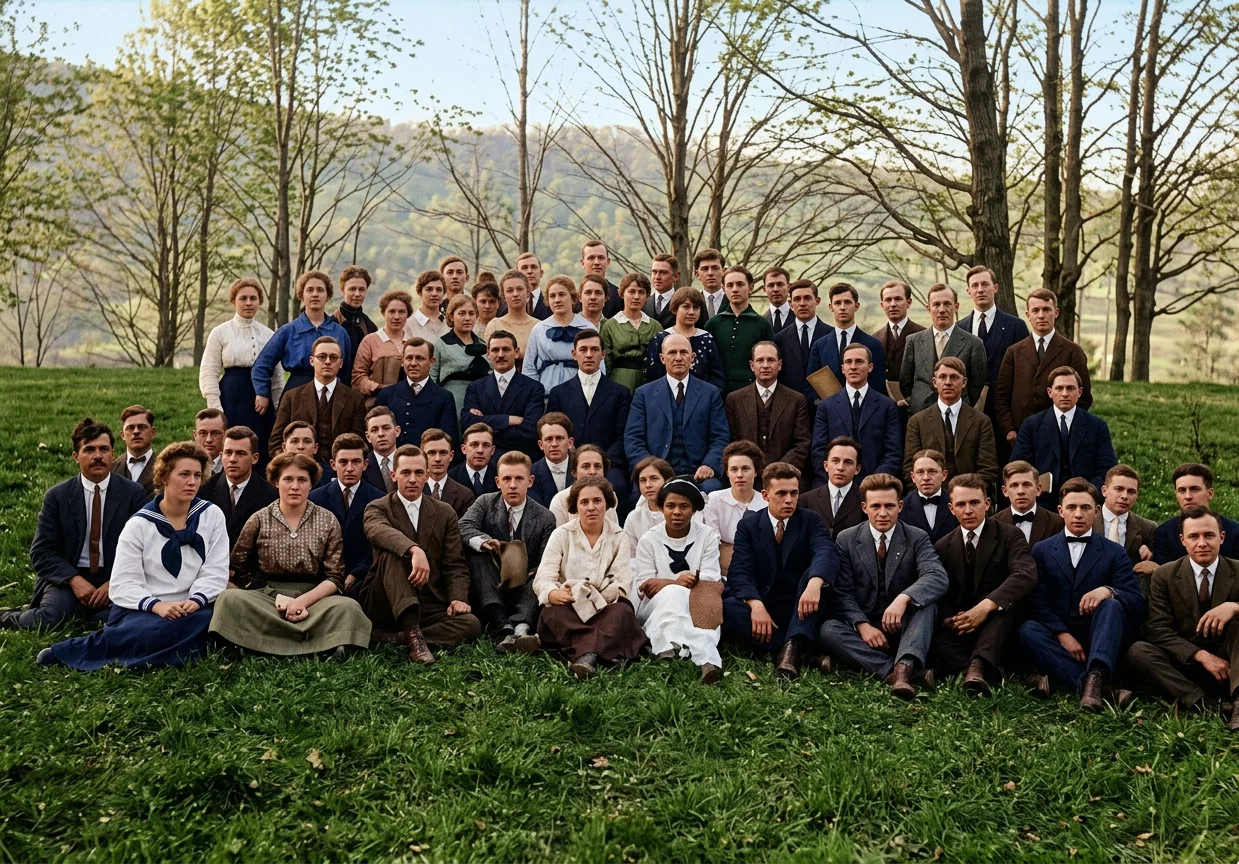
EMMANUEL, MISSIONARY COLLEGE CANVASSERS’ CLASS ’15
We must hold the highest standard of purity and right living in our sanitariums for every member, from the superintendent and business manager down to the humblest worker.
In one of our institutions in one year thirty-two persons came to a knowledge of the truth. We should have persons everywhere speaking a good word for us on account of the spiritual blessings they have received from us.