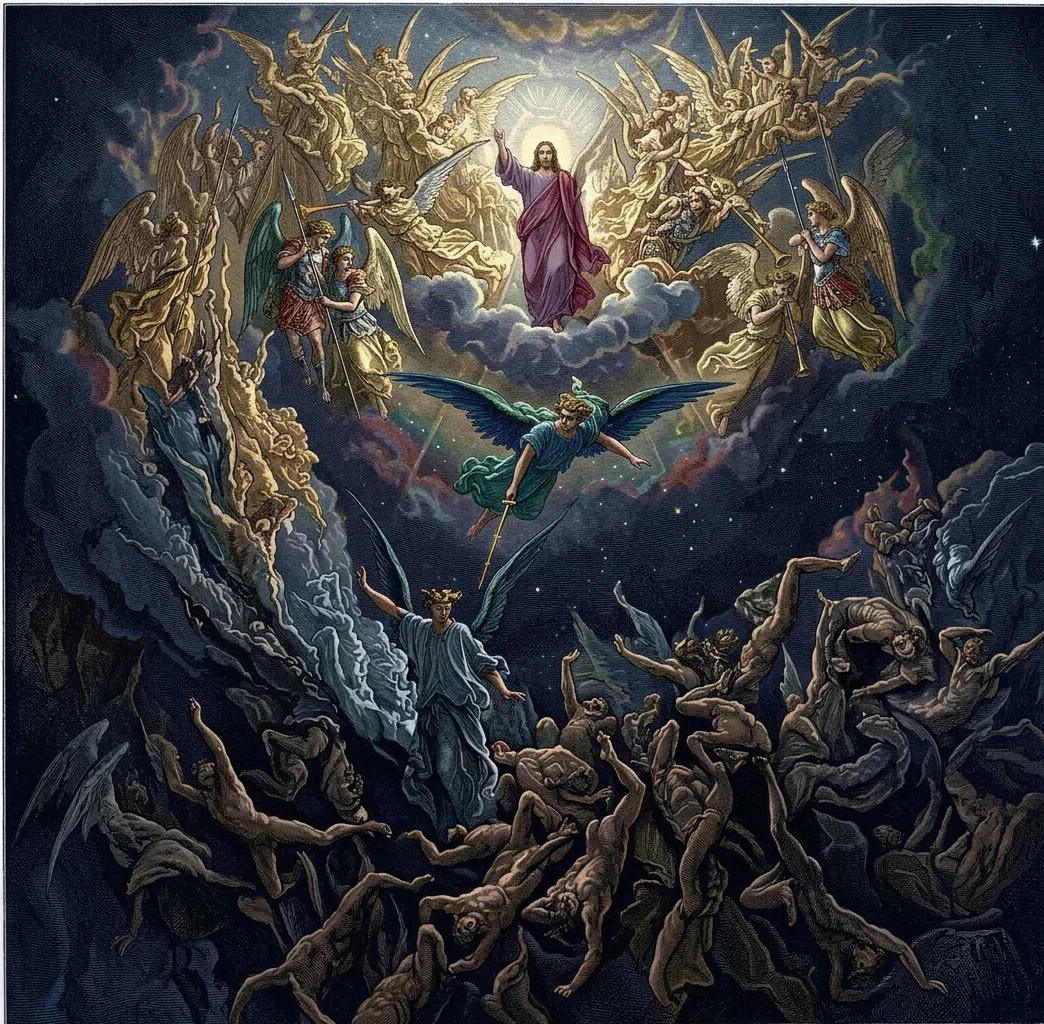
“When the dragon saw that he was cast unto the earth, he persecuted the woman which brought forth the man child.” “And the dragon was wroth with the woman, and went to make war with the remnant of her seed, which keep the commandments of God, and have the testimony of Jesus Christ.” Rev. 12: 13, 17.
With the expulsion of Satan and his sympathizers from heaven, the great controversy between Christ and the archangel was transferred to the earth. The nature of the contest was also changed in a measure: instead of continuing a struggle to regain possession of a place and a position in heaven, Satan resolved to destroy man,—especially men who were loyal to the Creator,—and to wrest from the Son of God himself the possession and sovereignty of the earth.
While the controversy was still between Christ and Satan, human wills and human hearts were now to be the battle ground. Christ endeavoring to win fallen man back to his allegiance to Heaven, and Satan striving to hold the ensnared race fast in the meshes of the net of sin that he had artfully cast over them.
The original war in heaven was between the Son of God in his own proper person as a divine being, and Satan, the most exalted of created intelligences. But when transferred to earth, the controversy must be fought out between Christ become “the seed of the woman,” “the Son of man,” and this same powerful angel, Lucifer, fallen it is true, but still mighty in the wisdom and strength with which the Creator had endowed him.
To Vindicate God's Justice
Satan had sought to justify his rebellion by the charge that God's government was unjust in that the divine law could not be kept even by angels, and still less by men. To disprove this charge, and to afford in the presence both of fallen angels and of unfallen worlds, ample and complete vindication of the justice of the divine government, the Son of God would himself become flesh, would be born into the world just as all men are born, would subject himself to all the untoward circumstances by which men are surrounded, and under these conditions would meet and overcome the enemy of all righteousness on his own ground.
Adam had failed, but through the promised seed defeat would give place to victory. From Adam's race would spring One pledged to destroy not only the work of Satan, but even the great enemy himself, as is plainly implied in the words, “I will put enmity between thee and the woman, and between thy seed and her seed; it shall bruise thy head, and thou shalt bruise his heel.” Gen. 3: 15.
“THERE WAS WAR IN HEAVEN.” REV. 12: 7
The true history of God's people and of his dealing with them, whether we find it in the Scriptures or in other writings, is a history of the great controversy between Christ and Satan. For even though the envenomed shaft of Satan's malice be directed against the humblest saint of God, it must first pierce Christ's great heart of love and tenderness before it can find living sheath in the soul of one who is “in him;” for it is still true today, as it has ever been, that “in all their affliction he was afflicted.”
Though beguiled into sin, our first parents repented; and though weakened in moral power, they resumed their attitude of loyalty to the Creator. The seeds of sin were, however, transmitted to their offspring. Cain, their first-born, by unbelief gave himself into the control of Satan. He lived in sin, and finally slew his brother Abel. But Seth, Adam's third son, followed the example of his parents, and served the Lord.
The good and the bad were mingled together in the world. Through all the ages, Satan has pitted the evil against the good in an effort to destroy both. Not only by direct outward attack, but also through human passions and human frailties, the enemy has constantly endeavored to degrade and alienate the fallen race. But though at times the conflict has waxed fierce, a true seed has ever been preserved in the earth, imperfect it is true, weak and sinful it must be confessed, but nevertheless having a heart set to obey the Lord.
The Promise to Abraham
By and by the time came that God would make choice of one man through whom the promise of Gen. 3: 15, the promise of a Saviour, should be fulfilled. And he chose Abraham, calling him out from his heathen environment of idol-worshiping friends and kindred, that he might make him the father of many nations, and the progenitor of the promised seed.
The story of this noble patriarch is familiar. The promise to Abraham was, “In thy seed shall all the nations of the earth be blessed.” Gen. 22: 18. In Gal. 3: 16 the apostle tells us that these words were a promise of Christ: “Now to Abraham and his seed were the promises made. He saith not, And to seeds, as of many; but as of one, And to thy seed, which is Christ.”
All the promises of the Old Testament looked to the coming of the “Desire of all nations;” toward this event were the eyes of all people directed, for in him centered the hope of the world. And as he was the center of hope, even though often vague and shadowy, so, too, was he the center of warfare; against him were directed all the fiery darts of the enemy. At every turn Satan sought to cut off hope of the realization of the promises by breaking the continuity of the line of fleshly descent from Abraham to the promised Seed; and by seeking to destroy even the Seed himself soon after his birth in Bethlehem.
Satan's Effort to Defeat God's Plan
When Jesus was born into the world, the event was announced by angels, not to the learned and the great in Jerusalem, but to the humble shepherds watching their flocks upon the plains of Bethlehem, under the open canopy of heaven, and their story and song was: “Unto you is born this day in the city of David a Saviour, which is Christ the Lord.” “Glory to God in the highest, and on earth peace, good will toward men.” Luke 2: 11, 14.
The jealousy of Herod was the agency by which Satan endeavored to defeat the plan of God, by destroying all the male children in Bethlehem and the region round about, from two years old and under, according to the time of the visit of the wise men from the East, But God's plan was not to be defeated. Joseph, warned of God in a dream, had taken the young child and his mother, and fled by night, going down into Egypt, where he abode until the death of Herod. The climax of the great controversy was reached in the garden of Gethsemane, upon Calvary, and in Joseph's new tomb. And at each of these crucial points, Christ conquered. In the garden and at the cross were fulfilled the words: “I have trodden the wine press alone; and of the people there was none with me.” Isa. 63: 3.3
Victory by Submission to the Divine Will
Underwood & Underwood, N. Y. MESSENGERS OF DEATH
In each of these supreme tests, victory was by surrender. We can never know how dark in the garden of Gethsemane seemed “the malignity of sin,” nor “how terrible was the temptation to let the human race bear the consequence of its own guilt, while He stood innocent before God.” But to have drawn back would have been to accept defeat, and his word of surrender to the divine will, “O my Father, if this cup may not pass away from me, except I drink it, thy will be done,” was a veritable token of victory. Then again on the cross we see manifested the same spirit of perfect submission when he made the final surrender: “Father, into thy hands I commend my spirit.”
Following Christ's life of spotless righteousness, there could be but one issue at the tomb, namely, his resurrection, as it is written: “Whom God hath raised up, having loosed the pains of death: because it was not possible that he should be holden of it.” Acts 2: 24.
“Who, being in the form of God, . . . took upon him the form of a servant, and was made in the likeness of men; and being found in fashion as a man, he humbled himself, and became obedient unto death, even the death of the cross. Wherefore God also hath highly exalted him, and given him a name which is above every name: that at the name of Jesus every knee should bow, of things in heaven, and things in earth, and things under the earth; and that every tongue should confess that Jesus Christ is Lord, to the glory of God the Father.” Phil. 2: 6-11.
Satan was vanquished when Christ rose triumphant over death. Christ took man's place, and died, “that through death he might destroy him that had the power of death, that is, the devil.” Heb. 2: 14. The fulness of time is near at hand, when the number of the children of the kingdom will be made up, redeemed from the power of the evil one, and then Christ will come in glory as King of kings and Lord of lords. Then sin and the author of sin will be destroyed, and it will have come to pass as written,—
“The kingdoms of this world are become the kingdoms of our Lord, and of his Christ; and he shall reign forever and ever.” Rev. 11: 15.