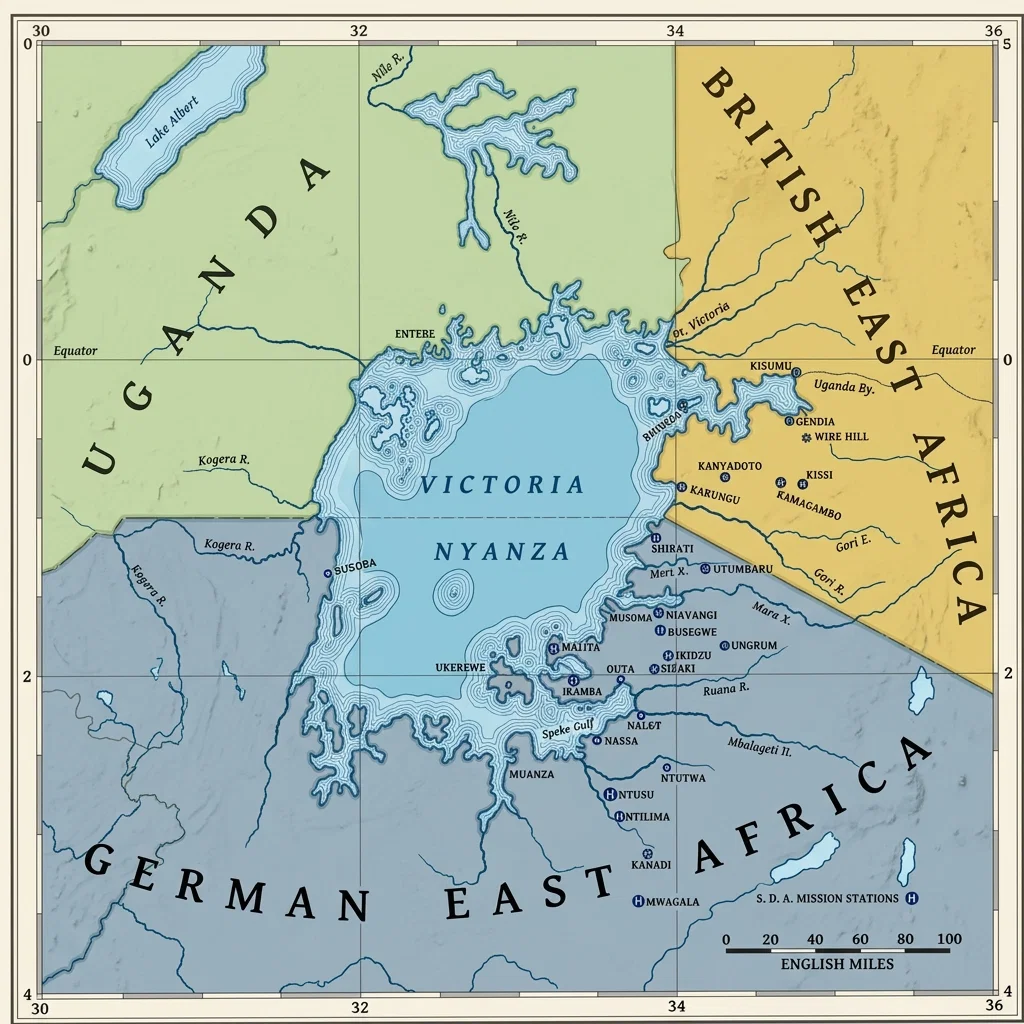
At the outbreak of the war the mission stations in German East Africa were cut off from communication with the outside world, save as a few fragmentary reports were sent out in the early stages through Portuguese East Africa. This is the first full report that we have received from the missions along the Victoria Nyanza, since the conquest by the British forces in German East Africa. It is sent by Brother V. E. Toppenberg, who is of neutral citizenship, and who was therefore able to remain on the stations until he could reach the advancing British lines. His report of the perils that surrounded them in the interim, when the natives of the country were left without any governmental supervision, will be read with deep interest. We believe Brother Toppenberg is of Danish citizenship, though he formerly lived in America, having worked in Colorado. Sister Toppenberg was Miss Minnie Hansen, of the Washington Sanitarium Training School for Nurses. The letter, in part, is as follows:—
“ENGLISH CAMP, UKEREWE ISLAND (formerly German East Africa), August 6, 1916.
“To the Mission Board of Seventh-day Adventists, Washington, D. C.
Map, drawn from sketch furnished by V. E. Toppenberg, accompanying his report from Victoria Nyanza Mission. First report received since beginning of war.
“DEAR BRETHREN: Finally, after two long years of waiting, the way opens so that we can get in communication with the outside world, so I think it my duty to report from this remote corner of the Master's vineyard.
“When the war began, we were not very well prepared for it as far as food and clothes were concerned. We had just sent orders to British East Africa for sugar, flour, oil, and other supplies. Large shipments of goods from Europe and America had arrived in Mombasa, none of which, however, ever reached us. At a stroke we were set back in the Middle Ages. We had no white flour, not even wheat from which to make it, no white sugar, no petroleum, no soap; in short, none of all the things we have been accustomed to think indispensable. For these and many other things we had to find substitutes. We had bananas, native grains and muhogo for flour, wild honey for sugar, candles made of tallow for lights, and soap made from wood ashes and lime. Clothes were also unprocurable, so we replaced worn-out garments by clothing made of goat and gazelle skins; made yarn of cotton, and knitted stockings of it; and improvised in other ways. But in spite of all, our bread and water has been sure, and more than that, God has given us an abundance of good things; his promises have been more than fulfilled.
“All building was stopped, but otherwise the mission work was carried on as usual. Uprisings among the natives were feared by the government people at the beginning of the war, and we were instructed to inform the natives of our stations that there was no war between the Europeans and the natives; it was only soldier against soldier.
“Not long after the opening of the war, Brother and Sister F. Bornath, at our station in Utimbaru, were taken for internment, as you undoubtedly know. Later the Masais, a fierce and warlike tribe east of us, came swarming the country, stealing cattle. At one time when they plundered in Usukuma, near Kanadi, Brother R. Munzig wanted to help his natives to keep them off, but lost his life in defense of the people for whom he faithfully worked. He was stabbed from behind by a spear, and cut with a sword on his cheek and neck, this attack also coming from behind. Before this occurred, Brother H. Palm had been shot in Shirati, of which I presume you have heard. [He was killed by a stray bullet that passed through the wall of the mission house,13which was in the zone of conflict.]
“Shortly before the war, we had been transferred from Sizaki to our oldest station, Busegwe, which Elder J. Persson left when he went on furlough to Europe, in July, 1914. Soon Sizaki, as well as some other stations, was entirely deserted by our missionaries, only a native teacher being left to hold school and to look after the station. The mission station in Utimbaru was made into a fort, Niavangi was occupied by the district secretary, and the school building in Busegwe was for some time used as a hospital for wounded native soldiers, and later as a base for supplies. In Ikidzu they occupied both school and shop, though we continued the work as usual on the last two of these stations. Considering the number of workers in mission service, I am sure the work during this time of war, until we had to entirely abandon our stations, compares very favorably with the same period in times of peace, as far as the number of natives won for Christ, and the tithes and offerings received, are concerned.
“In June, 1916, the English occupied Ukerewe Island, where I am writing this, and last month (July) they took Muanza, the seat of the provincial commissioner of this province, in which all our stations on the German side are located. When the natives heard of this, they lost fear of the German officials, and even openly disobeyed orders, and it became worse when all the officials as well as soldiers left Ikidzu, going south; uproar started immediately by the natives in Ikidzu killing the native police and watchmen left to guard the station. They robbed the government property, and it was reported to us that the Christians who had been left behind by Dr. F. W. Vasenius to watch his property and that of the mission, had been driven away, some having been killed and their huts burned. I tried to send messengers to them with words of courage and instruction, but all the letters were brought back undelivered because of the war raging everywhere. The uproar quickly spread from tribe to tribe.
“Every day brought new and startling reports. My family and I were the only Europeans left in the district as far south as the river Mbalageti, and we had been warned by the government officials that an uprising was to be expected. When Brother B. Ohme went south, he wrote that he feared an uprising, but did not know of any safe place where he could advise us to go. This was the last word we heard from any of our missionaries. With our fifteen months' old baby we could not very well run around in the unknown parts with the soldiers, so we decided to wait on our station until we were sure that the time had come for us to leave. We did what we could to protect ourselves, put out night watches, and for the rest we committed ourselves to God's care.
“Finally the uprising spread to Busegwe also. A chief and his subchief, with women and children, had fled from Niavangi with their one hundred and fifty head of cattle. Busegwe natives surrounded them and robbed them of all the cattle, and killed one woman and a child. This started trouble; the natives painted themselves for war, and all wore spears and swords, and carried bows and poisoned arrows. They rushed in crowds here and there, and finally came howling and yelling on the mission land toward our house. We now saw that the time had come to leave. We had everything ready for flight, and left Busegwe with the Christians belonging to the mission and the boys. Several chiefs who were robbed of all their property by the natives came to us, because the natives sought to kill them.
“So we started off. At every kraal we passed through, we heard of new troubles. Having remained behind eight days in a land without law, where there were uprisings, we were very tired from the nervous strain and from loss of sleep. Friday evening we arrived in Sizaki, our former home. Here the natives had already robbed the mission, and the teacher had fled. Sizaki was also in a state of war, the subchiefs having been robbed of their cattle, and the natives were attempting to steal the property of the chief when we came. We felt that it might be the last day we should ever see, and yet we decided not to go away before the Sabbath was over; accordingly we remained until Saturday night, when we left for Guta.
“Five chiefs and their subchiefs who feared for their lives, accompanied us through a country that was like a zoological garden. Right and left were thousands of zebras, hartebeests, wildebeests, and many other antelopes and gazelles, also ostriches, and other beasts and birds. I did not take time to hunt, but hurried right on. That evening we slept by the seashore, at Speke Gulf. Here the Swahili overseers of the lime works had been killed. We saw their empty huts and the empty house of the European who used to live here. Monday we came into country under the chief of Ukerewe, and Tuesday we were by the channel separating Ukerewe Island from the mainland. Wednesday we crossed in the canoes, and soon we were met by the English outposts,—and we were safe. The chief official himself came down to meet us, and received us very kindly. We were brought to the camp at Buramba, where we were given a very nice and comfortable thatch hut.
“Since coming here we have received news that the natives have not only robbed one station after another, but have destroyed the buildings and everything. We had hoped to be able to stay here until the English officials came to bring order and law into the country, and then to go back to our station, where we of course shall find all our things gone and the house damaged. We had personal property at the station to the value of $300 at least, besides much mission and government property. The chief official here thinks, however, that possibly we shall be called to Muanza, where all Europeans are sent who come from the German colony.
“During these two years we have had much sickness in our family, but we thank God that our lives have been spared through these seven years of labor in Africa.”