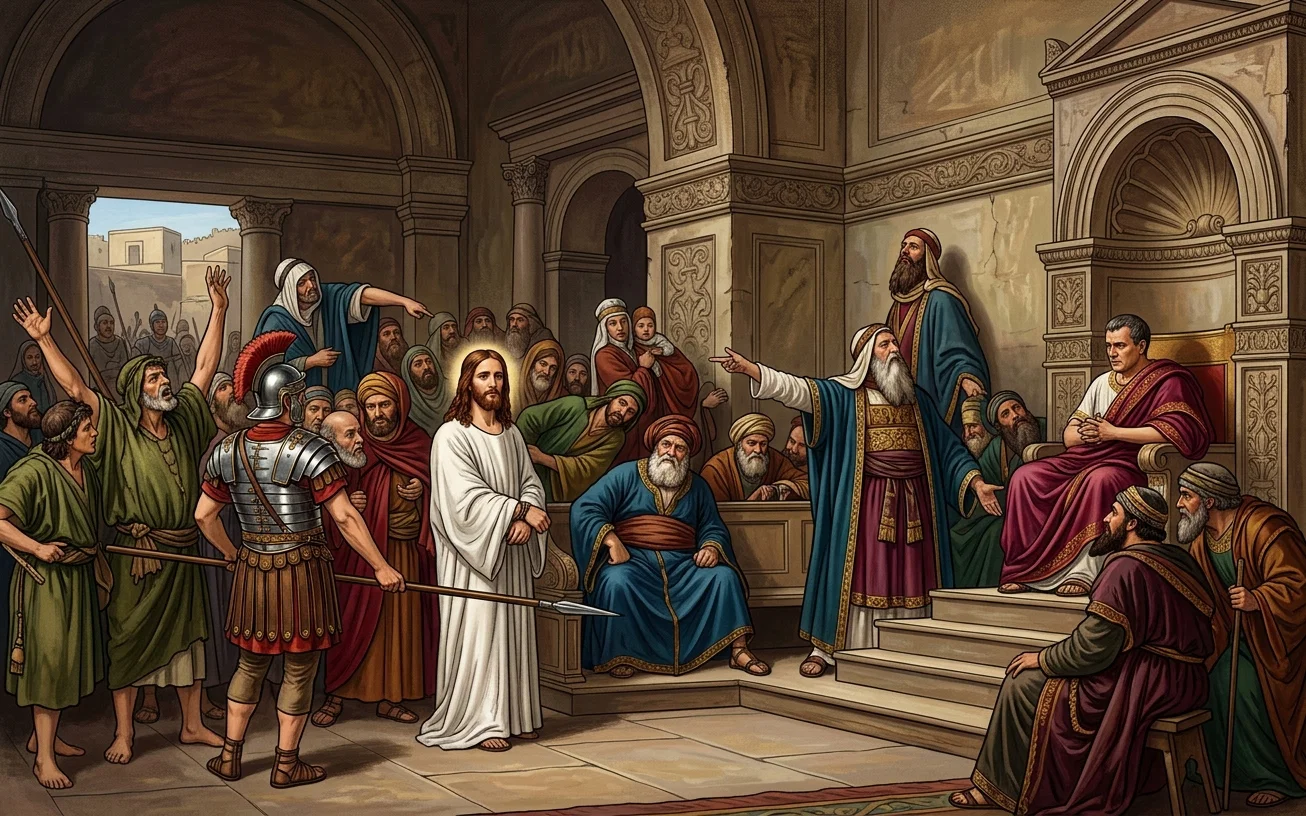
JESUS OR BARABBAS?

8%

Pacific Press Publishing Company · Mountain View, California · Mar 28, 1906

FromSigns of the Times, Vol. 32, No. 13.

Read the full edition

JESUS OR BARABBAS?

“BEHOLD, the Man!” in our last issue, should have followed this chronologically, but the order matters little to the great moral lesson involved. This part of the narrative of the passion week of our Lord deals with a great moral crisis, one of the critical moments of the ages, when the rulers of a nation write its doom.
CHRIST BEFORE PILATE.
JESUS had been before the proud Annas for examination, where He was denied of Peter. Thence He was taken to the haughty Caiaphas, the high priest. Here suborned witnesses testified against Him, and under oath Jesus declared Himself to be the Son of God. For this He was adjudged guilty of blasphemy and “worthy of death.” Then followed the abuse of the brutal servants, who sought, as such minds ever do, to curry favor with their meaner masters by abusing those whom the master hates. They mocked Jesus, and beat Him; they spit in His face; they blindfolded Him and struck Him, and tauntingly asked, “Prophesy unto us, Thou Christ; who is he that struck Thee?” And so the reviling and smiting went on, till even mad malevolence and bestial brutality grew weary. Even so have such hearts treated Christ’s followers in the crisis of centuries which have followed.
ALL this was in the night, and no sentence was then legal according to Jewish law. In the morning the farce was repeated, Jesus was brought before the Sanhedrin, He was condemned. Then came Judas with his too late confession, which condemned the chief priests and elders. Then, as the Jews had no power to execute the death sentence, Jesus was bound and delivered to Pilate in the Prætorium; but, with hypocritical sanctity, the priests would not go in for fear of defilement. They could defile their hearts with murder, but they must not run the risk of coming into outward contact with Roman leaven. By such tricks the devil deceives his dupes in making them believe that they have a conscience.
PILATE went out to the Jews, asked for their accusation, told them to judge Jesus themselves, which they admit they can not do. He examines Jesus, finds Him guilty of none of their charges, and declares to the Jews, “I find no crime in Him.” And when the accusations were heaped higher, the governor again declares, “I find no fault in this Man.” Then learning that Jesus had lived in Galilee, Pilate sent Him to Herod, the governor of that province, then in Jerusalem; and Herod, after his senseless mocking, sends Him back to Pilate uncondemned.
AT the great feast of the Jews, the yearly Passover, it was the Roman custom to release to the Jews whatsoever prisoner they desired. Many of the Jews imprisoned by the Romans were guilty of no petty crimes. Their crimes were against the Roman state. In the eyes of the Jews, they were patriots. Sometimes they had resisted the grasping Roman tax-gatherer, or publican. To make the Jews feel their yoke lighter, and to allay the national spirit likely to burst forth on this great annual gathering, they were allowed to ask this boon of their rulers.
AS THE multitude come before him and clamor for their privilege, Pilate sees in it an opportunity for releasing Jesus. He will not let them choose this time. He will choose two, one the very worst of criminals, a robber and a murderer, the son of Abbas, and the other Jesus. First, he asks, “Will ye that I release unto you the King of the Jews?” He knew that their envy moved them to act. Again and again, stirred by his own sense of justice, by his wife’s message, by the noble bearing of Jesus, he endeavors to obtain their consent to release Him. He tells them there is no crime in Him, nothing worthy of death, no fault at all. But the rulers of the Jews will not hear. They move the people to ask for Barabbas, and the unthinking mob asks for Barabbas. Is it possible, thinks Pilate, “Whether of the twain [Jesus or Barabbas] will ye that I release unto you?” and with one mad voice they cry, “Barabbas.” “What then shall I do with Jesus who is called Christ, whom ye call King of the Jews?” They all say, “Let Him be crucified.” And he said, Why, what evil hath He done? But they cried out exceedingly, saying, “Let Him be crucified.”
PILATE could do no more. He had weakly yielded to one thing after another, the choice of the people, the consent to scourge; and now the people forced him to the ultimate. He took water and washed his stained and guilty hands, and said, “I am innocent of the blood of this Righteous Man; see ye to it.” And all the people gave the awful answer: “His blood be on us, and on our children.” Then released he unto them Barabbas whom they asked for; but Jesus he scourged and delivered to their will to be crucified.” Thiswas the climax of the crisis with that nation. It was God’s last effort to save Israel by sending His only begotten Son. But they despised the prophet of God, they mocked His messenger, they laughed at His message, till the wrath of the Lord arose against them and there was no remedy. If they had known that the Man they crucified was the Son of God, the Messiah, they would not have said the words nor done the deed. They did not know because they did not desire to know. They were willing to be ignorant. They thought more of their sins than of His reproofs of righteousness, and they made an eternal mistake with its awful consequences.
THE lesson is for us as individuals. To us sometime comes the question, “What will you do with Jesus who is called Christ?” We must choose. We may not temporize. It is insistent and must be decided. Put it off if we will, it will come again till it asks, Which will you choose, your own sins and lusts and desires and ways, or Christ? Which will we take? He will not divide our heart between our sins and Himself. It is all or nothing. It is Christ or Barabbas, the robber, the murderer, of our lives.
“Once to every man and nation comes the moment to decide In the strife of Truth with Falsehood, for the good or evil side. Some great cause, God’s new Messiah, points each the bloom or blight, Parts the goats upon the left hand and the sheep upon the right, And the choice goes by forever, ’twixt that darkness and that light.”
Nations are deciding to-day. Men are deciding to-day. We have decided or are deciding to-day. O, decide for Christ. Choose not the son of Abbas, but the Son of God.