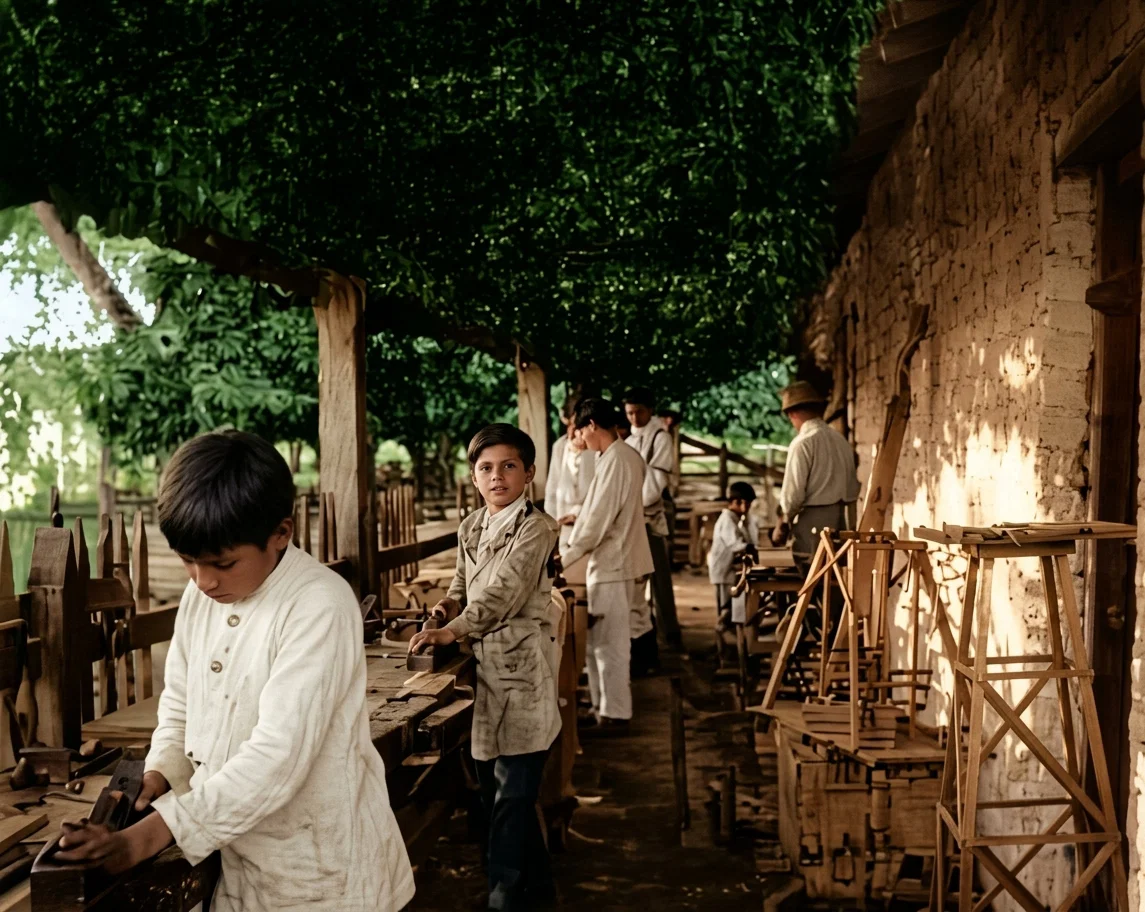
THE English school at Siguatepeque, Honduras, Central America, opened Feb. 1, 1914, receiving one recruit to the teaching force on March 25. The enrollment at the opening was twenty-one, but there has been an increase of seven, an evidence of a growing interest. Present indications point not only to a successful year's work, but also to the permanency of the institution.
Scarcely a year and a half have passed since the founding of this school, yet in this brief space it has claimed the attention of the citizens, and today occupies a prominent place in the minds of thinking men and women of Honduras. To the grace of God and the able management of Brother and Sister Snow may be ascribed the high degree of favor the school has attained at such an early period.
A congress of educators which convened at Tegucigalpa, the capital, in April, called for the finished products from the arts as an evidence that the training is a fact as well as a name, and later directed a committee to investigate in person the methods and principles of the institution, and the textbooks in service. May 28 brought to the school the nation's exponents of education in the persons of the minister of public instruction, minister of public improvements, postmaster-general, and their secretary. They expressed themselves as being both pleased and in sympathy with the institution. They intimated that they would, as far as possible, give their official support to the school, and by their suggestion a petition for financial aid was presented to the government.
SIGUATEPEQUE SCHOOL CARPENTRY CLASS AT WORK
Carl Snow, in charge of school, at right, with back to the wall.
The class numbers nine.
The actual studies that are being taught are as follows: Reading, writing, grammar, arithmetic, bookkeeping, descriptive geography, physiology and hygiene, carpentry, cabinet work, pencil and pen drawing, painting, music, dress-making, and embroidery. The principles of English are being taught in such a way that the pupils make rapid progress in acquiring the language. This year, and in the years to come, the following will be added: Algebra, geometry, physical geography, history (ancient and modern), rhetoric, blacksmithing, weaving, pyrography, electricity, and telephony. As these studies are added, more teachers and supplies will be procured from the United States.
Weaving has been added to the curriculum. The loom, a splendid gift from Mrs. C. E. Couch, is now in running order.
That the conservative people of Honduras feel the need of English, that they want American teachers, that they invite schools, and that some one will eventually accept their invitation, is now a matter of fact. Treatment rooms are also needed. Mountaineers often walk to the school for the simple treatment the teachers have to offer. A great work could be done through this avenue.