Our First Visiting Experiences

11%

Review and Herald Publishing Association · Takoma Park Station, Washington, D. C. · Oct 26, 1916

FromReview and Herald, Vol. 93, No. 53.

Read the full edition

Our First Visiting Experiences

Pioneering Experiences in the Solomon Islands — No. 6

Our First Visiting Experiences
G. F. JONES
LEAVING the pretty Rovian Lagoon and all its treacherous reefs and narrow, winding channels, we sailed once more into the open sea, and felt relieved from the constant strain of watching lest we at any moment run onto a reef or crash against a rock. Once outside, we relaxed, and watched with pleasure the lofty mountains of other islands, whither we were steering. We wondered what kind of people we should meet next. The flying fish flew away from us in confusion, and the porpoises seemed to play hide and seek with the ship, or to race with her. What a pity that the majestic scenery before us should be so marred with deeds of unrighteousness! The speed at which we were traveling soon brought us close to the land, and we entered a pretty harbor quite shut in from the open sea.
We could see no crowd of natives waiting either to welcome us or to kill us. As a rule, when they do not know the visitors, they are shy and stay back in the bush. That is just what they did this time. After a while, however, a shaggy, dirty-looking native came aboard, and we were able through our boys, who knew a little pidgin English, to ask where the chief and others were. They feared that ours was a government vessel, so had scampered away. The native said they had gone hunting opossums. One by one they assembled on the beach when they learned we were missionaries, but the chief did not appear until the next day.
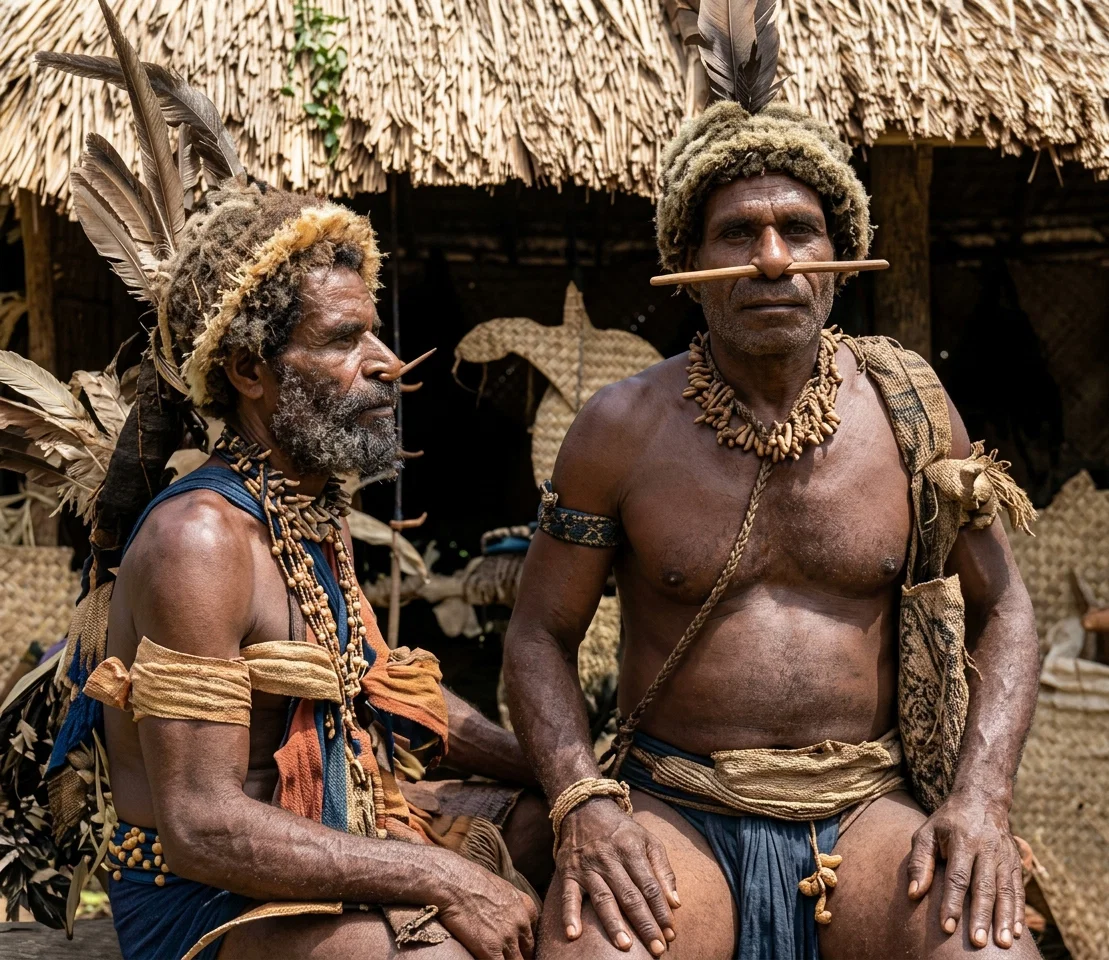
THESE ARE THE KIND OF CHIEFS WE MUST FIRST WIN BEFORE WE CAN PLANT OUR MISSIONS AMONG THEM
When he came, we met a sullen, forbidding savage. All the natives looked much like others we had seen, with long slit ears and scowling faces. We talked to them a long time, being unwilling to pass them by. When we finished and were ready to leave, they were not willing to allow us to do so, but the chief was still sullen and would not decide on our settling there. So I said that we would go away, and some day would return. At the time of this visit these people were just discarding their savage practices through fear of the government, the last in that district to yield.
The sequel to this visit occurred a few weeks ago, just two years afterward. A bright, intelligent police boy came up to me at the government station and said in pidgin English, “My father say you come be mission now.” I replied, “All right, Nomani, I’ll be there.” In a few days we reached the place once more, and met the people we had met two years before. But what a different meeting! They looked so happy and pleasant! Their minds were made up, and they were looking forward to a mission and a school and a missionary. They had it all planned. “This is where your house is to be,” they said. “This is where the school is to be.” We began looking at the places they pointed out, and stood with our arms around them, regardless of their skin diseases. They laughed and joked and called me, “Jouse.” “You must come back at once,” they said. I was very sorry to have to disappoint these dear savage friends of mine. I could not be there for three months at least, for I was obliged to go to Australia, and I had no one to send to them. So we parted with some sadness, but they were hopeful. Now I am on the steamer going to New Guinea, thence to Australia. Is it not sad that we cannot fill these openings? On account of the war our young people cannot leave Australia. What is to be done? Every day of delay makes it more dangerous to travel. Obstacles of international strife may have come to stay, or to block up the way of freedom. The signal to advance now can be clearly read. The only possible safe place is somewhere in God’s work. “Haste thee, escape thither; for I cannot do anything till thou be come thither.”