The foregoing statement of the case is supported by representatives of the different nations at war. The North American Review for September, 1914, contained an article from Dr. Dumba, entitled, “Why Austria is at War with Russia.” Dr. Dumba was then Austrian ambassador to the United States. He said: “The war between Austria-Hungary and Russia may well be said to be the outcome of conflicting civilizations and conflicting aims. The controversy between the Dual Monarchy and the Serbian Kingdom is only an incident in the greater struggle between German civilization as represented by Austria-Hungary, and Russian aspirations as represented by Serbia, the Russian outpost on the southern frontier of the Dual Monarchy.”
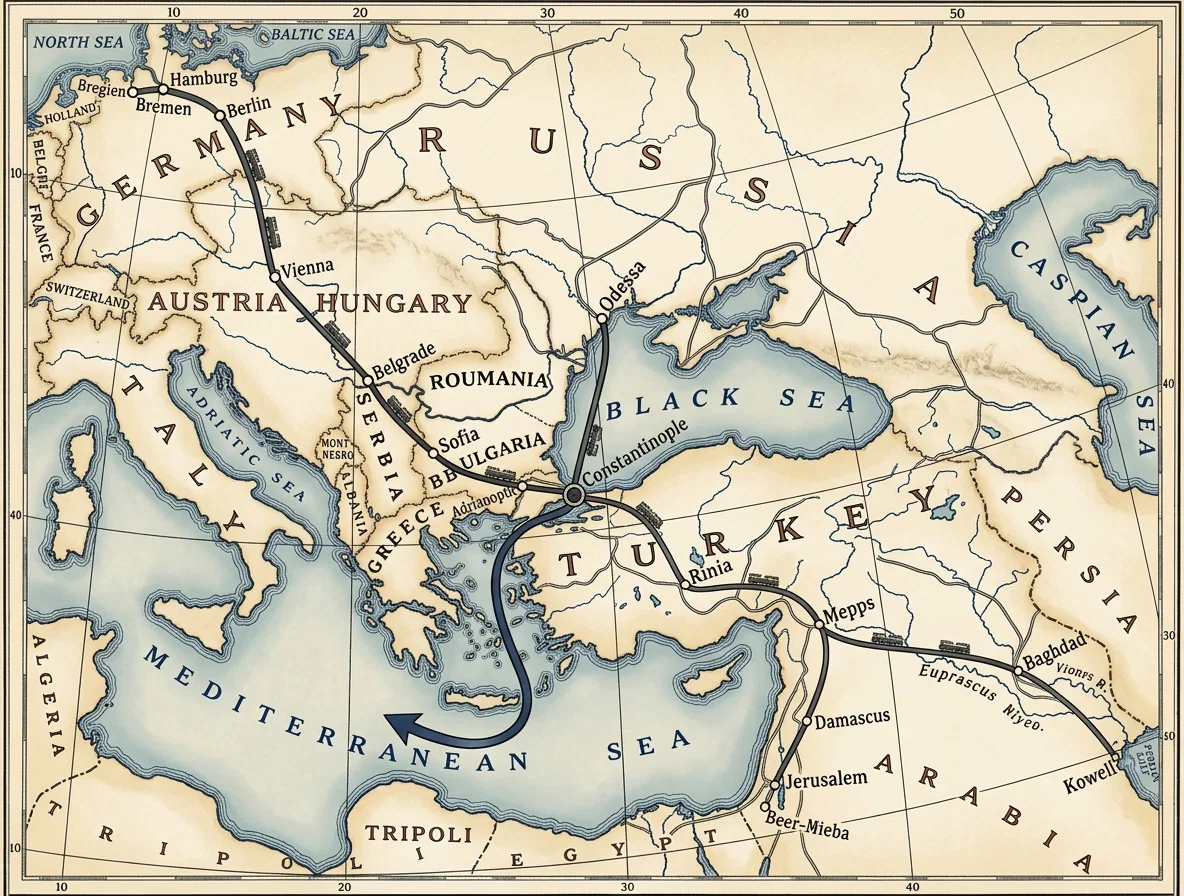
THE CROSS ON WHICH THE PEACE OF THE WORLD HAS BEEN CRUCIFIED
“The natural expansion of the Germanic empire of Austria toward the Near East began after the permanent expulsion of the Turkish hordes by the victories of Prince Eugene of Savoy. Parallel with the Austrian expansion southeastward went the Russian advance toward the Black Sea. In an effort to avert a clash in this parallel but gradually concentrating expansion, the Emperor Joseph and the Empress Catherine met late in the eighteenth century—1787—in the Crimea, and reached an agreement for the dismemberment of Turkey. “Under this project of monarchs the western part of the Ottoman Empire, including Bosnia and Herzegovina, now the bone of contention between Austria on the one hand and Russia on the other, was apportioned to Austria. To Russia were allotted the regions now known as Roumania and Bulgaria. It was at this period that the Russian dream of the possession of Constantinople, first broached in a mystical will of Peter the Great, began to assume reality as a governing principle of Russian policy in southeastern Europe.”
Count Berchtold, foreign minister of Austria-Hungary, says: “Austria-Hungary looks upon this war as a purely defensive one, which has been forced on her by the agitation directed by Russia against her very existence. Russian statesmen wish to form an iron ring of enemies around Austria-Hungary and Germany, in order that Russia’s grasp on Constantinople and on Asia should never again be meddled with. . . . Germany knows that Austria-Hungary’s enemies are her enemies, and that the dismemberment of the Hapsburg monarchy would mean the isolation of the German Empire.”
Germany
In the Independent, Dec. 7, 1914, Dr. Bernhard Dernberg made the following statement for Germany:—“Germany has been for about thirty-five years the associate of Turkey in developing Turkish territory, commerce, and industry. She has acquired the Oriental railways and built the Anatolian and Bagdad lines. She has established harbors and shipping companies, and engaged in mining and very extensive irrigation works. She must be left with a free hand to go on with this commercial development as far as she can arrange with the sovereign power of
the Porte and without outside interference. This would mean a recognized sphere of influence from the Persian Gulf to the Dardanelles.”
Russia
In explaining to the Russian Duma the dangers that threatened the empire, M. Sazonoff said: “The plans for the domination of Germany over the Turkish Empire comprised the formation of an enormous German-Mussulman Empire, extending from the Scheldt to the Persian Gulf. Such an empire, which appears in the dreams of Pan-German as a new caliphate, to which by historic analogy the name ‘Caliphate of Berlin’ would be adopted, is, according to them, to strike a mortal blow at the historic existence of Russia and Great Britain. It is a terrifying dream, but God is merciful!”
In a recent issue of a leading Petrograd paper, Prince Eugene Troubetzkoi explains Russia’s policy in the following emphatic language: “Our friends and our foes alike ought to know what is the point of view of the Russian nation, as well as what is said by diplomacy, the one and only solution which accords with the state interests of Russia; namely, Constantinople and the strait must be Russian. Every other solution, whatever its nature, is impossible of acceptance by us, because every other would only make the position for us worse than it was before the war began. . . . Nothing less than the independence of Russia is bound up with this question of the strait.”
Great Britain
The editor of the London Saturday Review, March 6, 1915, states the situation from the British viewpoint. He says:—“The cause of the reversal of British policy in the Near East, which has passed almost without comment here as on the Continent, is bound up with, but plainly lies far deeper than, the Austrian ultimatum to Belgrade. The threat to Serbia was a culmination of a steady German thrust toward the East. The main difficulty in the German path in the Near East, the little kingdom of Serbia, was to be got out of the way by Austria; and, that ‘necessity’ accomplished, Germany would have had the clear road which she desired to Turkey, where her ambitions have grown since the visit of William II to the late Sultan with a grandiose project of financial, commercial, and ultimately political dominance on the Golden Horn and eventually through Asia Minor.”
“The first had been completely attained, and Germany’s absolute control of Constantinople has been demonstrated to the whole world.”
“The second had yet to be fulfilled; but it was on the road to fulfilment. The tortuous and intricate history of the Anatolian and Bagdad railways during the last fifteen years is sufficient evidence of the gradual penetration of German influence through Asia Minor.
“The B. B. B. line—Berlin, Byzantium, Bagdad—was an instrument of German policy in which millions of German money had been invested, and in whose success the Deutsche Bank in particular was deeply involved—how deeply it is still a matter of conjecture. This huge scheme, which had made considerable progress, had added enormously to the already great influence of Germany in Asia Minor.
“British opinion no longer has any misgiving concerning the approach of Russian influence toward Constantinople. Disraeli’s policy was constructed before the first steps had been taken in Egypt. It was conservative, and the times are now revolutionary. Germany’s action has revealed to us the menace of a Near East under Teuton rule, a menace which would have been far more formidable than anything which the past generation of British statesmen imagined from Russia.
“Since its foundation sixteen centuries ago, Constantinople, by position and natural destiny, has been one of the key-cities of the earth. It has been many times attacked and twice conquered. Its second conquest, like its foundation, marked the end of an epoch and changed the history of the world. Its third conquest can do no less.”
These National Viewpoints Summarized
Thus it is clear that through territorial expansion, increase of populations, agricultural, manufacturing, and commercial development, and international alliances a world-change has been effected which presents many vitally conflicting interests. These clashing interests have finally culminated in the most serious clash of nations the world has ever seen. No satisfactory adjustment seems possible. Great Britain does not consent to surrender any of the great over-seas possessions of her far-stretching empire. As long as she holds Egypt, India, and Australia, she must control the Mediterranean highway. She must
continue to hold such strategic positions as Gibraltar, Suez, the Persian Gulf, and Singapore. To surrender these would be to invite the dismemberment of her empire.
Russia’s situation and policy seem equally vital to her existence. She has extended her conquests over a vast area and many peoples. Only the land area of her empire is equal to one seventh of the land area of the world, while her population is about one eighth of the world’s population. Her natural resources are very great, but she requires an adequate highway to the world’s markets in order to reap full benefit from them. She has been struggling for that highway for centuries. It was to secure a road through the Baltic that Peter the Great moved the capital from Moscow to the Baltic marshes and began the building of Petrograd. But Germany established her naval base in the Baltic between Petrograd and the ocean, thus placing an effectual menace in Russia’s road.
Then Russian statesmen turned their eyes toward the Pacific. At great expense and toil and patience they built a steel road across the plains of Siberia to Vladivostok and Port3Arthur. Here they were met by the Japanese and cut off from the ocean highway.
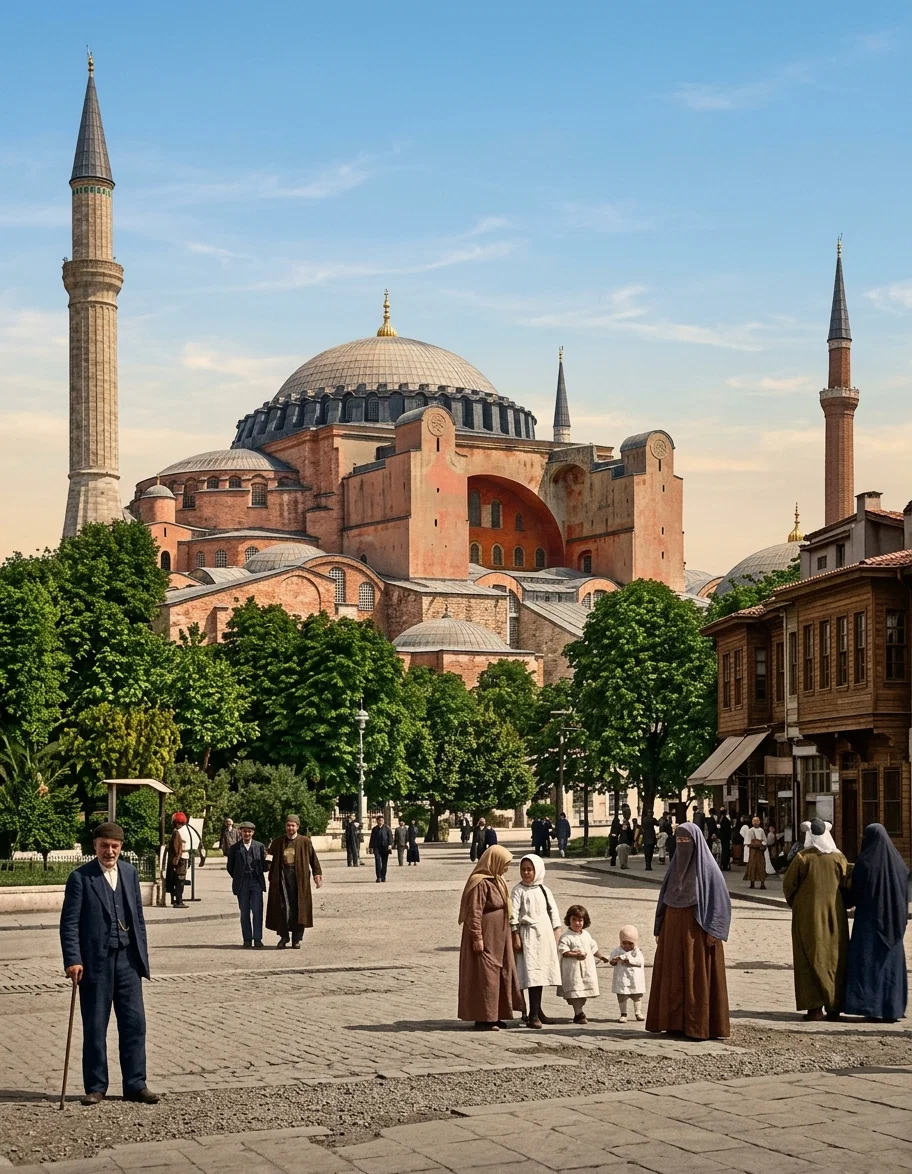
THE FAMOUS ST. SOPHIA MOSQUE IN CONSTANTINOPLE
Again Russia turned to her natural highway, the Bosporus and the Dardanelles, which she had been endeavoring to secure for more than a century. But here she found that Germany had all but succeeded in throwing a bridge across the Bosporus at Constantinople which would effectually block her road through the Bosporus and the Dardanelles to the Ægean and on to the world’s markets. Believing that the German road threatened her very existence, Russia decided to stake all in the endeavor to prevent its completion.
This brings us to Germany’s interests. She found herself an inclosed empire without what she considered suitable access to the markets of the world. Her only outlet was through the North Sea. But this was controlled by England. Thus she found herself in exactly the same position in which she had placed Russia in the Baltic. Eventually she turned eastward, and began a vast enterprise to secure possession
of the Persian Gulf. If she could establish a highway from Berlin to the Persian Gulf, she would not only secure an open road to the world, but she would place herself in a position to completely dominate Russia, and seriously threaten England’s vast empire at any time it might seem necessary to her own interests. She claimed that with England’s highway already established, and Russia’s road about to be driven through from the Black Sea to the Mediterranean, her own existence was imperiled.
Austria’s situation was similar to that of Russia and Germany. Her only outlet was down the Adriatic, the lower part of which was guarded by the forts and warships of Italy. For this reason Austria has always looked to the Ægean Sea as her only safe, adequate road to the oceans. With this in view her steady policy has been to hew out a clear path to Saloniki. But the Turks and the Slavs of the Balkan Peninsula have always stood in her way. This has been true of Serbia especially.
Serbia, being supported by Russia, effectually blocked Austria in her drive to the Ægean, and also Germany in her drive to Constantinople and on to the Persian Gulf. It appeared to both Austria and Germany that this ring drawn around their eastern and southeastern boundaries meant their ruin. For this reason they decided to break it at any cost.
As for France and Italy, they both feared the results of a Teutonic victory. Their position in the Mediterranean was such that they felt safer under the paramountcy of England and Russia, and therefore joined them against the central powers.
These conditions are so vital to the very existence of these different powers that they see no way of surrendering their ground. Yet they clash so violently that it seems impossible to hold it without war. Of course in the end some or all must give way. They have unsheathed their swords to reach a settlement. The price being paid is staggering.