1. What announcement immediately follows the judgment-hour message of Rev. 14: 6, 7?
'There followed another angel, saying, Babylon is fallen, is fallen, that great city.'Rev. 14: 8, first part.
2. What reason is assigned for the fall of Babylon?
'Because she made all nations drink of the wine of the wrath of her fornication.' Same verse, last part.
The Fall of Ancient Babylon
3. How was the overthrow of ancient Babylon foretold?
'Babylon, the glory of kingdoms, the beauty of the Chaldees' excellency, shall be as when God overthrew Sodom and Gomorrah.'Isa. 13: 19.
4. What call was made to come out of Babylon?
'Flee out of the midst of Babylon, and deliver every man his soul; be not cut off in her iniquity; for this is the time of the Lord's vengeance; he will render unto her a recompense.'Jer. 51: 6.
5. What did ancient Babylon do to all the nations?
'Babylon hath been a golden cup in the Lord's hand, that made all the earth drunken: the nations have drunken of her wine; therefore the nations are mad.' Verse 7.
6. What was the effect of this apostasy?
'Babylon is suddenly fallen and destroyed; howl for her; take balm for her pain, if so be she may be healed.' Verse 8.
7. Just before the fall of Babylon, what did her king do?
'Belshazzar the king made a great feast to a thousand of his lords, and drank wine before the thousand.'Dan. 5: 1.
8. By what command did the king repudiate the religion taught in Babylon by Daniel and others who feared God?
'Belshazzar, while he tasted the wine, commanded to bring the golden and silver vessels which his father Nebuchadnezzar had taken out of the temple which was in Jerusalem; that the king, and his princes, his wives, and his concubines, might drink therein.' Verse 2.
9. What marked the climax of Babylon's apostasy?
'They brought the golden vessels that were taken out of the temple of the house of God which was at Jerusalem; and the king, and his princes, and his wives, and his concubines, drank in them.' Verse 3.
10. While drinking the wine, what gods did they honor?
'They drank wine, and praised the gods of gold, and of silver, of brass, of wood, and of stone.' Verse 4.
11. What immediately followed this complete apostasy?
'In that night was Belshazzar the king of the Chaldeans slain. And Darius the Median took the kingdom, being about threescore and two years old.' Verses 30, 31.
NOTE.—The gospel of the kingdom was preached in Babylon through Daniel (Daniel 4), and Nebuchadnezzar was brought to acknowledge and to worship the true God. But after the death of Nebuchadnezzar, Babylon relapsed into idolatry, and this apostasy was rendered hopeless when Belshazzar used the sacred vessels from the house of God, dedicated to the worship of the God of heaven, in which to drink the wine of Babylon while worship was offered to the false gods. Then came the handwriting on the wall, and the fall of ancient Babylon.
A Prophecy Concerning Modern Babylon
12. In the visions of John, what interpretation is given to the woman who sat upon many waters?
'The woman which thou sawest is that great city, which reigneth over the kings of the earth.'Rev. 17: 18.
NOTE.—The great city which reigned over the kings of the earth in John's time was Rome, and that city has given its name to the church which is represented by the woman, the church of Rome, or the Papacy.
13. In this same prophecy, how is the Church of Rome, the Papacy, designated as the antitype of ancient Babylon?
'Upon her forehead was a name written, MYSTERY, BABYLON THE GREAT, THE MOTHER OF HARLOTS AND ABOMINATIONS OF THE EARTH.' Verse 5.
14. What specific statement emphasizes this identification?
'With whom the kings of the earth have committed fornication, and the inhabitants of the earth have been made drunk with the wine of her fornication.' Verse 2. See verse 4.
NOTES.—The Church of Rome is called Babylon, and its religion is a revival of the religion of ancient Babylon. Like ancient Babylon, she claims a priesthood with exceptional powers and privileges. Like ancient Babylon, she, through the dogma of the immaculate conception of the Virgin Mary, denies that God in Christ dwelt in the same flesh as fallen man has. Dan. 2: 11. Like ancient Babylon she claims universal spiritual jurisdiction, and demands submission under pains and penalties. See Daniel 3. Like ancient Babylon she repudiates the fundamental gospel truth of justification by faith, and boasts of works. See Dan. 4: 30.
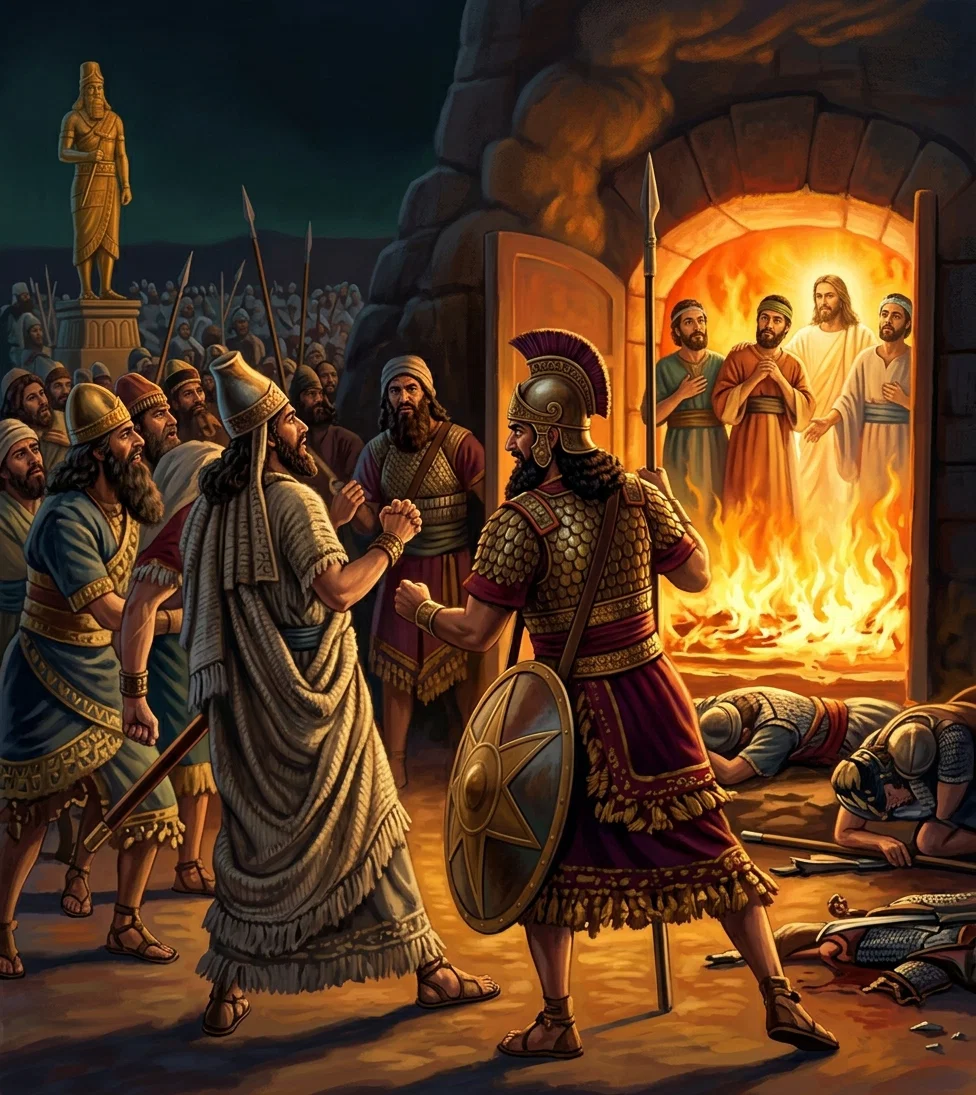
THE HEBREWS PERSECUTED FOR REFUSING TO WORSHIP THE GODS OF ANCIENT BABYLON
A careful comparison of the rituals of ancient and modern Babylon shows that the latter is copied from the former; and it is easy to trace the connection historically in the paganism of political Rome.
After the conquest of Babylon by Medo-Persia, the priests of the Babylonian system were banished to Pergamos, in Asia Minor, where they established a college in which their doctrines were taught. Later some of the young men from Rome were sent to Pergamos for training, and they carried back to Rome the religion of ancient Babylon, which was incorporated into the paganism of Rome. Papal Rome received it, with slight variations, from pagan Rome. See reference to Pergamos in Rev. 2: 12, 13.
The Daughters of Babylon
15. What relation does the Church of Rome sustain to other apostate churches?
'Upon her forehead was a name written, MYSTERY, BABYLON THE GREAT, THE MOTHER OF HARLOTS AND ABOMINATIONS OF THE EARTH.'Rev. 17: 5.
NOTE.—In the creed of Pope Pius IV, an authoritative statement of Roman Catholic belief, is found this statement: 'I acknowledge the Holy Catholic Apostolic Roman Church for the mother and mistress of all churches.'—Article X. (Italics ours.) When the professed Protestant churches repudiate the fundamental principle of Protestantism by setting aside the authority of God's Word and accepting tradition and human speculation in its place, they adopt the fundamental principle of modern Babylon, and may be regarded as the daughters of Babylon. Their fall is then included in the fall of Babylon, and calls for a proclamation of the fall of modern Babylon.
Many representatives of modern Protestantism have, in one way or another, rejected many fundamental doctrines of the Bible, such as—
The fall of man.
The Bible doctrine of sin.
The infallibility of the Scriptures.
The sufficiency of the Scriptures as a rule of faith and practice.
The Deity of Christ, and his consequent headship over the church.
The miraculous conception and the virgin birth of our Lord.
The resurrection of Christ from the grave.
The vicarious, expiatory, and propitiatory atonement of Christ.
Salvation by grace through faith in the Lord Jesus Christ.
Regeneration by the power of the Holy Ghost.
The efficacy of the all-prevailing name of Christ in prayer.
The ministration and guardianship of holy angels.
Miracles as the direct manifestation and interposition of God's power.
Although many leaders of modern Protestantism, known as higher critics, have no formally adopted the creed of the Church of Rome and have not become an organic part of that body, yet they belong to the same class in rejecting the authority of God's Word, and accepting in its place the product of their own reasonings. There is just as much apostasy in the one case as in the other, and both must therefore be included in Babylon, and both will go down in the fall of Babylon. The warning message applies with equal force to both classes.
'Come Out of Her, My People'
16. What final call to come out of Babylon is to go forth?
'I heard another voice from heaven, saying, Come out of her, my people, that ye be not partakers of her sins, and that ye receive not of her plagues. For her sins have reached unto heaven, and God hath remembered her iniquities.' Verses 4, 5.
17. How complete is to be the fall of modern Babylon?
'A mighty angel took up a stone like a great millstone, and cast it into the sea, saying, Thus with violence shall that great city Babylon be thrown down, and shall be found no more at all. ... And in her was found the blood of prophets, and of saints, and of all that were slain upon the earth.' Verses 21-24.
18. What song of triumph follows the overthrow of Babylon?
'Alleluia: for the Lord God omnipotent reigneth. Let us be glad and rejoice, and give honor to him.'Rev. 19: 6, 7.