The South India Mission

7%

Review and Herald Publishing Association · Takoma Park Station, Washington, D. C. · Mar 23, 1916

FromReview and Herald, Vol. 93, No. 15.

Read the full edition

The South India Mission

J. S. JAMES
A NUMBER of months have slipped by since I reported anything for the columns of the REVIEW, but this has not been because of empty garners or flagging interest. On the contrary, we have been busy to the limit of our strength ever since resuming our duties on our return from furlough, and God has greatly blessed the efforts of all the workers in the field the past year, for which we give him our heartfelt praise and thanks.
The last year has witnessed a number of important advances in this mission. A year ago Pastor and Mrs. Lowry wereable to join us again in labor, and their return made possible the opening of our Indian training school, a much-needed facility in our rapidly growing work here in the south. Our first school work was begun eight years ago at Nazareth, where the children of friends and adherents were gathered and instructed. To these were later added a number of orphan boys and girls who were supported by friends at home. This school advanced in its numbers and grades until it became necessary to place the older students in higher grades, in which they could be prepared for active service in the Lord’s cause.
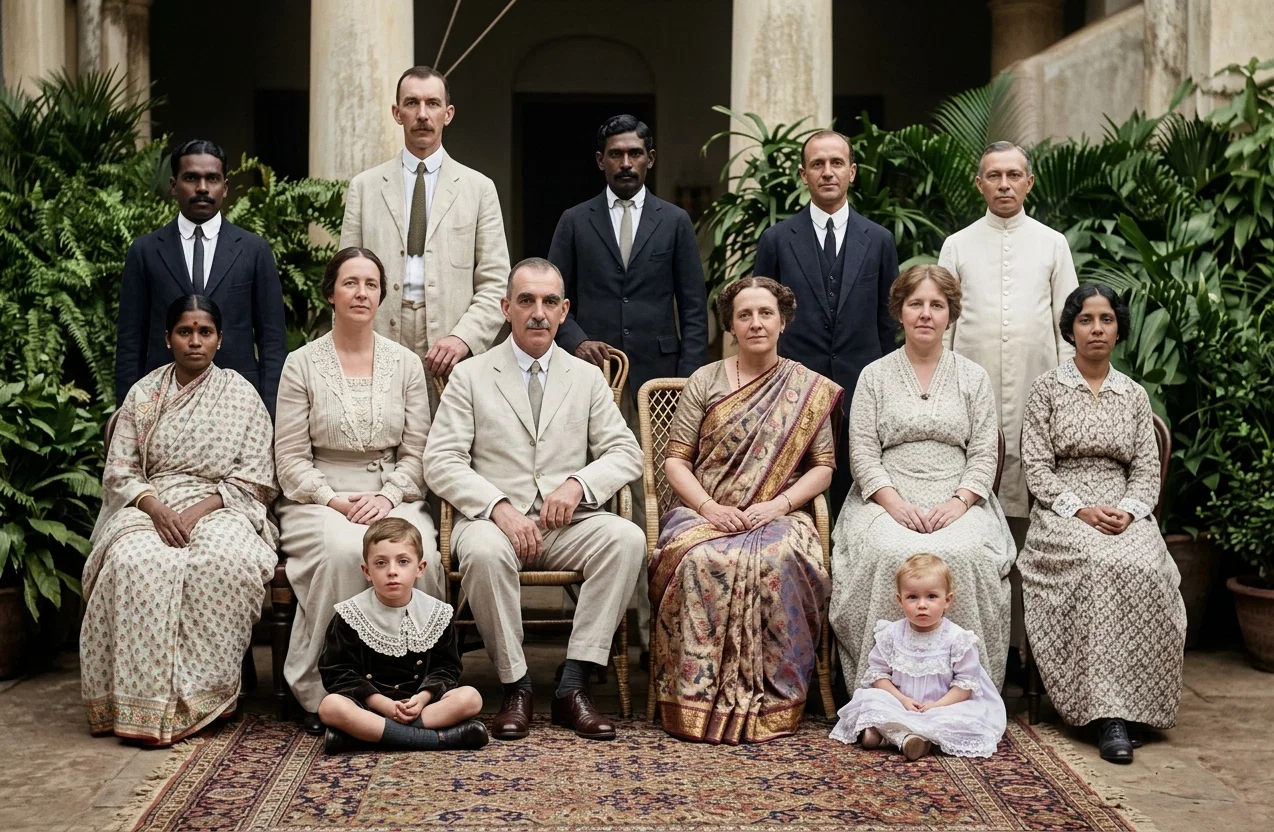
GROUP OF WORKERS IN MADRAS, INDIA
This school, centrally located at Coimbatore on one of South India’s main railways, in a good climate and within easy reach of the summer capital of the Madras Presidency, in the Nilgiri Mountains, was opened in July, 1915, under the supervision of Pastor G. G. Lowry, assisted by two Indian teachers. It was my privilege to visit this school a few days ago, and I found the work there progressing very encouragingly. Brother and Sister Lowry have worked beyond their strength to get this new school started, but their efforts have been well repaid, and a splendid work is now being done. Twenty-eight bright boys and girls are in attendance, with few exceptions the children of Sabbath keepers, and many of them are preparing to enter the work within a year or two. Some of these students are from the Telugu field, some from Nazareth, some from Pondicherry, and a few are resident pupils. As our churches and companies multiply, the attendance at this school will be largely increased. It did my heart good to look into the faces of these boys and girls and reflect that eight years ago many of them were little tots running aimlessly about the village where our work started, but are now nearly grown, and separated only by a few months from active service in the Lord’s vineyard.
In the beginning of our work we had no believers in the truth to help us. When school work was begun, we were obliged to employ teachers not of our faith. To preach the truth and teach school as we desired to see this kind of work carried forward, without helpers who were in full sympathy with us, might appear to be paradoxical; but this was one of the many human extremities where God worked according to the “mystery of his will,” and he helped us to “make brick without straw.” Many of those who were brought in close contact with us in various enterprises, later became interested in the truth, accepted it fully, and are now heart and soul with us in the message. But the providence of God manifested in extremities cannot always be followed as a general rule of action, so we are hoping that in the near future we shall be able to draw trained and more efficient workers from our school at Coimbatore.
Pastor and Mrs. Lowry are compelled to proceed with this new school under very adverse conditions, and are at this moment working against great odds. The mission having no property of any kind in Coimbatore, they had to rent such buildings as they could, for residence and school purposes. They were able to secure an unfinished native house for their own dwelling, and for school purposes they got an empty cotton warehouse in the outskirts of the city, twenty by one hundred and twenty feet, built of stone, and covered with tile. About one third of this was partitioned off for a boys’ dormitory, where the boys sleep, eat, and have all their belongings. The other portion, without any partitions, is used for the school work. The building improvised for a girls’ dormitory is very inadequate, situated in a low, unhealthful quarter, and at a distance, making it difficult for the students to go to and from their classes. These temporary arrangements are very unsatisfactory, as the owners are Hindus, and our missionary activities at any time are provocative reasons, to them at least, to ask us to vacate or pay an exorbitant rent. School work cannot be successfully operated under such conditions. We must have our own property and buildings, where we can carry forward our work unhindered by the religious prejudice or caprice of heathen landlords.
In addition to the oversight of the school, Brother Lowry is making efforts to carry the truth to the populous city of Coimbatore, and to the surrounding villages, of which there are many. The older boys in the school are organized into mission bands, and visit these villages occasionally on preaching and colporteur expeditions. This training and experience will be of great value to them when they begin work for themselves.
In September, 1915, we moved our local headquarters from Trichinopoli to Madras, the chief city of South India. This was done to afford better facilities for printing our rapidly increasing volume of vernacular literature, and to place the office more nearly in the center of the territory we must reach. Madras is a seaport city, and the converging point of all the railways in this presidency. Here are located large educational and publishing interests in connection with the government and the various mission societies operating in South India.
No effort has ever been made in this city to present the truth publicly, but plans are now being laid to this end. With the coming of the new year we hope to have money which will enable us to open a place for public meetings, and furnish equipment and workers to carry forward an aggressive campaign. Brother P. C. Poley and his wife, from North India, have recently connected with the work in Madras, to engage in Bible work and assist in preparing the way for a public effort. Brother Charles Stafford and family, recently from Australia, have been a valuable addition to our forces here. They have settled in the city, where he is now having excellent success in canvassing for our English subscription books.
Brother V. E. Peugh is also making Madras his headquarters while he gives his time to the circulation of our vernacular and English papers among the educated Indians of the Madras Presidency. Our great need at present for this important city is an evangelist who can give his undivided thought and energies to the work of building up a strong English church.
There is a large European and Anglo-Indian population here, especially the latter, and the mind of the populace is in such a state of inquiry, owing to the great European conflict, that a public presentation of the message is sure to reach many earnest seekers for truth. A worker for this particular work was voted more than a year ago, but thus far we have been unable to secure one.
Madras.