Under South American Skies — No. 2

5%

Review and Herald Publishing Association · Takoma Park Station, Washington, D. C. · Mar 23, 1916

FromReview and Herald, Vol. 93, No. 15.

Read the full edition

Under South American Skies — No. 2

On Thursday morning, January 6, there gathered a company of workers in the church at Santo Amaro, a suburb of Sao Paulo, Brazil. By actual count, more than seventy-five persons were present. It was the first meeting of the workers of the Brazilian Union Conference, who had come together for a week of study and exchange of experiences before the opening of the regular biennial session of the conference. Some of these had been laboring in the interior, and had not met any of their fellow workers during the biennial period. They had therefore been looking forward to this meeting as a time of special privilege, when they could once more unite with others engaged in the same workin waiting before the Lord for such blessings as would prepare them for more efficient service in winning souls for the kingdom of God.
During the last two years a church has been raised up in Santa Amaro, and a neat church building has been erected, in which the conference meetings were held. Quite a number of the members of this church met with the workers, so that the audience room was well filled at the first meeting.
The program provided for three meetings in the forenoon, two in the afternoon, and one in the evening. This gave opportunity for some committee work between the public meetings. Elder F. W. Spies, the president of the Brazilian Union Conference, conducted the opening service at the first meeting, and nearly an hour was spent in giving expression to the feeling of gratitude which prevailed in view of the privileges of the hour and of expected blessings. I then began a series of Bible studies, which continued during both the workers' meeting and the conference. The general purpose of these studies was to show that the whole Bible is a revelation of Christ and his gospel, and that the third angel's message is the final presentation of that gospel before the setting up of the everlasting kingdom of God. Two texts were taken as a motto: “Looking unto Jesus,” and “Christ is all.” Christ was then presented as the only and all-sufficient Saviour, the Mediator of the new covenant, and our High Priest in the heavenly sanctuary. Some time was spent in the study of the prophecies of Daniel and John, in order to make clear our time and our work. An excellent interest was shown in these studies, and I was led to believe that they were a real help to the workers.
During this whole time Elders O. Montgomery and N. Z. Town conducted daily lessons upon important topics. These included the place of our literature in finishing our work, the principles of organization, the home missionary work, the work of the ministry, etc. The attendance upon all these studies was regular, and the interest was excellent.
Portuguese is the language of Brazil, and as we three could not speak in that language, interpreters were necessary.
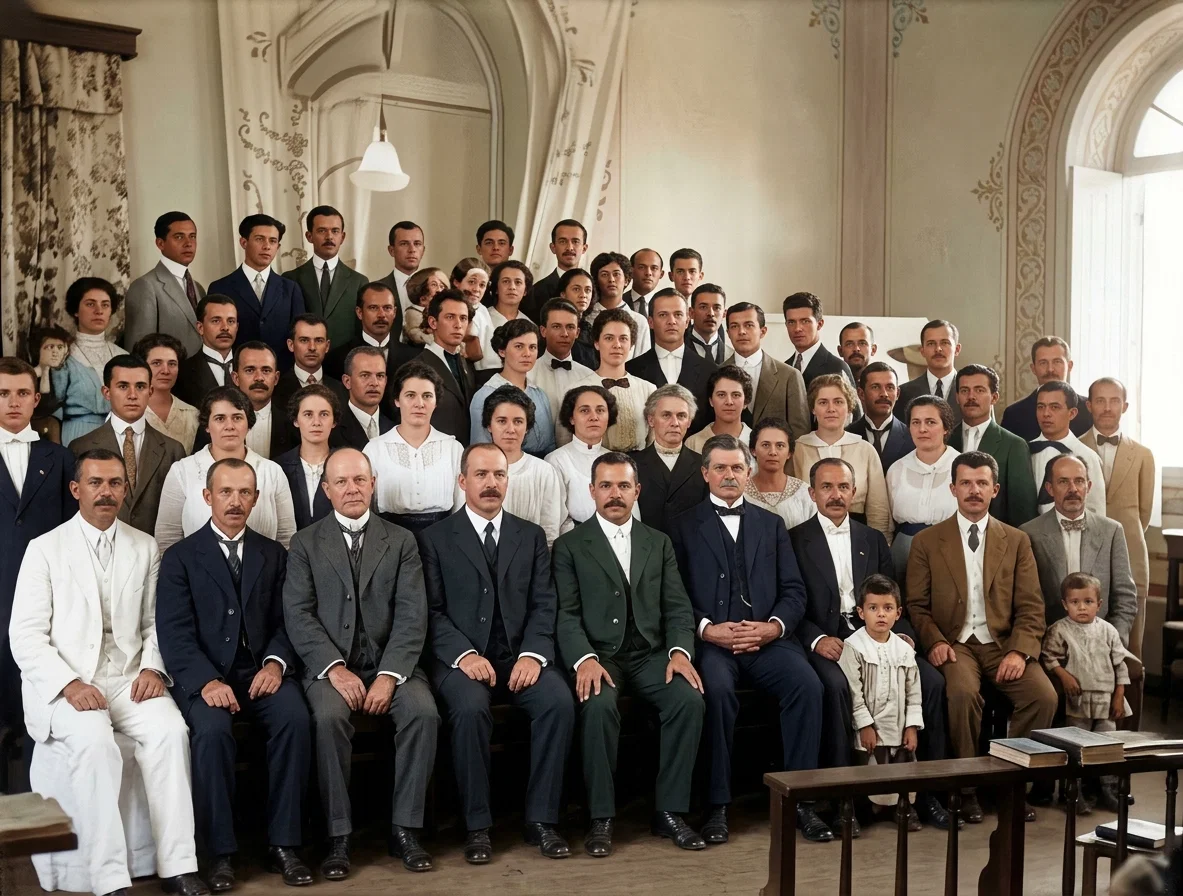
WORKERS IN ATTENDANCE AT THE BRAZILIAN UNION CONFERENCE, JAN. 6-23, 1916
Elders H. Meyer, the president of the Rio Grande do Sul Conference, John Lipke, and E. C. Ehlers served in this capacity, and were successful to a gratifying degree in bringing us into sympathetic touch with the hearers. Much depends upon the spirit of the interpreter, and these brethren spoke from the heart as well as from the mouth.
The three Sabbaths of the workers' meeting and the union conference were days of special blessing. The word of God was earnestly preached, the need of a vital and fresh experience on the part of each worker was emphasized, and calls were made for decided action in putting away sin by repentance and confession, and for a new consecration to God's work. There was a good response, especially upon the last Sabbath, when the work of Christ in cleansing the heavenly sanctuary and the church on earth was presented. Victories were gained, and advance steps were taken. As a result of the instruction given, many testified with gratitude to God that they had obtained a new spiritual experience during the meetings, and I am sure that more abundant fruit of their labors will appear.
In the sessions of the union conference encouraging reports were given concerning the progress of the work in various parts of Brazil. Elder F. W. Spies, the president of the conference, in his opening address, presented a brief review of the fields and the different lines of work. The presidents of the two organized conferences and the superintendents of the five mission fields entered into more details in their reports, and told of some most interesting experiences, especially in new fields. The impression left upon my mind was that now is a most favorable time to work in Brazil. Doors seem to be opening on all sides. Many of the people have lost confidence in their priests, and some are looking for better things. A very large proportion of the converts to the truth come directly out of Roman Catholicism, and I was surprised to learn that, generally speaking, it is not very difficult to secure a hearing for the message. The Bible workers find all the openings they can fill, and some excellent families are deeply interested. I wish the number of workers were increased tenfold.
From the reports submitted I have gathered the accompanying statistics showing the progress of the work in this union conference during recent years.
These figures show that there has been a steady gain in membership, and that during the last biennial term there has been a net increase of 575. This result has been attained in the face of a determined and persistent effort carried forward in a number of churches to overthrow confidence in the Spirit of prophecy and to bring about a schism.
In order that the financial part of these statistics may be better appreciated, I will copy a paragraph from the president's report:— “A rather severe financial crisis wasburdening Brazil at the time of the last session of our union conference, and things in the commercial world moved slowly and uncertainly. But when the European war suddenly broke out, the already acute condition in the business world grew worse, and for a little time it was not even possible for us to obtain from the banks the money we had deposited in them. Added to this crisis, the year 1915 brought a terrible drought and consequent famine in the northern part of the country. The famine was so great in several states that the people in certain places were compelled to abandon their homes and flee to the coast. Many who did not do this, or who delayed too long before doing it, perished from hunger and thirst.”
In spite of the financial crisis and the hard times in the North, the tithes and offerings have increased, if the last quarter of 1915 averages with the other three quarters reported. The book sales have shown a very decided increase—an increase which is most encouraging under the circumstances.
An interesting feature of the meeting was the call for special donations in behalf of the school. The needs were presented, and a statement was made concerning a plan to devote a thirteenth Sabbath offering in the United States to this school enterprise. The response was hearty, and the whole amount asked for (three thousand milreis), was subscribed, and something over.
The officers of the union conference were chosen as follows: President, F. W. Spies; secretary, L. Lotz; treasurer, A. Pages; other members of the committee, H. Meyer, A. Rockel, John Lipke, F. R. Kuempel, R. Wilfart, M. Rhode, R. M. Carter.
During the last two years the secretary of the union conference, Brother Paul Hennig, has taken a special interest in developing the Sabbath school, the home missionary, and the young people's work, although the departmental work had not been formally organized. At this session of the union conference it was thought advisable to organize the various departmental lines of work as far as circumstances would permit, and Elder F. W. Spies, the president of the conference, was selected to act as educational secretary, and Brother Max Rhode was placed in charge of the Sabbath school, the home missionary, and the young people's departments. The fact that it was necessary to make the president of the union conference a departmental secretary, and to choose only one secretary for three other departments, will show how the brethren in the mission fields are compelled to cut the garment according to the cloth. The scarcity of well-trained laborers is a constant embarrassment in the effort to enlarge the work.
While the conference was in progress, evening meetings were held in a tent fifty by seventy feet, for the benefit of the people of Santo Amaro. Announcements were circulated and the usual invitation to attend was extended. From three to five hundred persons were present at these services. At the same time a special mission was being held in the Roman Catholic church only two or three blocks away. Whether this mission was appointed at this time in order to keep the people away from our services, I do not know, but I was told that the same thing happened two years ago when the union conference was held in the same place. The method of conducting the Roman Catholic mission was in rather marked contrast with the way in which we worked. At frequent intervals during their mission they fired off a large quantity of fireworks, including ordinary firecrackers, giant crackers, and rockets. At these times there was an incessant clanging of the bell in the church tower, and at night this tower was illuminated with electric lights of various colors. Some of these noisy celebrations were held as early as four o'clock in the morning, and quite near our church. On the closing day of the mission there was a procession to the cemetery, led by a brass band.
I am writing the latter part of this report on board the steamship “Vestris,” en route from Santos to Buenos Aires. This is a good ship, and with comfortable weather and a quiet sea we are able to get some rest after about three weeks of rather strenuous work. We are due in Buenos Aires on Sunday, January 30, and shall then proceed at once to La Plata, where the workers' meeting for the South American Union Conference is now in progress. This will be followed immediately by the biennial session of that conference. I will tell of these meetings in my next report.
W. W. PRESCOTT.
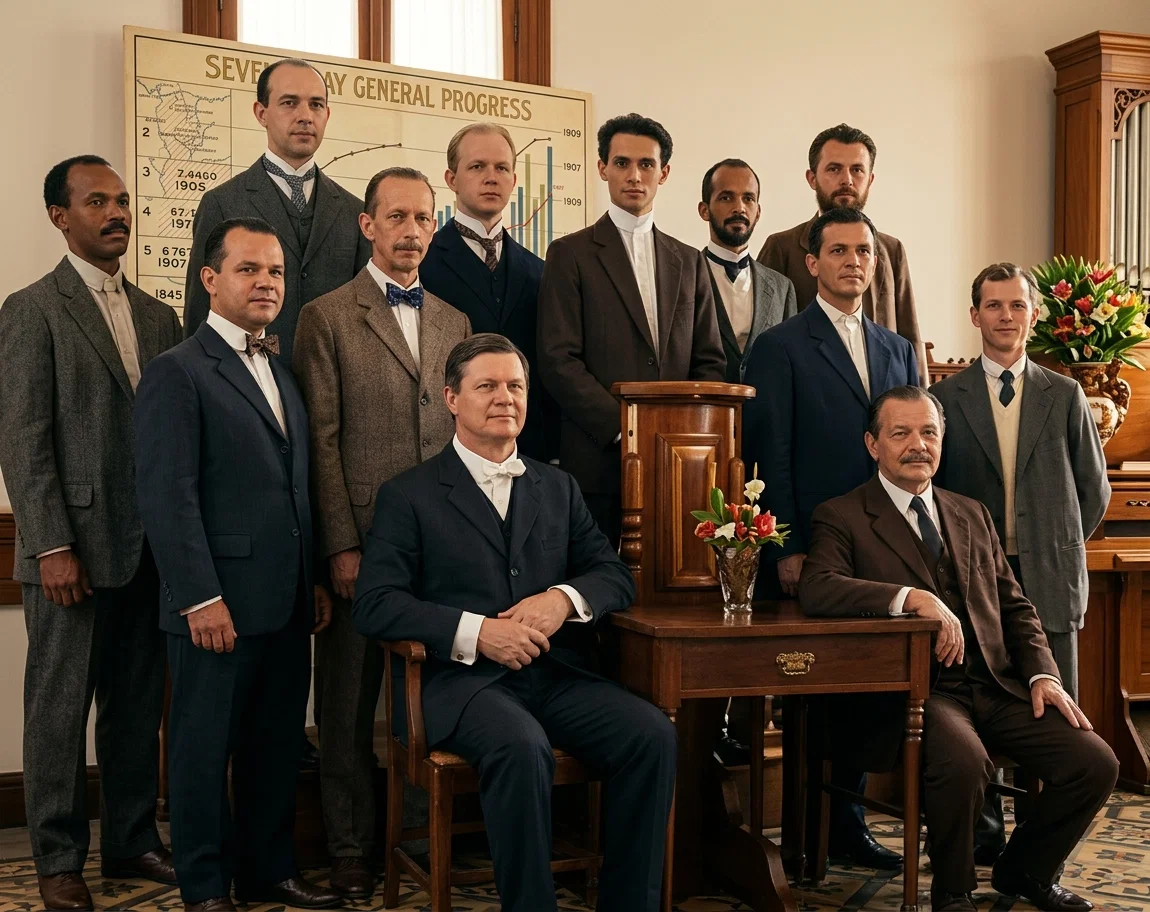
NEWLY ELECTED UNION COMMITTEE