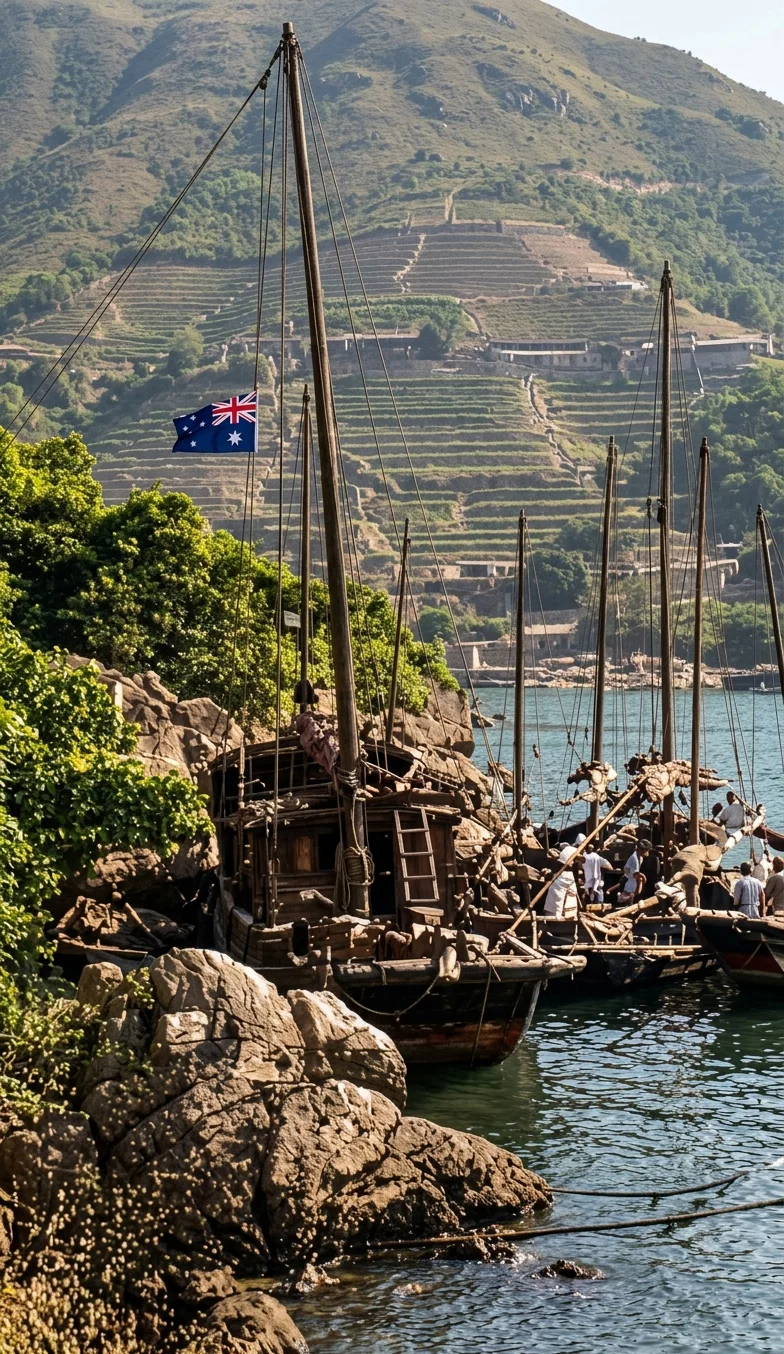
Our boat after the experience at the Tsin Tan rapid. Described in REVIEW, July 23. The Australian flag flying at the mast.
March 30. As I write this I am sitting in a Chinese inn facing the river. In the distance I can see our boat with the Australian flag still flying at the mast, and the Chinese flag at the stern. I am encouraging the captain to try again today to cross the rapid. He, poor fellow! has had his many bags of rice soaked, and is not feeling any too happy about the matter; and besides, what is worse than all, he says he has “lost face.” However, I think he will try again today. We are taking our goods off the boat and having them carried above the rapid; so if the boat goes down this time, we and our goods will be safe.
Today, no less than four boats have been wrecked at this place, and one man lost his life. The others were saved by the life-boats. In one case they also saved a dozen pigs which were thrown into the river when the boat was wrecked.
Since writing the above I have helped the trackers pull our boat up the rapid. We had more than sixty men on shore pulling, and with the men on the boat there must have been over seventy engaged in this work. These men pulled like mules to get the boat up the raging water. The whippers (leaders of the trackers) screamed, shouted, cursed, and struck the men in order to make them pull harder. We had two long bamboo towlines attached to the boat. One of these lines was thirty-six hundred feet long and was attached to a stone pillar on the shore. The other was more than one thousand feet long. Two safety lines were fastened to rocks nearer the boat. These emergency ropes save the boat from being dashed on the rocks if the two towlines part. The captain frantically shouted his commands to the first whipper, and he in turn passed the command along to the next whipper, and finally it reached the men, accompanied with curses and blows.
“Some idea of the force of this enormous volume of water may be given by mentioning the exploits of the steamship ‘Pioneer,’ which on three consecutive occasions attacked this rapid (that is, Yeh Tan rapid, which is not so fierce as the Tsin Tan) when at its worst, and, although steaming a good fourteen knots an hour, failed to pass. She was obliged to lay out a long steel hawser and heave herself over by means of her windlass, the engines working at full speed at the same time; hard and heavy was the strain, gaining foot by foot, with a tension on the hawser almost to the breaking strain—a veritable battle it seemed with the mighty dragon of the Yangtze.” I have quoted the above to give some idea of the tremendous force of the water at these rapids. However, I am glad to say that our boat crossed safely, and by 9:30 P. M. all our things were once more on board, and by 10:30 we went to bed. I was tired, very tired, and slept like a child until next morning.
April 1. We left Tsin Tan about 10 A. M., and having a strong, favorable wind, we traveled fast. During the day we passed several rapids, but they were not so dangerous. At one place our towline broke and we drifted downstream however we were not in a dangerous place, and so no harm was done. Further on we saw a number of wrecks. The poor boat people managed to save a lot of cargo from the river, and have it on the banks of the river drying in the sun.
The first place we passed after leaving Tsin Tan rapid was Hsiang Chi. Here we saw cuttings that were for the Hankow-Szechuan Railway.
We passed Yeh Tan rapid (the one referred to in the preceding quotation) at 3 P. M., and had no difficulty at this place. There we saw nearly a score of tents belonging to those who are surveying the railway line to Szechuan. Further on at a small place called Ba Dou, we saw two foreigners10and a number of Chinese surveyors engaged in surveying the route for the railway just mentioned. It seems it will not be long before our field will be connected with the rest of China by railway. Thus these men are unconsciously helping to spread the third angel’s message by preparing quick means of communication.
April 2. At 12:30 today we leave the province of Hupeh and cross into Szechuan. It is inspiring to us to realize that after a delay of five years (it is five years since I was first appointed to this field) the message is at last to go to the 88,000,000 people of West China. We read Rev. 14:6-14. Thank God his word will never fail; and this message will go to all the world in this generation, and then shall the end come.
April 3. Last night, strange to say, it snowed upon the mountain tops; so today it is very cold. The wind is still favorable, and it will not be long before we shall reach Kwei Chow Fu, a city of about 40,000 people. We have already made thirty miles today, and it is only 11 A. M. This is fast traveling for China. Truly our Lord is good.
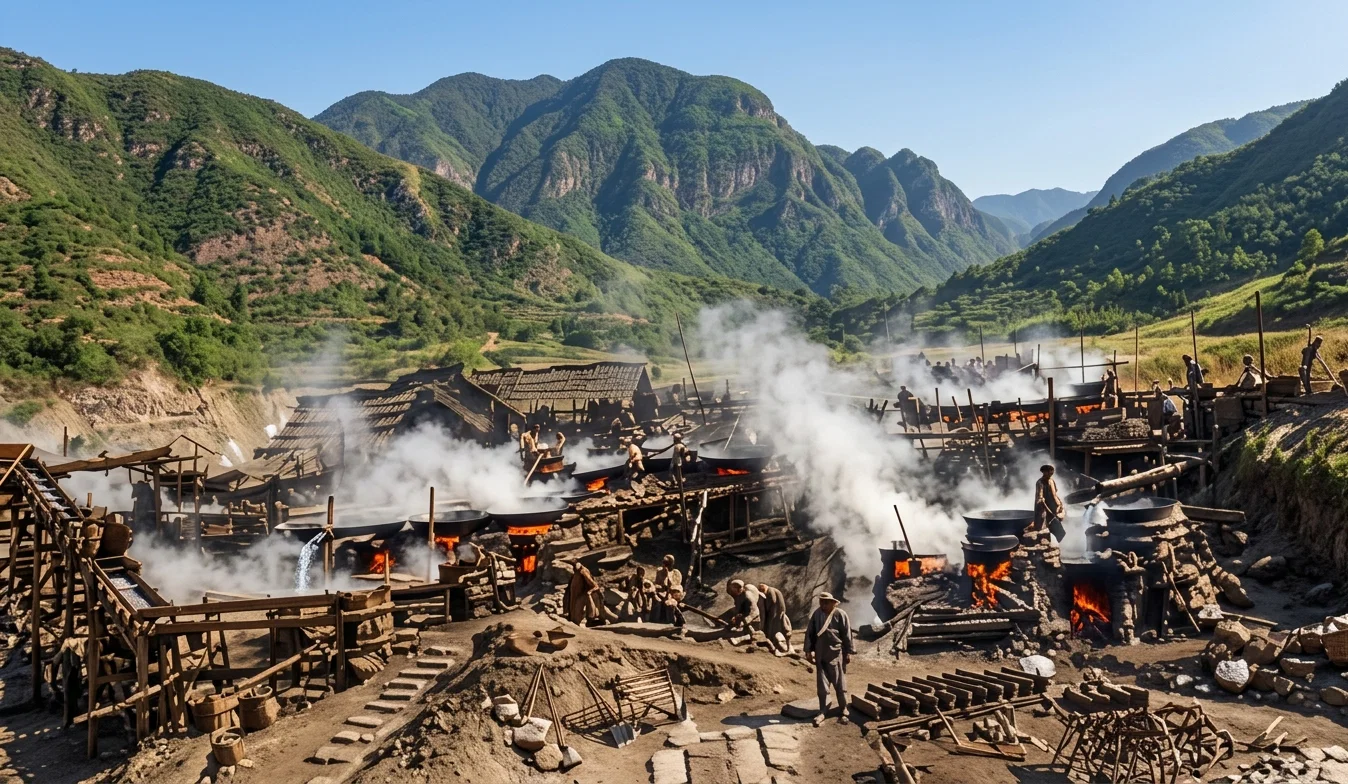
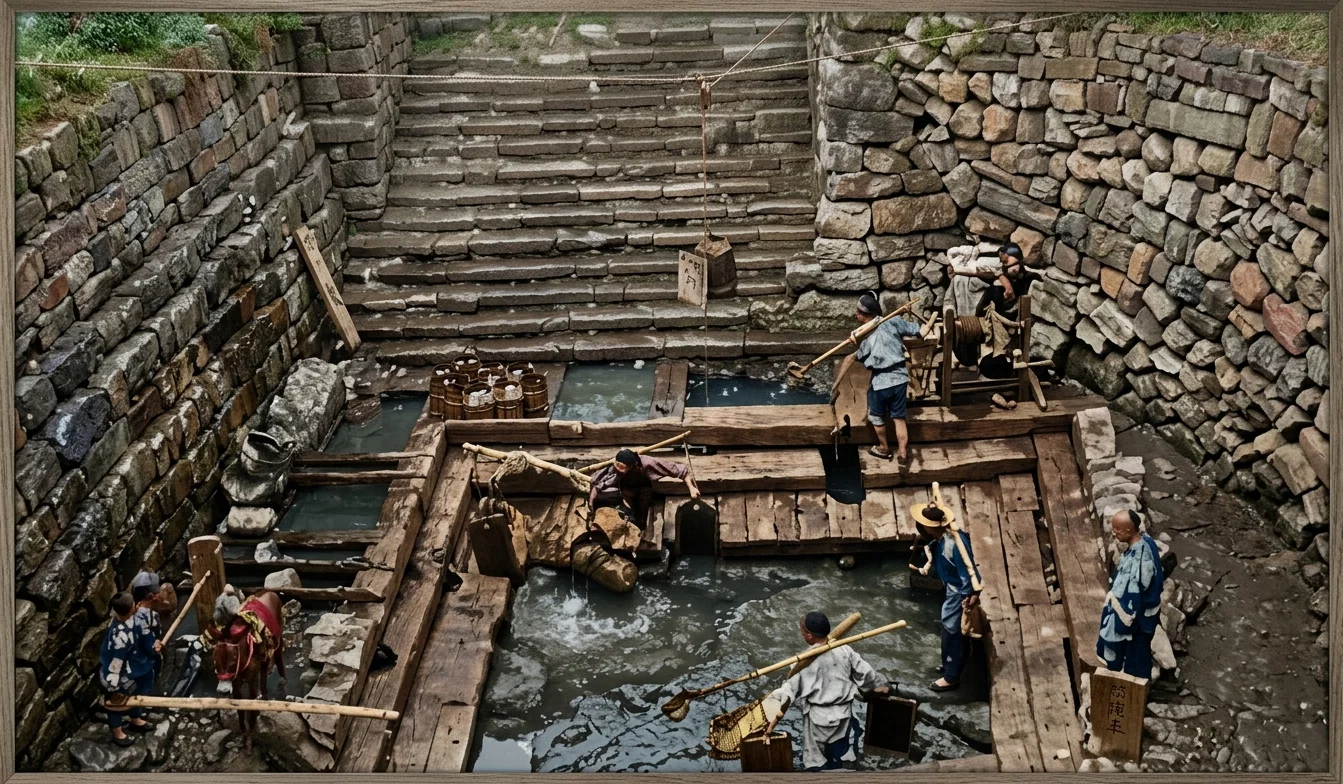
We arrived at Kwei Chow Fu about twelve o’clock. A little below this city is a celebrated brine well which is located on a small island, or sand bank. The salt water is dipped up in buckets and emptied into wooden troughs, through which it runs to large iron pans. There is enough brine to keep one hundred and twenty large pans constantly in use during the season the well is worked. One authority says that one million five hundred thousand pounds of salt are made annually. This island is above water only from January to May, and the manufacture is confined to those months.
In the city of Kwei Chow is a noted Roman Catholic church which is said to date from 1662. This shows how early the Papacy entered this part of China.
April 4. We stayed in a small market town over Sabbath. It is called An Pin, which means “rest” and “peace.”
We had Sabbath school at 11 A. M., and then organized the first Sabbath school in Szechuan. We elected Brother M. C. Warren superintendent, and Dju H. S., our Chinese evangelist, secretary. After this we entered the town, and the evangelist and I spoke to the crowd that soon gathered. The people listened well, and our own souls were refreshed by telling the story of the cross. In the afternoon I held a Bible study with a Christian from another boat, which was detained by adverse winds. We studied the three messages.
General view of salt industry at Kwei Chow Fu, showing the fires and steam arising from the large iron pans in which the salt is being refined.
April 5. We left An Pin early Sunday morning, and at 11 A. M. we passed another rapid; we finally anchored below the Shintu Lung rapid (the New Dragon rapid), which is considered the worst rapid in Szechuan, just as the Tsin Tan is considered the worst in Hupeh. This rapid constitutes the last formidable stepping-stone during low water en route to Chungking.
“It was formed by a landslip as recently as 1896, when the whole side of a hill falling into the stream reduced its breadth to less than a fourth of what it was previously, and produced this roaring rapid.
“According to Chinese myths, the landslip which produced the rapid was caused by the following circumstances: The ovum of a dragon was deposited in the bowels of the earth at this particular spot, which in due course became hatched out in some mysterious manner. The baby dragon grew and grew, but remained in a dormant state until quite full-grown, when, as is the habit of the dragon, it became active and at first awakening shook down the hillside by a mighty effort, freed itself from the bowels of the earth, and made its way downstream to the sea; hence the landslip, the rapid, and its name.”
The celebrated brine well at Kwei Chow Fu, Szechuan.