Personal Soul-Winning; the Duty of the Church in View of the Close of Probation
G. B. THOMPSON
“BEHOLD, the day of the Lord cometh, cruel both with wrath and fierce anger, to lay the land desolate: and he shall destroy the sinners thereof out of it.” Isa. 13:9. “Knowing therefore the terror of the Lord, we persuade men.” 2 Cor. 5:11.
Prophets have portrayed the day of God in the most solemn and thrilling words. The close of probation, the fixing of the destiny of earth’s unnumbered millions, the day of the Lord’s anger,—these are words of terrible import.
To look upon our neighbors, friends, and kindred, whom we dearly love, and know that in a few brief years, if unsaved, they must stand without any hope in God, and with all the tribes of the earth, mourn as they see the Son of man and all the angelic host come in glory and power, is a most solemn and appalling thing to consider.
To view the ruin of one city shocks the sensibilities; but to meditate upon the ruin of every city—ruin world-wide and indescribable—when the “slain of the Lord” will be “from one end of the earth even unto the other end,” when the “foundations of the earth” will shake, mountains be moved out of their places, and islands disappear, staggers the imagination, and causes the heart to cry to God for a hiding-place in that dreadful hour.
As the overshadowing cloud of the world’s doom grows darker, surely great earnestness should characterize the lives of those who believe these things. We should be untiring in our personal efforts to warn and save the souls of our neighbors, our friends, and our kindred. If we saw them in a burning building, fast being consumed by the angry flames, we should put forth almost superhuman efforts to save them from destruction. No earthly thing would be allowed to hinder us in the work of rescue. But a doom more terrible than this awaits those in our homes and neighborhood who are unconverted. Can we sit unmoved and indifferent and see them swept over the great Niagara of ruin? Gracious Lord, forbid! The hour has fully come for every one who believes this message to take hold of earnest missionary work.
Our greatest need is a burden for souls. Many do but little in soul-winning. Every unsaved, unwarned soul should pain our hearts.
One day from the deck of an ocean liner a boat was seen drifting in mid-ocean. It had come from a sinking vessel. A boat and crew were sent in pursuit. In the bottom of the drifting boat a man was found, exhausted and unconscious. As he was lifted up and taken into the other boat, he partially revived, and the first feeble words heard from his lips were, “There’s another man in the boat.” Saved himself, his first thought was to have another saved.
This incident illustrates the spirit of the true Christian. One of the first evidences of conversion is an interest in some other soul, in the other man in the boat. The Scriptures abound in examples of personal work for souls. Some of the greatest sermons Jesus preached were to one soul. By night he talked personally with Nicodemus, and instructed him about his soul. A large part of the third chapter of John is a record of the instruction given at this interview. In a personal talk he taught the Samaritan woman the way of life, who began personal work and brought other souls to the Master. To the one who said, “Master, I will follow thee whithersoever thou goest,” Jesus gave some valuable lessons. To another he said, “Go thou and preach the kingdom of God.” He instructs another concerning the sin of “looking back.” The one man seems to have been the congregation in much of Christ’s ministry. In this he has left us an example. Are we following in his footsteps?
Andrew, who had found the Messiah, “findeth his own brother Simon,” Philip, being found of Christ, “findeth Nathanael.” Philip, the evangelist, has a personal interview with the treasurer of Queen Candace, and leaves him a baptized believer. Paul and Silas labor personally with the jailer and his household in the midnight hours, and have the joy of witnessing their conversion and baptism before dawn. Aquila and Priscilla do personal work with Apollos and expound unto him the way of God more perfectly. These few examples gleaned from the lives of Christ and his followers, as recorded in Holy Writ, should admonish us as Christian workers to similar endeavor.
A visitor at a pottery observed a workman molding a piece. The process seemed slow. The visitor asked if there was no tool that could do the work. “No,” replied the potter, “we have tried several, but somehow in this work we must have the human touch.” So in molding human souls into vessels for the Master’s use, there must be the personal touch. We cannot do our missionary work by proxy, we must personally come close to those needing salvation.
It is this personal work in our churches which I am sure needs emphasis. To be a successful soul-winner, we must put forth personal efforts for others. Much of the fruit of souls must be hand-picked. There is danger, while giving attention to other things, of our losing sight, in a measure, of our real work, that of saving souls.
Within easy reach of each of us there are many lost fathers, mothers, and youth who need some one to show them the way to their Father’s house. Their condition is a mute appeal to us for help. Some of these sit every Sabbath in our churches. Some are in our homes. It seems unspeakably sad to allow them to sit there week after week and no personal effort be made to bring them to Christ.
I was on a camp-ground once when the word went out that a little boy, who had been left in a tent while the parents attended a morning meeting, was lost. Soon the whole camp was astir. Tears were shed, and anxiety was seen on every face. Breakfast was forgotten. None cared to eat. In every direction scores of people scattered and continued their search until the lost boy was found. But in every church there are lost boys and girls, and no such stir as this is seen. Can anybody give a satisfactory reason for our indifference? What can we say personally?
If you are a Christian, you are to be an agent in the hands of God to resurrect the dead, those who are “dead in trespasses and sins.” An instructive miracle wrought by Elisha throws some light on how this may be done. The son of the Shunammite woman died. In her sorrow and distress, the mother laid him on Elisha’s bed, and hastened to the man of God for help. “And when Elisha was come into the house, behold, the child was dead, and laid upon his bed. He went in therefore, and shut the door upon them twain, and prayed unto the Lord. And he went up, and lay upon the child, and put his mouth upon his mouth, and his eyes upon his eyes, and his hands upon his hands: and he stretched himself upon the child; and the flesh of the child waxed warm. Then he returned, and walked in the house to and fro; and went up, and stretched himself upon him: and the child sneezed seven times, and the child opened his eyes.” 2 Kings 4:32-35.
Elisha had to deal with the dead. He was not satisfied with merely cleansing the dead body, embalming it, or wrapping it in fine linen and leaving it still a corpse. He was not satisfied either when the corpse seemed to wax warm. The dead must live. He labored on until life was restored. Our mission is bringing life from heaven to spiritually dead souls. When Elisha came, he shut the door, and alone with the dead child prayed earnestly to God. He came in close personal touch with him. He was rewarded by seeing the dead live. There is a lesson in this for each of us as to how to win souls for the Master. It means prayer, unconditional surrender, deep consecration, and personal, persevering labor.
It would help us, perhaps, to become more active and earnest in the work of saving souls if we could realize fully the value of even a child. I read something recently which impressed this very deeply on my mind:—
“A farmer in North Carolina once1104drove with two high-mettled horses into the town. Stopping in front of one of the stores, he was about to enter when his horses took fright. He sprang in front of them, and heroically seized the reins. Maddened by strange noises, the horses dashed down the street, the man still clinging to the bridles. On they rushed, until the horses, wild with frenzy, reared on their haunches, and, leaping upon the man, all came with a crash to the earth. When the people came to rescue the bleeding body of the man, and found him in death’s last agony, a friend, bending tenderly over him, asked, ‘Why did you sacrifice your life for horses and wagon?’ He gasped with his last breath, ‘Go and look in the wagon.’ They turned, and there, asleep in the straw, lay the man’s little boy. As they laid the mangled form of the hero in his grave, no one said, ‘The sacrifice is too great.’”
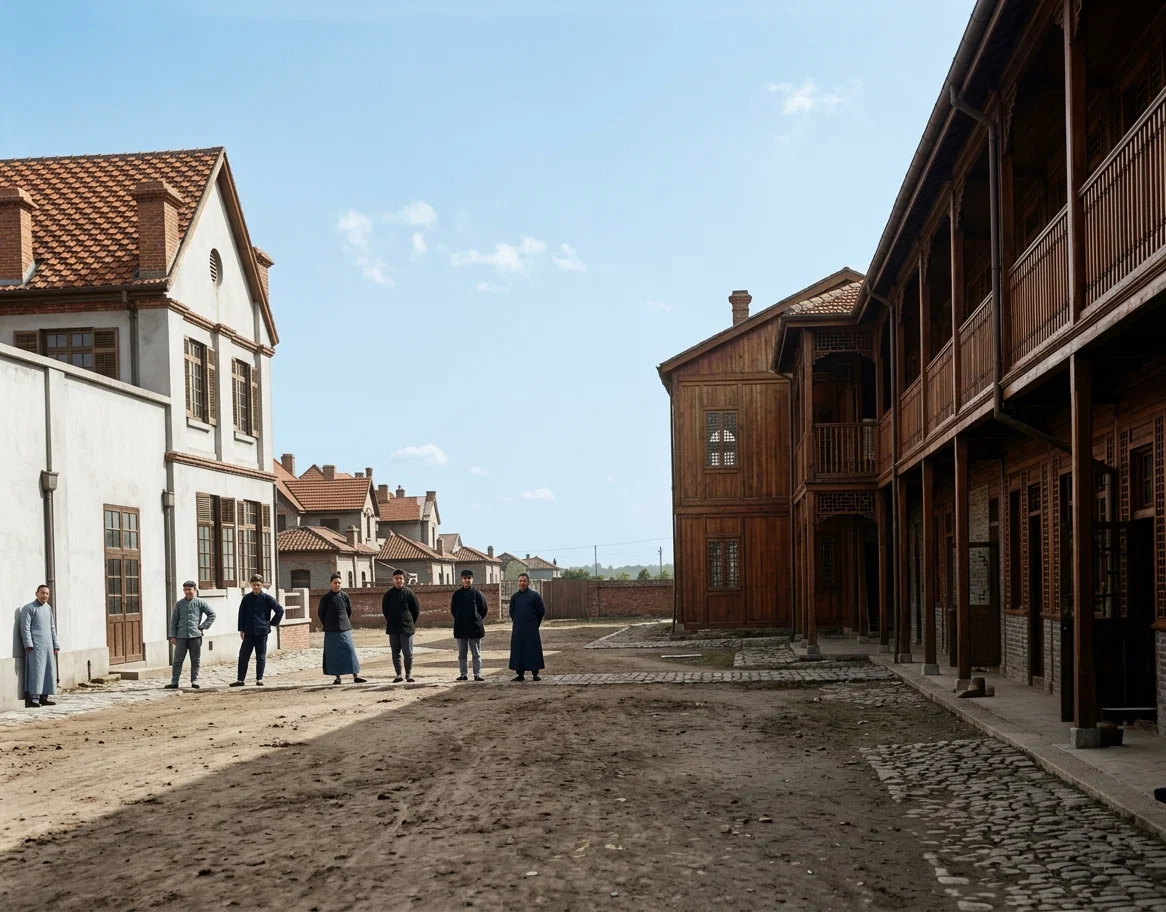
REAR VIEW OF SHANGHAI, CHINA, HEADQUARTERS
Now it was his little boy asleep in the wagon that caused this father to sacrifice his life. He was not thinking about the value of the team or the wagon. He was thinking about his boy. He was entirely oblivious to danger, and willing, if necessary, to die to save his little boy. Did he make too great a sacrifice? Nobody will say he did. But there are boys, worth just as much as this boy, near us who are not saved. Is it putting it too strong to say that we should put forth as earnest efforts to save eternally in heaven those who are unconverted as this father put forth to save his boy from being killed?
If all the church-members had this yearning of heart to see souls saved, many would be brought to Christ. I sometimes fear that our efforts to save souls are illustrated by the man who was drowning in the pond on a cold day. Some one, desirous of helping him, gave him the end of a plank that was covered with ice. The man tried repeatedly to get hold of it and save himself, but finally exclaimed, in despair: “Give me the other end of the plank; this end is icy!” We need to be sure, if we wish to win souls, that we do not hold out to them the icy end of the plank, but through love come in warm, personal touch with them.
Our responsibility in personal work, as well as the need of our doing it, was impressed on my mind recently by the following incident:—
“A minister was called to conduct the funeral service of a young girl who was a stranger to him. He went to her Sunday-school superintendent and asked, ‘Was Minnie a Christian?’ ‘Really, I don’t know,’ replied the superintendent. ‘She has attended Sunday-school for several years, and I have often thought that I should like to ask her, but never did.’ The minister then called upon her teacher and said, ‘Was Minnie a Christian?’ The teacher replied, sadly, ‘I do not know. I have often thought that if I ever got her alone, I should talk to her, but never did.’ Then the minister went to her mother, and repeated the question, ‘Was Minnie a Christian?’ ‘I do not know,’ replied the weeping woman. ‘She went to Sunday-school, and I thought the teacher and the superintendent ought to talk to her. I never seemed to be able to say anything to her on the subject.’”
I have wondered if a condition similar to this exists in any of our churches. Should one of the children in your church die, would you know at the funeral whether he was a Christian or not? We may know that he came from a Sabbath-keeping home, and attended church and Sabbath-school, but that does not make him a Christian. Young people need a change of heart. They must be converted to be saved.
Our greatest joy in heaven will be to see souls there whom we have led to Christ. “For what is our hope, or joy, or crown of rejoicing? Are not even ye in the presence of our Lord Jesus Christ at his coming? For ye are our glory and joy.” 1 Thess. 2:19, 20.
We may consistently ask ourselves the question, Why am I a Christian? Is it for my own good, or is it for the good of others? Believing that the days of human probation are almost past, we have a great responsibility resting upon us. “We owe a great debt, and it is long overdue. ‘I am a debtor both to the Greeks, and to the barbarians,’ said Paul. What had he received of them?—Absolutely nothing. But he had what they needed and must have, and he was their debtor until he had met that need. We have in our hand a pardon for a man condemned, and we are his debtor until we put it into his hand. It was for that purpose that we received it, and with it went the message, Go quick everywhere.”
O that the Lord would break the spell of coldness and indifference upon us concerning the lost! A godly minister once said, “I am a broken-hearted man; not for myself, but on account of others. God has given me such a sight of the value of precious souls that I cannot live if souls are not saved.” David Brainerd said, “I cared not where or how I lived, or what hardships I went through, so I could but gain souls to Christ. I dreamed of these things; and when I waked, the first thing I thought of was this great work.”
But before we can prevail with men, Jacob-like we must prevail with God. The gospel we preach must save us; we must be able to tell of personal salvation. We ourselves must be in the ark to which we invite others. We must be men and women of prayer. We must receive from God in secret before we can disperse in public. Mr. Whitefield’s chapel was called a “soul trap.” This is what every place of worship should be,—a place where souls are caught for the Master.
It has been suggested that we set as a goal the doubling of our membership. It seems like a big task to talk of doing this. But it is quite possible if we all take hold of the work. It means simply that we each bring one soul into the truth, and the task is accomplished. Cannot we do this much the coming year? Is one soul a year too many in the days of the close of probation?—Surely not. Brethren, this can be done, and more. Shall we not consecrate ourselves to the work of bringing people to Christ as never before? Shall not each of us determine, God helping us, to bring at least one soul to Christ the coming year? This will bring new life into our own hearts, new life into our churches, new power into our work, and hasten the close of the work of God in the earth. How many will dedicate themselves to this work, and know no rest till they have brought some souls to Christ?
There will be no starless crowns in glory. Our own salvation, as well as that of others, depends on our faithfulness in guiding the lost to the fold.