The Bahama Islands Mission

7%

Review and Herald Publishing Association · Takoma Park Station, Washington, D. C. · Sep 11, 1913

FromReview and Herald, Vol. 90, No. 37.

Read the full edition

The Bahama Islands Mission

W. A. SWEANY
A YEAR ago last winter, among the many tourists who fled from the frozen regions of the North to spend a few weeks in the “isles of golden sunshine and sapphire seas,” were two prominent Canadian gentlemen who conceived and proposed to the people of the Bahamas the idea of seeking for the admission of the colony into the Canadian federation. Through mass-meetings and legislative enactment, the people indorsed the proposal, and the plan met with favor in official and mercantile circles in Canada. But the agitation of the matter led to the discovery of the somewhat peculiar fact that multitudes of the people knew nothing of the existence of the Bahama Islands; and others who knew of them had a very hazy idea of their location. These islands, beginning just off the east coast of southern Florida, extend in a southeasterly direction a distance of nearly eight hundred miles, to Haiti and Santo Domingo. The group consists of thirty islands of some size, 660 islets, and 2,387 rocks, reefs, and cays.
Compared with the great, populous countries and cities, the sixty thousand inhabitants of this little corner are only as a drop of the ocean, and the work of carrying this message to them might seem to be easy of accomplishment. But in undertaking it, we find them scattered in hundreds of small settlements, many of them only a few families, reached only by small schooners and sloops, oftentimes long delayed and hindered by contrary winds, or by calms in which the vessel lies as motionless as “a painted ship upon a painted ocean,” for days, and sometimes even for weeks.
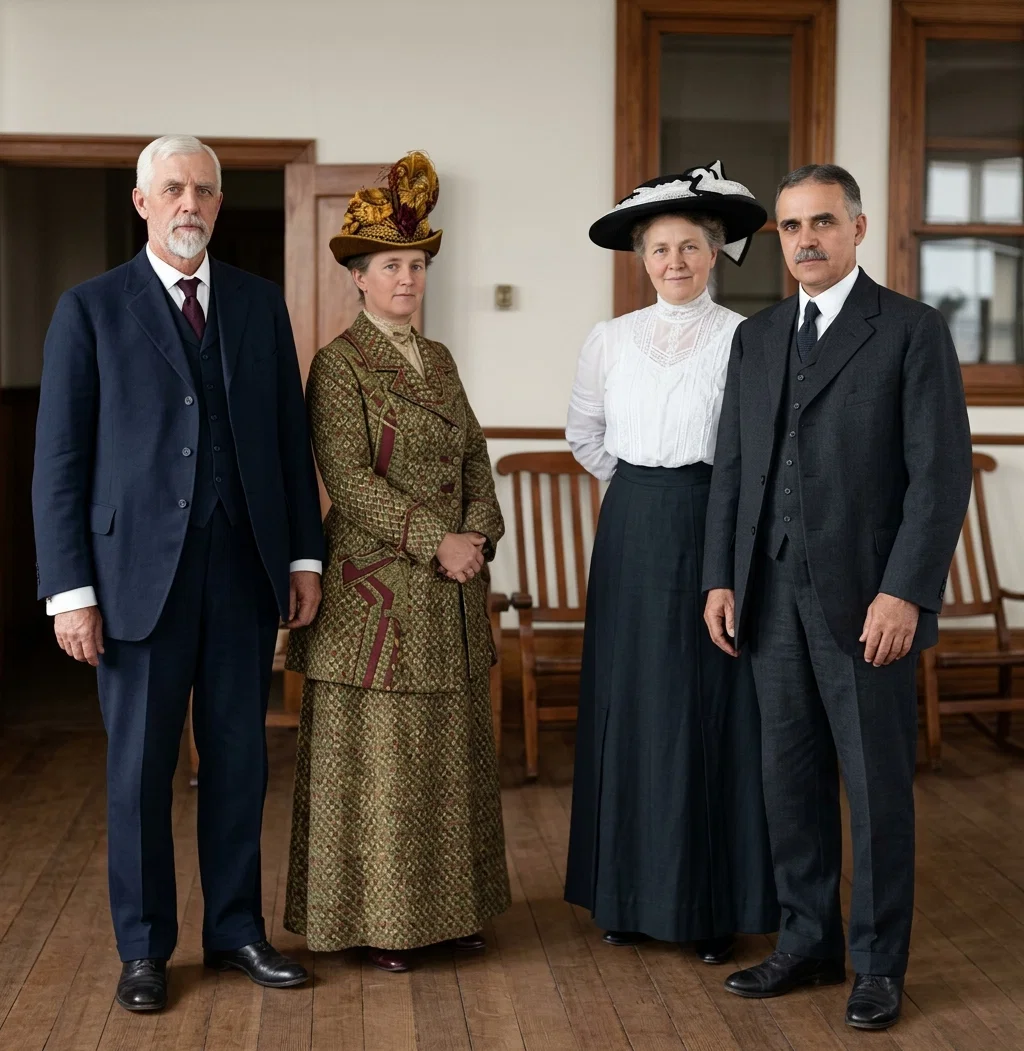
R. C. PORTER AND WIFE.  I. H. EVANS AND WIFE
R. C. PORTER AND WIFE. I. H. EVANS AND WIFE
Four years ago we located in Nassau, the capital of the colony, a town of about thirteen thousand inhabitants, on the island of New Providence. As far back as fifteen years ago, Brother C. F. Parmele and family spent some time in the colony, sowing the seed in the form of the printed page, in a number of the islands. Two or three other canvassers have, since then, passed through Nassau, remaining, however, only a few days or weeks.
As some of the results of Brother Parmele’s labors, we found two lone sisters keeping the Sabbath. One of these died soon after our arrival. The other, with her family, joyfully accepted the whole message as soon as it was presented to her, and slowly but steadily the number of believers increased, till at the present time we have an organized church of twenty-one members and a Sabbath-school of about thirty-five.
As an indication of the quality of these believers, a few items from our annual financial report are presented. Tithe for four years, $1,245.26; Sabbath-school offerings, $412.20; other mission offerings, $223.67; offerings for local work, $325.29. Total, $2,206.42. The establishment of the work in this field, together with its prosecution for four years, has required only $918.97 from the Mission Board treasury, and half of this has been received in the form of literature. Only a few more believers like those we have now, and the field will be entirely self-supporting, and from the vantage-ground of the beginning already made, that much-to-be-desired result will be much easier of accomplishment than has been the beginning. The necessity of first establishing the work in the capital has prevented us from visiting more than about a dozen of the out-island settlements. Our experience in these few places, and the invitations that come to us from those we have never visited, reveals the fact that they are ripe for the message. The simple announcement that an open-air meeting will be held quickly spreads through the village, and
practically the whole community assembles and eagerly listens to the message as long as one wishes or is able to proclaim it.
Our services in Nassau are held in a storeroom, in a poor suburb, but our Sunday night preaching services have all along been well attended, not only by the common people, who still hear the message gladly, but by a considerable number of more prominent persons, many of whom, including at least some of the many tourists who spend the winter there, would attend if we had a suitable church in an accessible locality. A good, substantial church building and parsonage in the center of the city could be purchased for about $3,500; but although our people are loyal and liberal, that is still beyond our reach, unless some one in the States comes to our assistance with a large donation. However, we are praying, planning, and giving, and have nearly $900 in cash in our church building fund, and are hoping sometime to erect a building into which we can without shame invite the Lord and the people.
Perhaps our greatest need is a church-school for the children of our people, a need so desperate that I despair of portraying it before you. Suffice it to say it is awful to have to leave our children in Babylon, from which we ourselves flee to escape impending wrath. Compulsory educational laws require the attendance of all children under twelve at some school. Even a primary church-school would, of course, meet the requirements of the law.
There are plenty of schools, both gov-ernment and denominational, but many of the people sense the need of a better brand of education, and better conditions under which to obtain it, than these schools afford. And strange to say, although we have not yet made a start toward a school here, the people are looking to us for help. Only a few days before we left, to our unbounded astonishment, a committee of citizens—none of them Adventists—called on us with a memorial, which they wished us to present at the General Conference, asking that we start and operate a school for their children and youth, and pledging themselves to erect the building and fill it with paying pupils.
And so, although this corner of the field is small, it presents some openings, which, if filled, will surely lead to gratifying results. George Washington, Grover Cleveland, Mark Twain, Sir Frederick Treves, and thousands of other noted visitors unite in pronouncing the climate of these “sun-kissed, wave-washed isles of everlasting June” to be the best in the world. Here Columbus landed, De Leon sought the fountain of youth, while Black Beard, the pirate and buccaneer, long carried on his wicked operations. French, Spanish, and English have here made much bloody history, and in the days of the civil war, Nassau was the most noted rendezvous of blockade runners. It was just off the bar of Nassau that Captain Wilkes, of the “San Jacinto,” overhauled the “Trent” and captured Mason and Slidell, Confederate envoys to England, thereby nearly embroiling the Union in war with Great Britain.
But the greatest thing that can be said of these isles is that by patient effort jewels of worth, pearls of great price, may be found which, when polished by the truth, will shine in the palace of the King. The day of small things should not be despised nor neglected, for the Master says, “Gather up the fragments that remain, that nothing be lost.”