L. R. CONRADI

7%

Review and Herald Publishing Association · Takoma Park Station, Washington, D. C. · Apr 24, 1913

FromReview and Herald, Vol. 90, No. 17.

Read the full edition

L. R. CONRADI

German Victoria Nyanza Mission — No. 2

L. R. CONRADI
As our time was so limited and the other stations in the Wasakuma country were only being started, we did not go farther into that land, for it would have taken us at least another week. We met our Kidzu porters, and after great difficulty secured sufficient porters among the Wasakuma people to take us to Nassa, on the southeast corner of the lake. This is a trip of not less than eighteen hours. Our caravan had grown considerably, so that we were no less than ten white missionaries, and over forty boys and porters. To save ourselves the hard trip in the hot sun, we left on the evening after the Sabbath. As there is quite a stretch of sparsely settled country and desert, we marched the twelve hours, all the night through. After we had gone a few hours we found about a thousand of the Wasakuma people gathered on a hilltop having one of their great heathen feasts, which generally last the entire night. Young and old were hastening to the feast, bearing great pots of beer. As we were several porters short, two of the boys were secured as porters, but one of them had already swallowed so much that he had a rather hard time carrying his load.
Toward morning we passed the Kasema Mountain, where is a gold-mine, and we could clearly hear the noise of the machine crushing the gold ore. From five hundred to one thousand natives are employed there. Had it not been for the lack of time, we surely would have called. When we went into camp on December 22, we were all quite tired out and enjoyed our rest that day. As heavy showers came up, we appreciated the advantage of having that much of our journey behind us.
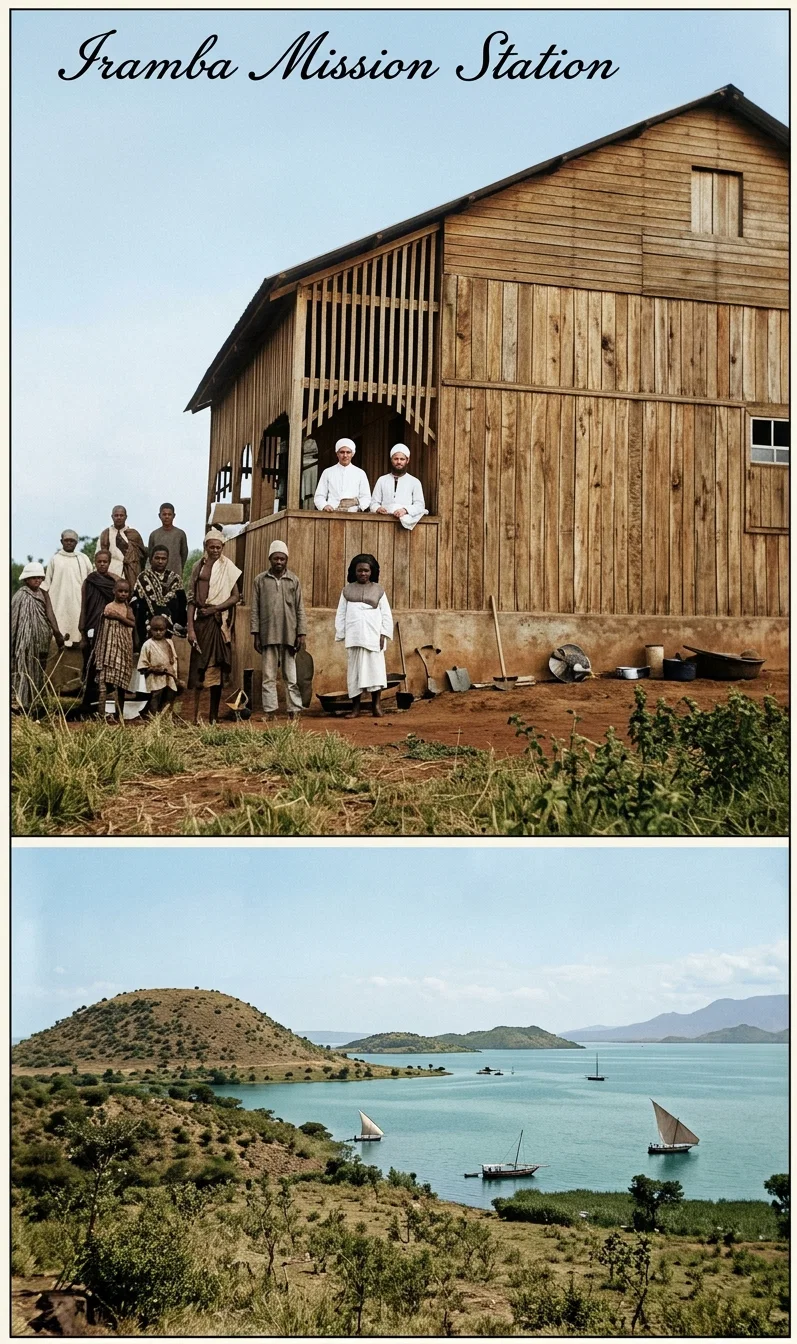
1. IRAMBA MISSION STATION
2. LAKE NYANZA FROM SAME MISSION
  1. IRAMBA MISSION STATION
  2. LAKE NYANZA FROM SAME MISSION
At 1 P. M. of the twenty-third we reached Nassa, on the Speke Gulf. From early in the morning we had been seeing the cheery waters of the lake, and as we neared it we saw the mast of our mission boat “Herold” awaiting us.
Nassa is an old station of the English Church Mission. Nine years ago when we started in German East Africa we carefully studied its history and thought some of purchasing it, as we knew the society would be willing to dispose of it. Two years ago the African Inland Mission took charge of this station, which is two miles up from the lake. Several of us walked up there to call on the missionaries. Mr. Suwalki, an American Pole, with his wife, is in charge. He is assisted by two other lady workers. They have an out-station besides this, which is at Nera, farther inland. The main mission building had burned down, the large school and church was also in ruins, there was some cultivated land, and another dwelling and school building had been put up. But the buildings and ground were in a condition forming quite a striking contrast to ours.
The Church Mission has four graves here. The African Inland Mission also has lost one man, and his bride, who had come from America, is one of the lady workers still there. When we wanted to visit the school, we found it had just been dismissed. The highest enrolment they report is thirty, but they had at the time scarcely more than half a dozen, and but very few boys living at the station. They had had baptism, but this American society has no real church organization; they pay no fixed salary, giving only an uncertain allowance. Mr. Suwalki would have been glad to attend our general meeting, but he was awaiting orders to be present at a meeting of their society. They have a small hand-press, and expect to get out some hymns in the Wasakuma.
At 10 P. M. we all gladly embarked on our mission boat, rather enjoying its close quarters after so long an overland trip. During the night we crossed the Speke Gulf, and by morning neared Ukerewe, a large island which is separated from the mainland by the narrow Busegwe Channel. The Catholics have old mission stations on the island, but already several of their people have come over to our stations to be taught. This naturally has enraged the missionaries of that body.
The channel, deepened by a German navy official with the help of the natives, was just deep enough in several places to allow our sailboat to pass through. We then entered the Baumann Gulf. Right before us was the high Majita Table-mountain, a leading way-mark on the lake, near which our main station, Majita, is located. But we passed up the gulf, and by noon our Iramba station came in sight. At 3 P. M. we were able to land, and a ten-minute walk brought us to the top of the hill, where the station is located.
A substantial dwelling-house has been erected, together with a good school building, workshops, native huts, etc. Brother Stein and his wife, who went out after the last large Friedensau council, are in charge of the station. We were well entertained in their cozy home. Their grounds are well laid out, and they have a fine view of the lake and bays and islands about them. They have alsoabout one hundred fifty students, and seem to be doing a good work.
Next morning at seven a fair wind took us across the gulf to Majita Peninsula in two hours. Here we found a well-settled and well-cultivated country. After ascending the hill we saw in the midst of the peninsula on a lofty elevation our main station. A number of the natives had come down to act as porters, and as we passed, the people tilling the land gave us a hearty greeting. At Iramba the sad news reached us that Sister Mertke, our faithful nurse, took ill of the blackwater fever December 21, and was in a dangerous condition.
On reaching the station, we found a splendidly laid-out mission, with good, substantial buildings. Last year Brethren Ohme and Winter erected a good three-room dwelling, where Brother Ohme lives and has his office. We have also a large iron-roofed chapel, which seats fully six hundred persons. Then there are the workshops, girls’ school, some native huts, and the old mission dwelling. But as this old building was put too much into the ground and not cemented, as the other buildings, the white ants had already attacked one end. Dr. Vasenius and Brethren Persson and Wallath arrived soon after we did. We found Sister Mertke in a rather low condition, but were pleased that Sister Ohme and the children and the other missionaries seemed to enjoy good health. Ample preparations had been made for the comfort of all the missionaries, and the natives soon came with baskets of food, etc., from all directions. We had scarcely arrived before the native sultan and his sons called on us. When we reached the station several hundred native boys were lined up, with Brother Winter, and they gave us a hearty reception.
Our main station, which commands a view of the lake from three sides, is surely well located, and is an honor to our work. Several of the German officials have taken extra trouble to come this way and take photographs of the station, but best of all we have been able to get an excellent hold upon the thrifty Majita people. Several hundred of their boys and girls attend the main school, and we have at the foot of the hill near the lake another excellent out-school with about one hundred thirty pupils, who came up on Friday to greet us, and were with us over Sabbath. While the Victoria Nyanza has no lighthouses as yet, and her steamers must anchor overnight, we are indeed thankful to the Lord that Seventh-day Adventist mission stations are planted all along the east coast, and even far inland, as bright beacon-lights. Let us remember them in our prayers.