While our British Mission occupies the northeastern half of the lake, the German covers all the southeastern, and of late has extended its field seventy miles southeast of it into the Wasakuma country. Four years ago the work was started in this field, and though we had some adversities at first, yet the work has recently developed well.
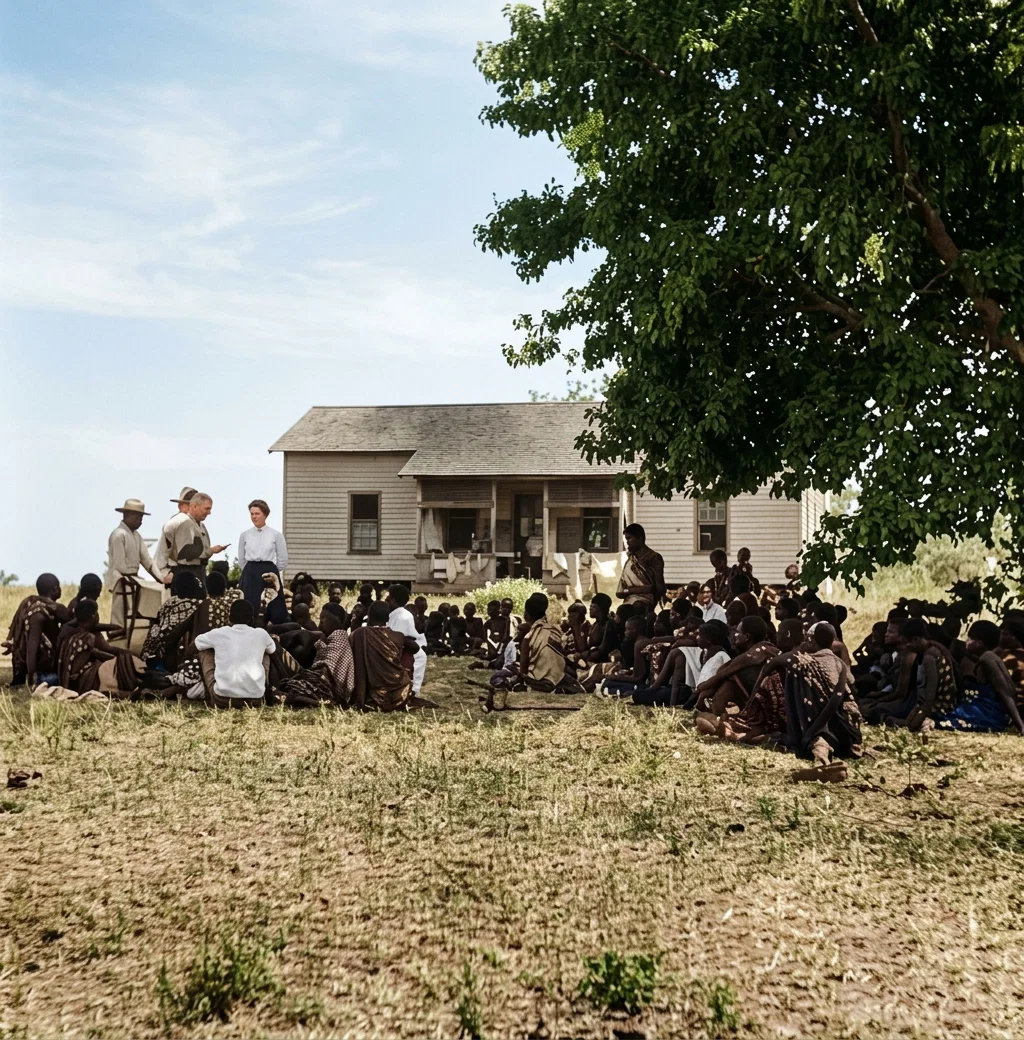
Leaving Karungu on the night of December 9, we reached Schirati, the German government station and port, by noon of the next day. Here we had a good visit with the secretary of the district, and then left in the afternoon, but did not reach Nyabangi, on the Mara Bay, until the next afternoon. As the Mara Bay goes many miles inland, and the main part of the district lies to the south of the Mara River, the German government has decided to put its district headquarters south of the Mara Bay. We saw a number of the new buildings on our way in; our station lies about three miles to the east of the headquarters, as the Catholics have an old mission site on the other side of the new government station. Brethren V. Toppenberg and E. Dominick are located here, and they were just about finishing the new dwelling-house at the station. The school is conducted under a large tree near by, about one hundred fifty pupils being enrolled. We remained here all day, December 12, preparing for our overland trip. During the day we visited the school and talked to the natives through an interpreter.
Early next morning we started out for the Busegwe station, which we reached after six hours' march. The people of this country, the Wasenaki, fearing the inroads of the Masai, have put their huts almost entirely out of sight. Nature rather favors them in this, as all over13the country we found the hills covered with large rocks, forming natural fortresses. We could see the station from afar, and the bell located on the tower of the adjoining hill was ringing in welcome of our approach. As we came close to the station itself, we found about two hundred boys all lined up, and the sultan and his whole staff; the drums were beating, and we were greeted with a rousing Nyambo, or the native “How do you do?”
KIDZU STATION AND PREACHING SERVICE
One of the first things we saw at the station was the grave of our faithful Brother Raessler, who laid down his life, and whose good wife later had to leave on account of the blackwater fever. Elder J. Persson, of Sweden, and his good German wife, have since taken charge of the station, and have made excellent headway. Several of the brethren addressed the natives. Brother E. Kotz could talk to them in the Swahili, which is the government language throughout the country. In the afternoon service I had the privilege of speaking to about three hundred, the schoolhouse being packed with people. We were especially pleased that six bright young men of this people were ready for baptism, and came to the general meeting at Majita. Early the next morning the young sultan accompanied us quite a way on our journey. He is deeply interested in the gospel.
Another eight hours’ march brought us to Kidzu, on December 15. This station is located on a high hill which can be seen from the lake. Dr. F. W. Vasenius and Brother O. Wallath are the workers here. They have a good dwelling-house finished, and the school is also under roof. They have about one hundred fifty students, of whom one fourth are girls.
On the sixteenth, the sultan came with his retinue, and listened attentively while I preached the gospel to them. As we had a three days’ trip from here into the Wasakuma country, it was necessary to secure about thirty native porters, while Brother A. A. Carscallen took his eight Kavirondos with him, so that we were, all together, nearly fifty. Dr. Vasenius thus far finds that the natives are rather shy in securing medical aid, especially if they have to pay something in return.
But gradually they are learning the advantage of a Christian doctor over the heathen medicine-men. On account of heavy rains we were unable to start before three in the afternoon of the seventeenth. Our path descended into a great plain, traversed by several rivers. In the distance we could see the range of hills—the aim of our next day’s trip. As the sun was setting, we pitched our two tents, the natives lighted the camp-fires, and after a hearty meal, we retired for the night. Traversing the plain the next day, we saw game of all sorts. After a good day’s march on the eighteenth, we camped for night near some government huts at important crossroads. The cheapest way of feeding such a large number of porters is to purchase a bullock of the natives, which costs us about two dollars and a half, while the hide will bring us nearly half of that when it is sold. There is but little to be had, besides the native flour, and the bananas and sugar-cane which may be found near the lake. The cane is generally rather expensive as compared with the meat.
On the nineteenth we marched another seven hours, and then reached the well-settled Wasakuma country. We pitched our camp in among the many villages. The rocks near by were covered with conies. The Wasakuma people are chiefly herdsmen and agriculturists. They number about one hundred seventy thousand. Ours is the chief Protestant mission among them now. The Catholics have occupied about one half of the territory. Next morning, before we started, a German ex-captain, who is in charge of mining interests, came up with his caravan. He was making the trip overland from the Cape to Alexandria. On Friday, the twentieth, about noon we reached Ntussu, where we met Brethren Kallenhauser, Palm, and Schurich. They had put up a good workshop, and were just finishing a good hut, where we were located during our stay. As there is no timber in the Wasakuma country, we have to bring the heavy timber from Nairobi. We hope that by the end of 1913 not only will Ntussu be finished, but also Kanage and Magala and Itilima. Soon after our arrival, Brethren Seiler and Munzig came up from Itilima, where they are erecting the first huts.
On Friday evening and Sabbath Brethren Dail and Kotz and I spoke to the natives. Brother Abrahamu, our native teacher of the Pare Mission, who accompanied Brother Kotz, also addressed all the natives at the different stations. They listened with great interest to his story of how he was converted from heathenism to Christianity, which he told them in fluent Swahili.
As the Wasakumas are busy on their farms, it will not be so easy to get a good start among them, but some boys are already preparing for school, and they proudly brought their slates and pencils with them, even some of the sultan’s children being present. The gospel does not yet exist in this tongue, nor does any other literature; but our workers are putting in hard strokes to get a good knowledge of the language. In view of the extent of this district and its distance from Majita, the headquarters, it was decided that one of our best missionaries in the Pare District, who is to be ordained soon, should come here and take charge of it.
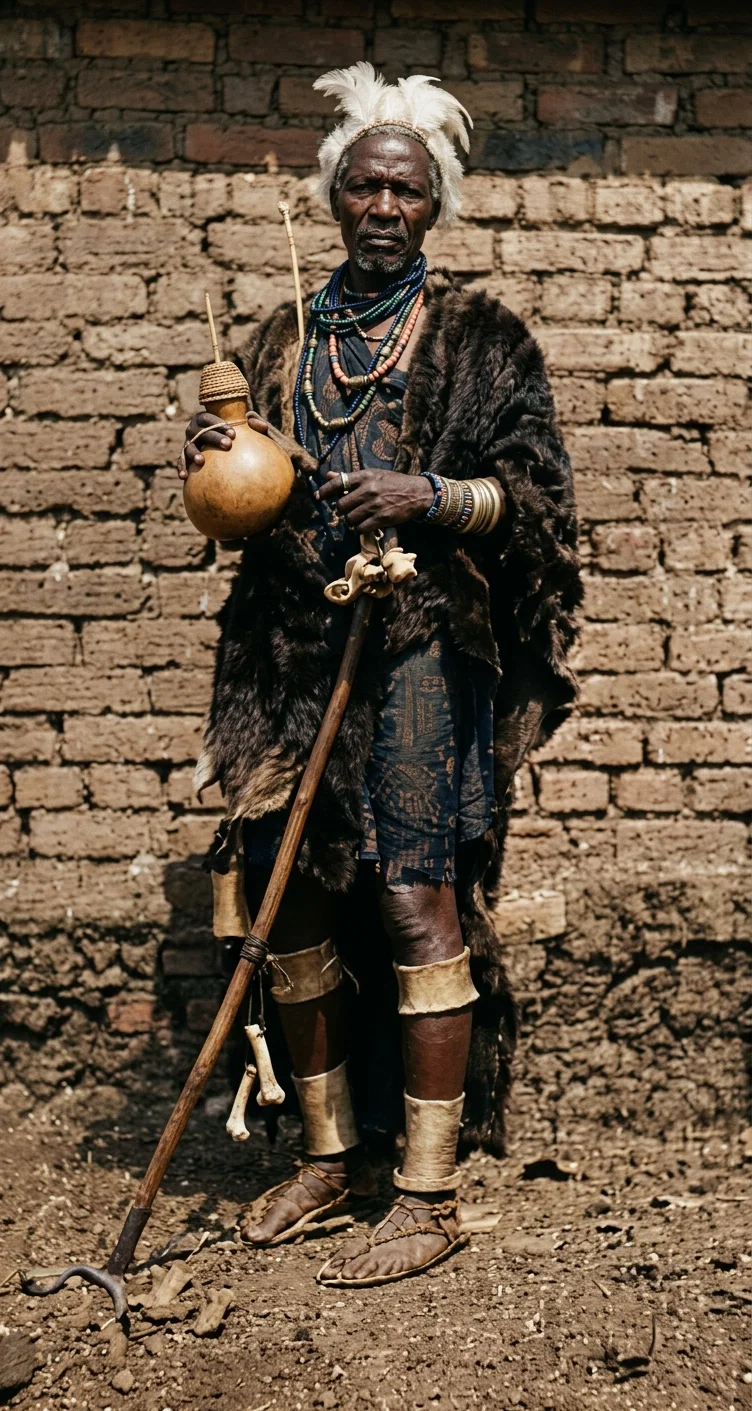
A HEATHEN MEDICINE-MAN AT WIRE HILL
It is a wonderful sight as one travels for days over vast tracts of land in the very heart of Africa to see nothing but native huts, no European building of any sort, except here and there, as light towers in the midst of heathen darkness, well-put-up Seventh-day Adventist mission stations. Let us remember the work among the Wasakuma people as well as among the Kidzu and Wasenaki.