WHEN we started our first mission in East Africa some nine years ago, our minds had already been directed toward the country about the largest sweet-water inland sea of the Dark Continent—the Victoria Nyanza—right under the equator. The southern half of this lake is German, while the northern half is British. At that time we had our minds turned to the country southwest of the lake, but we were informed by the German government that the Catholics were in that section, so we began our mission work in the South Pare District, near the coast of German East Africa.
Two years later, as we were planning our first mission in British East Africa, Brethren A. A. Carscallen and A. C. Enns selected a site in the Kavirondo country, on the northeast corner of the lake. All the eastern side of the lake from Kisumu, in British East Africa, to Nassa, in German East Africa, was practically unoccupied. The Roman Catholics had had a station or two in there, but had left the field. Four years ago when I visited the lake and made a nine days' trip around it, I was thoroughly convinced that the eastern side of the lake would not only give us a splendid field for the British Mission, but for the development of a large German mission as well.
When I then visited the field Brother Enns had again returned to the Pare District, and Brother J. D. Baker and his wife had joined Brother and Sister Carscallen. The dwelling-house and the school building at Gendia were only partially erected. There were not so many in the school, but the brethren were busy learning the language. We marched across the British territory, and selected a second station at Wire Hill. We also spent several days at Karungu, which had formerly been a British military station and was still occupied by British officials. Even then there was some talk of the place being sold to us by the government for a third mission site. Though no other mission had really been in this territory on the British side, for some reason we had been unable to secure any stations other than Gendia and Wire Hill.
We had sent out a number of workers: Brother and Sister B. L. Morse, Brother and Sister Horace Brooks, Brother and Sister F. A. Spearing, Brethren L. Lane and E. Phillips, and Brother H. Sparks, who had gone out on his own initiative. These were all present at the meeting in Gendia, save Brother and Sister Brooks, who had to return home on account of Brother Brooks's failing health. Just before our arrival the way seemed to open before us, and the six buildings at Karungu were sold to us at the reasonable price of $1,137. Several new stations have also been taken possession of by our workers, hoping we may secure final rights to them. There seems no question but that the Roman Catholics have been working against us here for years, but seemingly this influence has been broken of late, and the way is opening for our securing new stations.
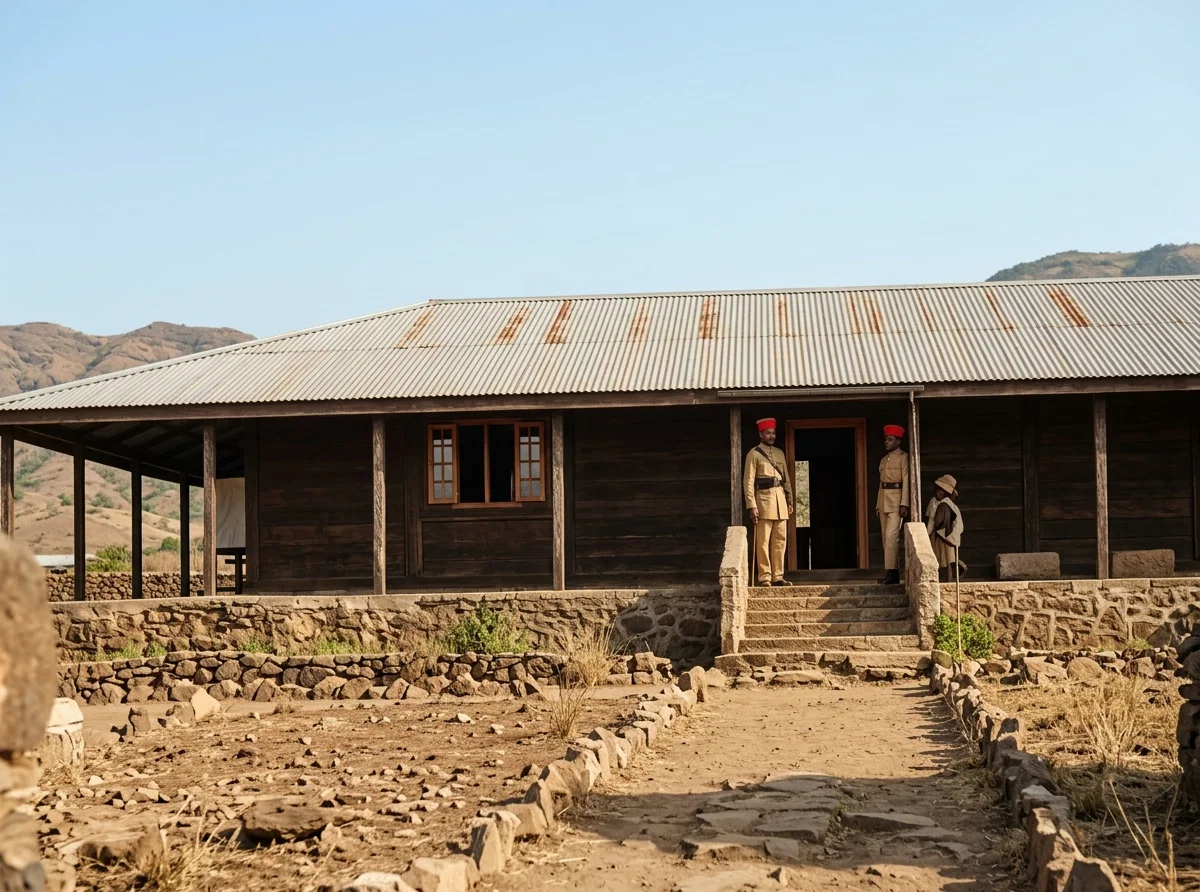
MISSION STATION AT KARUNGU
Recently purchased of British government, and now occupied by Seventh-day Adventists.
We are much pleased to see the progress made in the upbuilding of the two stations. Gendia now has a roomy burnt-brick dwelling, which furnishes accommodations for several families, as there are six good rooms, a bath-room, and two kitchens. There is also on the place a large school and chapel easily accommodating four hundred persons. In addition to these are the native huts and the workshop.
The Wire Hill station impressed us very favorably, being located on a plot of nice land that we were able to secure. The dwelling-house there is also a substantial burnt-brick structure, containing three rooms and a kitchen. There is a good workshop and a boys' dormitory, while the old dwelling now serves as a school and chapel.
At Karungu we have secured six good buildings, the best of which is the dwelling that had been recently renovated and painted. The hospital building had the roof flown off, but otherwise with very little repair to the buildings we shall have a good station here near the regular steamer landing.
However, our hearts were not rejoiced most at the material progress in putting up substantial buildings on the part of the missionaries, but rather at what God has wrought in the spiritual upbuilding of the natives. Two years ago we secured our first converts in both Wire Hill and Gendia, and last year we had a second baptism, so that now forty promising young persons have been baptized. We hope to have another baptism after our return to British East Africa from the German field, when some sixteen will probably go forward in this rite. The school is also well attended. Our brethren have made good progress in the study of the Luo language, so that they are not only able to begin the preparation of grammars and dictionaries, but also to translate portions of the Scriptures. We had no difficulty in securing ready translators from the English into the native tongue.
Our program was so arranged that of the six days we spent in the British field, four days were passed at Gendia and two days in going to and returning from Wire Hill. As we had Brethren B. Ohme and E. Kotz with our British workers, the time was fully taken up in an interchange of ideas and the laying of broader plans for the future. Some of the important points discussed were: A uniform course of study for the school, and for the native teachers; acknowledgment of the native workers by the local committee; progressive language study on the part of our missionaries; the manner of erecting mission buildings; the cost of each station; the estimates for 1913; the production of literature; church organization; distribution and relation of the workers to each other and to missionaries of other denominations.12
Thus every moment of our time was occupied with very weighty questions, and all felt that it is indeed profitable for us from the home land to meet with the workers right on the field who have had experience in various parts of Africa, to plan for the upbuilding of the work. In addition to the council meetings, we had regular sessions with our native and white missionaries.
Sabbath was an especially good day. About three hundred were out to the services. First we had the Sabbath-school, and later the preaching service to the natives, which was followed by the ordination of Brethren Baker and Morse to the ministry. These brethren had rendered good service in the school and in assisting Brother Carscallen in the conversion of the natives, and it was the voice of all present that they be set apart for the gospel ministry.
On Sunday morning, Dec. 8, 1912, we organized the Gendia church with thirty-nine members and the Wire Hill church with ten, Brother Morse being selected as elder at the former and Brother Baker at the latter.
One important matter was the distribution of the workers. Brother Carscallen had been in the field six years, and the time had come for his furlough. Sister Carscallen had already gone to her home in Scotland in October, while Elder Carscallen remained until after our visit to the field. He will return to Europe with us. It is expected that he will attend the coming General Conference, visit his people in America, and return to British East Africa next autumn. Brother Baker will have charge of the field during Brother Carscallen's absence, but plans to begin his furlough as soon as Brother Carscallen is in the field again. Brother Baker remains at Wire Hill, while Brother Morse will be in local charge of the Gendia station. As to the newly acquired station at Karungu, Brother Lane is to be located there, and Brother Phillips assists him temporarily. However, Brethren Lane and Sparks had already started two new sites, and as soon as a married man can be provided for Karungu we hope to have sufficient help for six stations.
In the afternoon of Sunday, December 8, Brethren Ohme, Carscallen, Kotz, and Dail and I, with Brethren Lane and Phillips and twenty-one natives, embarked on the British East African Mission boat, the “Kavirondo,” with considerable luggage, and departed for German territory. As the regular steamer service has become very irregular, we appreciate having our own sailing craft, although we must needs experience what it is to be dependent on the wind to move. Soon after midnight we were in open sea, and by Monday afternoon we had reached Karungu. Four years ago we made a three days' march of sixty-five miles in reaching the same place from Gendia. At Karungu we looked over the land and buildings, left some of the native help with Brethren Lane and Phillips, and by ten o'clock at night the anchor was lifted, and we quietly sailed away toward Schirati, German East Africa.